The Short Answer
If oil consumption on your VCM engine is climbing, the decision that matters is not which part to buy — it is whether you stop the cylinder cycling before you replace the parts that cycling is destroying. Do it in the other order and you pay for the same work twice.
| Where you are | What settles it first | The order that avoids waste |
|---|---|---|
| Plugs foul every few months, level steady between changes | Whether consumption is flat or climbing over a known interval | Stop the cycling, then fit plugs |
| Adding oil between every service | How the rate changes across two or three intervals | Stop the cycling, then measure again |
| Misfire returns weeks after new plugs | Whether the shut-down bank compresses lower than the running bank | New plugs will not hold. A part swap is past the point |
| One cylinder misfires repeatedly, others quiet | Whether that cylinder is inside the shut-down group at all | Often it is not — the fault is consumption across the engine |
What this page is for. It follows one chain: a sealed cylinder pulls oil past a ring that was not designed for it, and everything downstream follows from that. It then gives you the order of operations, which is the part most advice gets backwards. If your question is about a driveline lamp or a rear axle instead, that is a different system with different answers, and the VTM-4 page is where that starts.
What a sealed cylinder actually does to the oil film
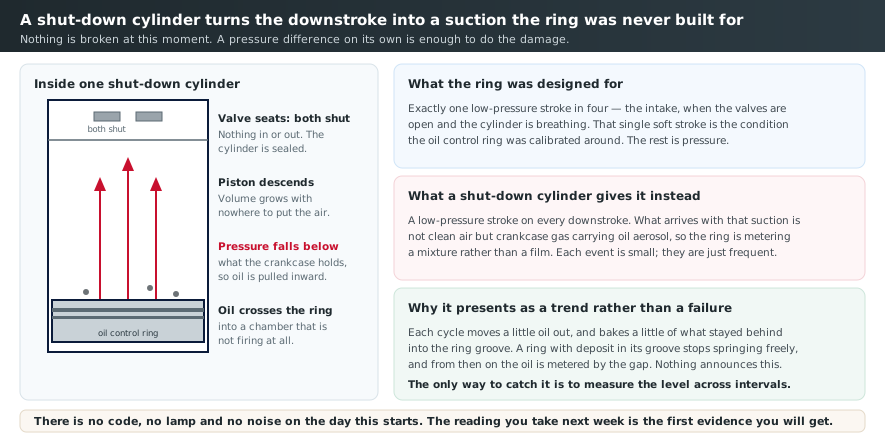
Everything that goes wrong on one of these engines starts with a cylinder told to shut down and a piston that keeps moving anyway. The damage is done by a pressure difference, not by a broken component, which is why nothing warns you at the time.
Honda's arrangement fails differently from the American systems, which removes a category of expected failure. Here the variable element is the cam follower, released from the cam by routing engine oil to a locking mechanism inside it. With the follower free, the valve spring holds the valve down, and nothing in this chain wears out the way a pushrod lifter does.
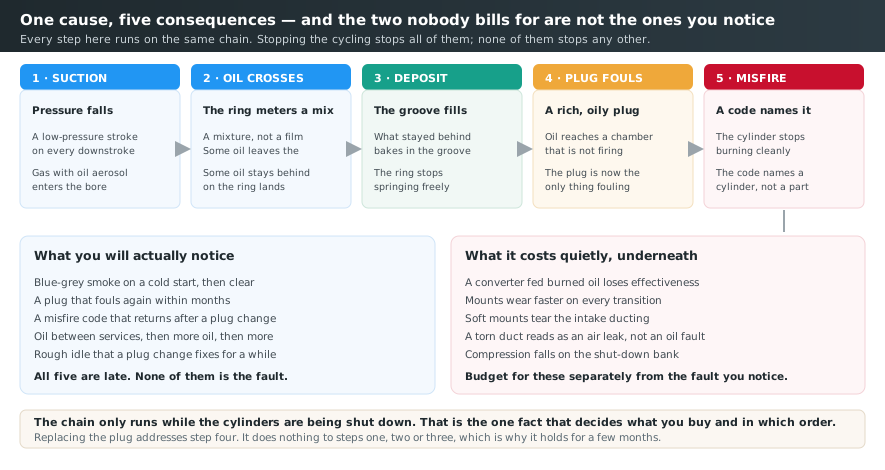
Put a piston in a cylinder with all four valves closed and watch the gas. On the power stroke it pushes against a closed volume and the pressure rises, which is the design intent — the cylinder becomes a spring. On the downstroke the volume expands with nowhere for the air to go, and the pressure inside falls below what the crankcase holds. That suction is the entire problem, and it is not a leak, because nothing is broken.
The part doing the damage is the part you cannot see
The oil control ring scrapes the wall on the way down and meters a film of oil back onto the ring lands on the way up. It is designed for a normal cycle in which exactly one stroke is low-pressure: the intake, where the valves are open and the cylinder is breathing.
A shut-down cylinder gives it a low-pressure stroke on every downstroke. The ring is not damaged by the extra work but by the consequence, because what comes with the air being pulled in is not clean air — it is crankcase gas carrying oil aerosol. Each event is small and the events are frequent, which is why this shows up as a trend rather than a failure.
Two things happen at once, and they are not the same problem
The oil that crosses the ring does two separate jobs, and separating them is the key to everything that follows.
- Some of it leaves the engine. It sits in a chamber that is not firing until the cylinder is asked to work again, and then it is burned. That is measurable fuel burnt as oil, and it is what an owner notices first.
- Some of it stays behind. It sits in the ring grooves in a cylinder where nothing is burning it off, warmth bakes it, and residue arriving from the neighbouring running cylinder joins it. A thin film becomes a deposit, and a deposit in a groove is a ring that no longer springs freely.
The first is a running cost. The second is a mechanical change. One engine can have plenty of the first and almost none of the second, which is why two vehicles with identical consumption figures can be years apart in what they face. Only the second turns a service into a repair.
Why one cylinder gets blamed more than the others
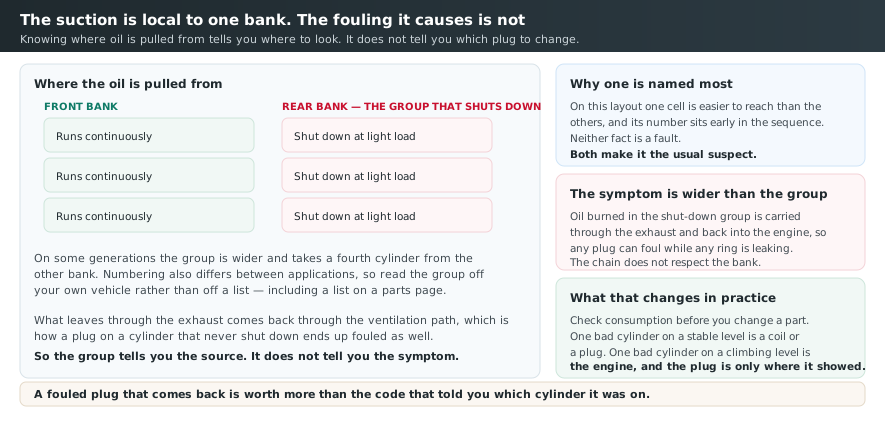
The most-repeated claim in this whole subject — that one specific cylinder is the problem — is an artifact of how the engine is built and how a misfire gets reported, not a distinct failure point. Believing it sends people to replace a healthy part and leaves the actual fault running.
The deactivated group is not scattered across the engine. It sits on one bank, and the group is a contiguous run of cylinders on that bank. On the generation that caused the most trouble, that run is four cylinders wide, and the cylinder that appears most often in owner reports sits inside it. That is the origin of the story, and it is a true observation. What turns it into a myth is everything that happens next.
Three separate things push one cylinder into most reports
Position. The cylinder that gets reported most is also the easiest one to reach on the transverse layout. A misfire code gets acted on by replacing the cheapest accessible component, and the easiest plug in the engine is the one that gets replaced most often, so it accumulates the most diagnoses for reasons that have nothing to do with its condition.
Numbering. A misfire is reported as a cylinder number, and cylinder numbers are assigned in a fixed order that has nothing to do with how hard each cylinder works. A number that appears early in that sequence is over-represented in any dataset, because people search it and share it and then go and look for it again next time something feels wrong.
Cross-contamination. This is the one that actually matters mechanically. Oil is burned in the deactivated cylinders. That oil leaves through the exhaust, and the exhaust of a transverse engine feeds a shared catalytic assembly. The combustion products come back into the crankcase through the ventilation path, and the whole engine is breathing that oil. A plug can therefore foul on a cylinder that has never once been shut down.
| What you were told | What is actually going on | How to tell them apart |
|---|---|---|
| A specific cylinder is faulty | That cylinder has the most accessible plug and the most memorable number, and it is reading oil from the rest of the engine | Check consumption. One bad cylinder with normal consumption is a coil or a plug. One with climbing consumption is the whole engine |
| The code names the failed part | It names a cylinder, not a component. The part is whatever stopped that cylinder burning | Pull the plug. Oil on the electrode means combustion had stopped, which is upstream of any ignition part |
| New plugs fixed it | New plugs restored combustion in a cylinder running on oil. They did not change why | Watch the interval. If it fouls again in months, the interval is the finding |
There is a practical consequence worth more than the diagnosis. Take the single-cylinder story at face value and you replace plugs, the fault clears, and you conclude the engine is fine. It is not. The consumption is still running, the deposit is still building, and the next time it appears it will be in whichever cylinder is farthest from the one you serviced. The clue is not the code — it is that a fouled plug came back.
Three stages of damage, and they are not the same problem
There is a point where this stops being a maintenance question and becomes a mechanical one, and the only way to find it is to see which of three stages you are in. Each stage has a different answer, and two of them get mislabelled as the third.
Stage one: the system is costing you, the rings are still free
Oil crosses the ring and burns. Plugs foul on a cycle, and a plug change genuinely holds until the next one. Compression on the deactivated bank is still level with the running bank. Nothing is permanently damaged; the engine is being charged a toll it should not be charged. This is where stopping the cycling is worth most and costs least, and it is the stage most owners leave.
Stage two: the ring is gummed, and no part swap changes that
Deposit in the groove stops the ring returning to its seal, so the oil that used to be metered is now metered by the gap. Consumption climbs, and the climb is the finding: a number that holds still is stage one behaviour, a number that rises each interval is stage two. A plug change clears the misfire and the misfire returns, because the oil is still arriving and now arrives faster.
Stage three: the wall is worn, and only a rebuild reaches it
A ring that has not been turning has not been controlling the film, and a wall running with an uncontrolled film is working against a condition it was never given. Compression on the deactivated bank reads lower than the running bank, and a compression test is the only thing that separates this from stage two. Nothing you plug in reverses it, and neither does thicker oil or a cleaner additive.
The one measurement that decides it
Almost every decision about this is made using an absolute number, and absolute numbers cannot tell you what you need to know. Two engines at the same level of consumption can be at opposite ends of this problem, and the only thing that separates them is whether the figure is moving.
How much oil a vehicle uses per distance is a poor question on its own, because it varies with how the vehicle is used, how warm it runs, and how often it is driven short and cold. But how quickly that figure changes across two or three measured intervals is a very good question, because the system drives it in one direction and the engine's ability to cope with it does not improve.
The method is dull and it is the whole answer. Check the level cold, on level ground, with the vehicle sitting still and level, and read it from the dipstick tube rather than with the dipstick withdrawn, because a withdrawn dipstick reads low enough to invent a problem that is not there. Write down two numbers: the reading and the distance since the last one, and repeat until you have three of each. Three intervals is the smallest number that can show a trend, and a single interval cannot tell a trend from a bad afternoon.
Read it cold for a second reason as well. Oil consumed while the engine is warm, and oil sitting in a shut-down cylinder overnight, both come out of the level the next morning. That overnight figure is the one that corresponds to what the engine actually does when you are not watching it, and on a vehicle that spends its life in short trips it is a considerably larger number than anything you would catch by looking during a drive.
Then look at the second number, not the first.
| What the intervals show | What it means | What it rules out |
|---|---|---|
| Flat across two or three intervals | Whatever the figure is, it is not getting worse — a running toll and nothing more | A ring that has stopped turning. Wall wear |
| Rising each interval | A ring has stopped moving; deposit is doing the sealing | The idea that a plug change or thicker oil addresses it |
| Rising, with one bank reading lower | The wall is involved. Past what a plug or an additive touches | The cheap end of the market entirely |
| Low, with oil in the dipstick tube or a puddle | There is a leak, and none of the above applies until it is found | Cylinder sealing as the cause — a leak reads as consumption and is not consumption |
If the level is dropping between services without warning, stop treating the interval as fixed. Carry oil, check more often, and treat the level as something to be watched rather than assumed: an engine that has run low on its own oil has a different end in front of it than one that never got there.
The order to do things in
There is a correct sequence, and almost everyone runs it backwards. Buy the symptom first, confirm it worked, and only then look at the cause — which means paying twice for the same job and believing the first fix was the fix.
The reason the reversed order is so common is that it feels like diligence. Replacing plugs is concrete, verifiable and cheap. Stopping the cycling is invisible and cannot be confirmed by looking at anything afterwards. So the concrete step goes first, and the invisible one gets deferred — and the deferred one is the one that was going to prevent the second replacement.
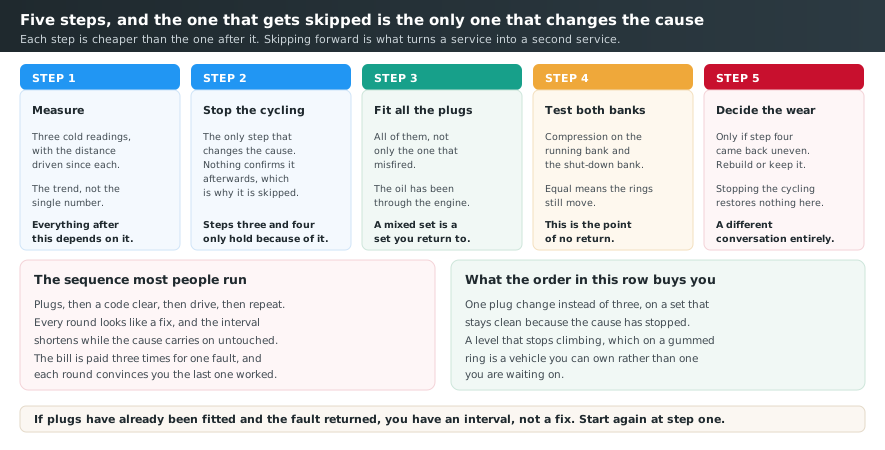
- Measure. Two or three intervals of level against distance, cold, on level ground. Without this you cannot tell which stage you are in, and every step after this one depends on it.
- Stop the cycling. This is the only step that changes the cause. It does not fix anything visible, which is why it gets skipped, and it is the reason the next three steps hold.
- Replace the fouled plugs. Do all of them, not just the one that misfired. Oil has been through the whole engine, and a mix of new and old is a set you will be back to.
- Compression test both banks. This is the point of no return. Equal readings mean the rings still move. Lower readings on the shut-down bank mean the wall is worn, and you are now deciding between a rebuild and a vehicle.
- Decide on the remaining wear. Only now, and only if step four came back uneven.
What that order buys you is specific. Once the cycling has stopped, the oil that burned off is not replaced, the deposit stops building, and the plugs you fit stay clean. On a stage one engine that is the end of it. On a stage two engine the ring is already gummed and the level will not return to where it was, but it will stop climbing, and a level that stops climbing is a vehicle you can own. On a stage three engine the wear is already there, and stopping the cycling at least stops it getting worse while you decide what to do about the engine.
Two variations come up constantly, and both change the starting point rather than the order. If plugs have already been fitted and the fault came back, step three is done — start again at step one, because what you now have is a measurement interval rather than a fix. If a device is already fitted and the level is still climbing, something else is going on, and step one is where it will show up: a rising trend on an engine that is no longer being shut down is not this fault, and it should send you looking elsewhere rather than further into this page.
What stopping the cycling does, and what it cannot touch
This is where most product claims get inflated, and the honest version is short: stopping the cycling ends the cause. It reverses nothing that has already happened, and the difference between those two statements is the whole difference between a sensible purchase and a disappointing one.
What it does do is stop the mechanism described in the first section from running. The suction on the downstroke of a shut-down cylinder stops, the oil no longer crosses the ring because the vacuum that pulled it is not there, and the deposit stops accumulating in a groove that was being baked warm and unwatched. Everything downstream of that stops with it: plugs stop fouling, the exhaust stops carrying oil, and the driveline stops cycling between two configurations.
What it cannot do is clean a plug that is already fouled, free a ring that has already stopped turning, restore a compression reading that has already dropped, or replace a mount that has already gone soft. Those four things happened while the system was running, and they stay exactly as they were. The correct way to hold this is as a change in what happens next, not as a repair of what came before.
There is a second effect that gets less attention than it should. An engine that is never asked to shut a cylinder down runs the configuration it was designed to run, in the terms its own engineering assumed. That is the argument for fitting a device before anything is wrong, on a vehicle that has spent its life on short trips and cold starts — and equally the argument against fitting it to an engine already at stage three and telling yourself the engine was saved. It was not saved. It was stopped from getting worse.
| What you are looking at | Stopping the cycling | What it actually needs |
|---|---|---|
| Plugs fouling every few months, banks even | Stops it recurring once the plugs are replaced | Plugs, and the decision to stop the cause first |
| Consumption climbing, banks still even | Stops the climb. The stuck ring stays stuck | The device, and a decision to own a known level |
| Shut-down bank reading lower | Stops further wear. Restores nothing | A decision about the engine |
| Mounts already soft, intake duct torn | Stops the movement that caused it, not the damage | Mounts and ducting, which is separate work |
The mechanics of how such a device is fitted, and which Hondas need which variant, are a different page from this one — the fitment is per model rather than per fault, and it is covered in full on the Honda guide. What matters here is the ordering: the device is step two, and no amount of parts fitted before it will hold.
One last separation worth making, because the two get mixed up constantly. The cylinder deactivation system on this engine is about closing valves to save fuel. VTM-4 is about driving the rear axle. They are different systems on different Hondas, and a lamp in the instrument cluster about the rear axle has nothing to do with oil consumption or fouled plugs. If that is the light you are chasing, the VTM-4 page covers it properly.
What to write down before you decide anything
The cheapest useful work on this problem happens before a single part is discussed, and it takes one evening in a driveway. Anyone about to spend money on this needs it, and none of it requires the engine apart or a conversation with anyone selling anything.
Start with the level, because it is the only number that is both continuous and yours. Read it cold, on level ground, with the vehicle sitting still, and take it from the dipstick tube rather than with the dipstick out, because a withdrawn dipstick reads low enough to invent a problem that is not there. Write down the reading and the distance driven since the last one, and repeat until you have three of each. Three intervals is the smallest number that can show a trend, and the trend is the finding.
Next, the codes, written down rather than cleared. Which cylinders appear, whether the same ones appear each time, and whether the set is stable or it wanders. A stable set is a different conversation from a wandering one, and clearing the codes destroys the evidence that separates them for no gain.
Then the plugs, if you are going to look at all. A fouled plug tells you more than its presence or absence: oil on the electrode and a wet insulator is a cylinder that was not burning, which sits upstream of any ignition component, while a dry black deposit is a different conversation about mixture and heat. Either way, photograph them before they go back in, because the comparison against the next set is the cheapest measurement available.
Finally, write down what you are actually deciding, in one sentence. Stopping a running cost, owning a vehicle with a known and stable level, or buying an engine are three separate conversations, and a purchase that answers none of them is the expensive way to learn which one you were in.
- Three cold level readings on level ground, with the distance driven between each. The trend, not the figure.
- Every stored code, written down, and whether the same cylinders return each time.
- What the fouled plugs look like, photographed before they go back in.
- Whether the engine has ever run low between services, and what you had to add.
- Which cylinder keeps coming back — the same one, or whichever is nearest the top.
- One sentence on the decision itself, which is the part most people never write down.
None of that requires a workshop. It is the part that separates a decision from a reaction, and on this particular fault the reaction is the expensive one, because the most common symptom — a plug that keeps fouling — looks like a cheap parts problem right up until it has been paid for twice.
What this page covers, and what it does not
This page follows one chain from a shut-down cylinder to the parts it damages, and then gives the order of operations. It does not cover the fitting, the fitment, the codes catalogue, or the other two systems on these vehicles.
What it covers: why a sealed cylinder pulls oil past a ring, why the cylinder that gets blamed is usually not the one that failed, the three stages the damage passes through, how to tell which stage you are in, what order to do the work in, and honestly what stopping the cycling does and does not achieve.
What it does not cover: how the system is switched off on a given model, which vehicles carry which generation, or how a device is fitted. Those are fitment questions and they live on the Honda guide. It also does not cover the driveline system, which is a separate arrangement with a separate set of answers in the VTM-4 page, and it does not attempt to cover the general question of how a diagnosis should be approached, which the diagnosis guide handles in a general way that applies well beyond this engine.
Finally, the boundary of what you can conclude from a measurement. A compression test tells you whether a wall is involved. It does not tell you what caused the wall to wear, how long it has been happening, or whether the vehicle is worth repairing. Those are the three questions this page exists to help you arrive at with real information, and none of them can be answered by a single reading in a driveway.
Frequently asked questions
Why does my Honda burn oil?
On these engines the most common route is a cylinder being shut down: the sealed cylinder pulls oil past the piston ring, and that oil is burned when the cylinder next works. The rate tells you how far along it is, but the useful number is how fast that rate is changing.
Why is my oil consumption worse after a cold start?
Cold oil is thicker and holds more air, so the ring is metering a mixture rather than a film. Cold starts also mean more shut-down cycles, because the engine is cold and lightly loaded for longer. Both push the same way, and a vehicle driven mostly short and cold will show this sooner than the odometer suggests.
Why does my Honda smoke blue only at startup?
Because that is when the accumulated oil gets burned. Oil sitting in a shut-down cylinder all night meets combustion the first time the engine starts, and the visible smoke is that oil leaving. Smoke that appears cold and then clears fits the cycling; smoke that persists is a different question.
Does VCM cause spark plug fouling?
Yes, and it is the most direct consequence in the chain. Oil arrives in a cylinder that is not firing, the plug runs rich, and it fouls. The tell is the interval rather than the plug: one that comes back fouled within a few months is reporting a cause, not failing as a part.
Why does replacing spark plugs only last a few months?
Because the plugs were never the fault. A new plug restores combustion in a cylinder that is receiving oil, so it runs until enough oil has arrived again to foul it. The interval between replacements is a direct measurement of how fast oil is arriving, which makes it one of the most useful numbers you can keep.
What is a VCM defeat device and how does it work?
It is a small module that reports back to the engine computer in a way the deactivation conditions are never met, so the system never engages and every cylinder runs all the time. The mechanism and the fitting are on the Honda guide, because which variant fits which model matters more than the principle.
Does disabling VCM fix an engine that already burns oil?
It stops the oil being pulled past the ring, which is the cause. It does not free a ring that has already stopped moving, clear a plug that is already fouled, or restore a compression reading that has dropped. On a stage one engine that is the whole fix; beyond it, it changes what happens next rather than what already happened.
What is a VCM Muzzler?
A name for the small third-party module that holds the deactivation system off, the same category of device described above. The category has several names for one function, which is part of why the pages on this subject are hard to compare — what to check is whether it fits your model and year, not what it is called.
How much oil consumption is normal for these engines?
Judge the rate of change rather than an absolute figure. A level that holds steady across two or three measured intervals is not getting worse whatever the number is. A level that climbs each interval is a ring that has stopped turning, and that is the finding which should change what you do.
Can I drive my Honda if it burns a little oil?
Yes, with the level watched rather than assumed. The concern is not distance covered but running the engine low on its own oil, which is what causes the damage that cannot be reversed. Checking between drives and carrying oil turns an unknown into a managed condition.
Will thicker oil stop my Honda burning oil?
It changes the appearance of the problem rather than the direction. A thicker film may slow transfer across a ring that still moves, but it does not free a ring that has stopped and does not address a wall. It is worth doing nothing at all until the stage is known.
Does VCM damage the catalytic converter?
It can, and it is a separate expense from the one people budget for. The oil burned in the shut-down cylinders leaves through the exhaust, and the converter is fed a steady diet of it. A converter that fails this way reads like a catalyst problem and gets diagnosed as one, which is why it belongs on the list when you work out the full cost of leaving the system running.
Is there any help available for VCM misfires?
Some vehicle year ranges carry an extended warranty covering misfire repairs for exactly this failure, and it is time-limited rather than permanent. Check before you pay for anything, because it takes one call and being out of date on it costs you the entire repair.