The Short Answer
An oil change interval controls what flows through a lifter. It does not control what the lifter is asked to endure. Three of the failure routes a deactivating lifter takes are driven by the oil's condition — and those three move when you tighten the interval. The other three are driven by load and geometry, and their clock is cycle count rather than distance. So the answer to "did my maintenance protect me" depends entirely on which of the two families your engine is running.
| What you are looking at | Establish this first | What the result tells you |
|---|---|---|
| You change oil early and on schedule | Whether the failures you are worried about run on oil condition or on load | Tightening the interval moves one family and leaves the other where it was |
| You changed oil and something went wrong anyway | Whether the fault is one cylinder or several | Several points at the medium. One that repeats points at a part |
| You are deciding what to spend your maintenance effort on | Which of the three readings below you can actually take | Level trend and oil age are worth chasing; chasing cycle count is not something an interval can do |
| You have already had one lifter replaced | What else was inspected at the same time | A replaced lifter on an unchanged schedule says nothing about the routes an interval never touched |
What this page is for. It takes the claim apart — what an interval actually holds constant, which failure routes respond to it, which ones do not, and why a clean maintenance record can sit beside a failed lifter without either being evidence against the other. Then it gives three readings that let you work out which side of the line you are on, and states plainly where the page stops. If what you have is a noise you are trying to place rather than a schedule you are trying to judge, the symptoms page is the one that answers that instead.
What an interval actually controls
The interval is a statement about the state of a fluid at a moment in time. Everything it protects against has to run through that fluid. Anything that does not is outside its reach, and the failure list splits cleanly once you look at it that way.
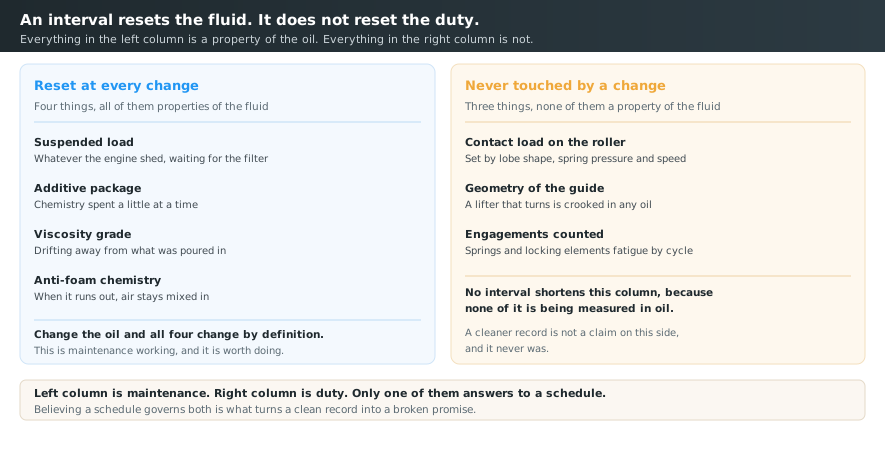
Between two changes, the oil in the sump is doing several jobs at once. It carries load on a film, it carries heat away, it holds particles in suspension so they can reach the filter instead of the galleries, and it delivers the pressure that a hydraulic lifter needs to fill and hold. Those four jobs all decay across the interval, and each one fails in its own way:
- The suspended load grows. Whatever the engine has shed stays in the oil until the filter catches it or the change does.
- The additive package is consumed. Every mile of work spends a little of the chemistry that was blended in.
- The viscosity drifts away from the grade on the bottle. Heat and shear pull it one way, dilution pulls it another.
- The anti-foam chemistry runs out. That is what lets air stay mixed into the oil rather than leaving it.
An interval is simply the point at which you choose to reset all four at once. Nothing about that is a general endorsement of the fluid, and it is worth keeping it that narrow.
That framing matters because it draws a boundary rather than giving a number. A lifter failure caused by any of those four degradations sits inside the interval's reach. A lifter failure caused by something that happens to a hardened part under repeated load sits outside it, no matter how often the oil is replaced — because you are not changing the thing that failed when you change the oil.
What the oil looks like on the day it is changed
Fresh oil at the correct level gives you the strongest film, the lowest suspended load, the full additive package, and the least air in it. Those four properties are not a general endorsement of the fluid; they are the specific inputs that the oil-driven failure routes depend on. When someone says a shorter interval helps, this is the mechanism they are pointing at, and it is a real one.
The same framing tells you what a shorter interval cannot buy. It does not change the hardness of a needle bearing, the straightness of a lifter in its bore, the tension of an internal spring, or the number of times a locking pin has been asked to engage. Those are properties of parts and of duty, and they are simply not on the list of things a fluid change resets.
What the interval is written in
One further wrinkle, and it is the one most often missed. An interval is stated as a distance. The oil degrades as a function of time, temperature and how the vehicle is used. The wear mechanisms in the second family accumulate as a function of how many times the part has been cycled. Three different quantities, all being tracked with one number on the dashboard.
Which means a vehicle that covers the same distance in long highway runs and one that covers it in short cold trips have not had the same oil at the end, even though both have gone the same distance since the change. Neither has had the same lifter experience. The odometer is a convenient proxy for all three and an exact measure of none of them.
The three failures an interval genuinely moves
These are the routes where the oil itself is the thing that does the damage. Stop the oil from degrading the way it does and the route is closed — which is why maintenance is genuinely worth doing rather than merely worth doing.
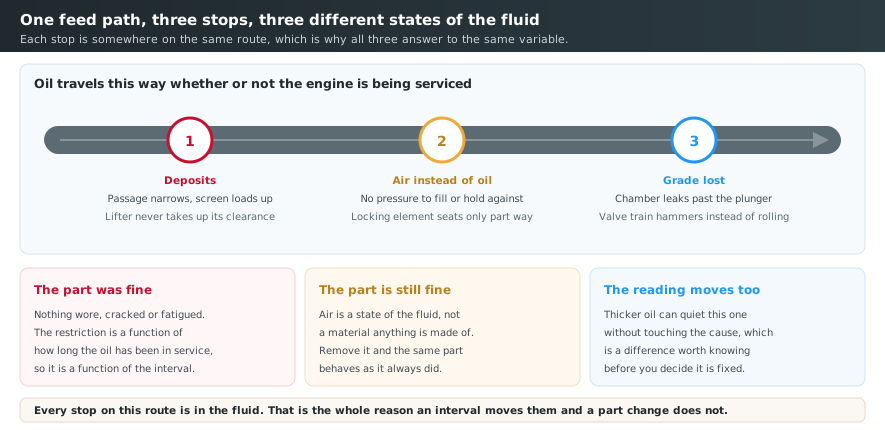
They share a property worth naming: in each case the part was fine, and the medium around it became the problem. That is the signature of something an interval can fix, and it is also how you recognise the family when you are looking at a report rather than performing the work yourself.
Feed passages that stop feeding
A hydraulic lifter fills through small passages and holds itself solid by trapping oil behind a check valve. Those passages are narrow, the pressure they need is modest, and anything that reduces their free area reduces how well the lifter pumps up. Deposits do exactly that: they accumulate on internal surfaces, on the small screens that sit between the main galleries and the components that need clean oil, and on the valve seats inside the lifter itself.
The result is a lifter that is mechanically perfect and hydraulically short — it does not fill quickly enough to take up the clearance, and it ticks for as long as that restriction is there. Nothing has worn. The restriction is a function of how long the oil has been in service and what has been happening to it while it was.
Air, not dirt
The second route is less intuitive and deserves its own heading, because it is the one people miss when they assume an interval is only about cleanliness. Oil that has lost its anti-foam chemistry, or that is being drawn down by a low level, will hold air. Air is compressible and oil is not, so a lifter fed aerated oil behaves like one fed nothing: it cannot build or hold pressure, and the mechanism inside it that has to move cleanly under load instead moves partially.
Partial movement is the expensive part of this route. A component that was supposed to engage fully and instead engages halfway is now taking impacts it was never shaped to take. This is a condition of the fluid rather than of the part, and it responds to fluid condition — which is precisely the variable an interval sets.
Viscosity that is no longer the grade you bought
The third route is the most direct. Viscosity is what makes the oil a hydraulic fluid rather than a lubricant, and it is what makes it a lubricant rather than a solvent. Heat, shear and dilution all pull it away from the grade on the bottle. Once it has moved far enough, the lifter chamber leaks past its plunger faster than the pump can refill it, and the valve train starts hammering instead of rolling.
Thicker oil poured into an already-failed lifter will not reverse any of this — it changes the reading while the part stays broken. But keeping the oil within its grade across the interval prevents the condition from developing in the first place, which is a different job and one an interval does well.
The three it has no claim on
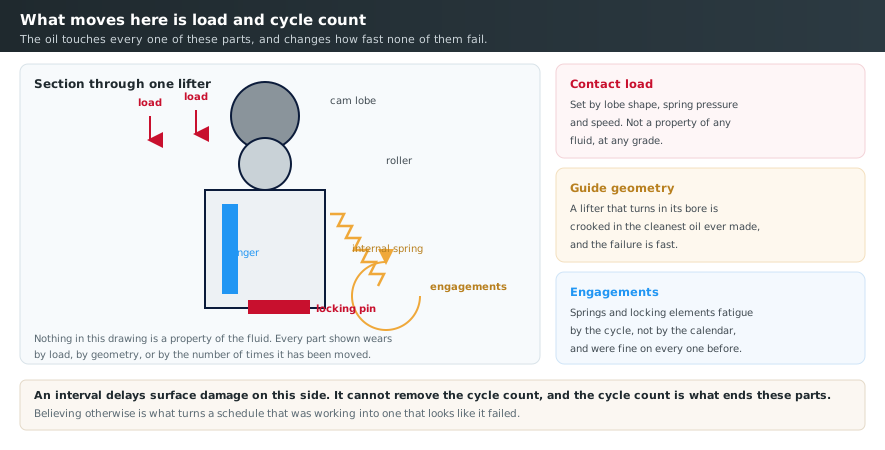
The second family runs on geometry and on load cycles. Neither has any relationship to when the oil was last replaced, so improving one leaves the other exactly where it was — and this is where a clean maintenance record stops meaning what people want it to mean.
This is not an argument that maintenance is pointless; the first family is real and worth protecting against. It is an argument about scope. Understanding which family a given failure belongs to tells you whether tightening the schedule is a rational response to the risk you are worried about, or whether you would be spending effort on a variable that does not touch the mechanism you fear.
Contact load on the roller and its pin
A roller at the bottom of a lifter carries the cam lobe's profile through a rolling contact that repeats every time that lobe comes around. The load on it is a function of valve spring pressure, lobe shape and engine speed. The surface underneath it is a function of hardness and finish. Neither of those quantities appears anywhere in an oil change.
Rolling contact damage grows with the number of cycles and with the load on each cycle. Clean oil delays the onset of surface fatigue the way it delays any wear process, and a longer interval absolutely does make that worse at the margin. But it does not make it better in the way people expect: a lifter fed the freshest oil available is still accumulating the same cycle count, and the failure it eventually reaches is a fatigue failure rather than a contamination failure.
Geometry that lets the lifter turn
The lifter is held in its bore by a guide that keeps the roller square to the lobe. When that guide loses its grip — through heat cycling, through wear, through a part that was never quite right — the lifter can rotate a few degrees in its bore. The roller then drags across the lobe diagonally instead of rolling along it, and the damage from that is measured in minutes rather than miles.
There is no oil property involved. A lifter that is crooked is crooked in the best oil ever made, and the failure is geometric rather than chemical. An interval cannot see this, cannot prevent it, and cannot shorten or lengthen it. It is the clearest member of the second family precisely because the fluid is entirely irrelevant to it.
An internal part doing its ten-thousandth cycle
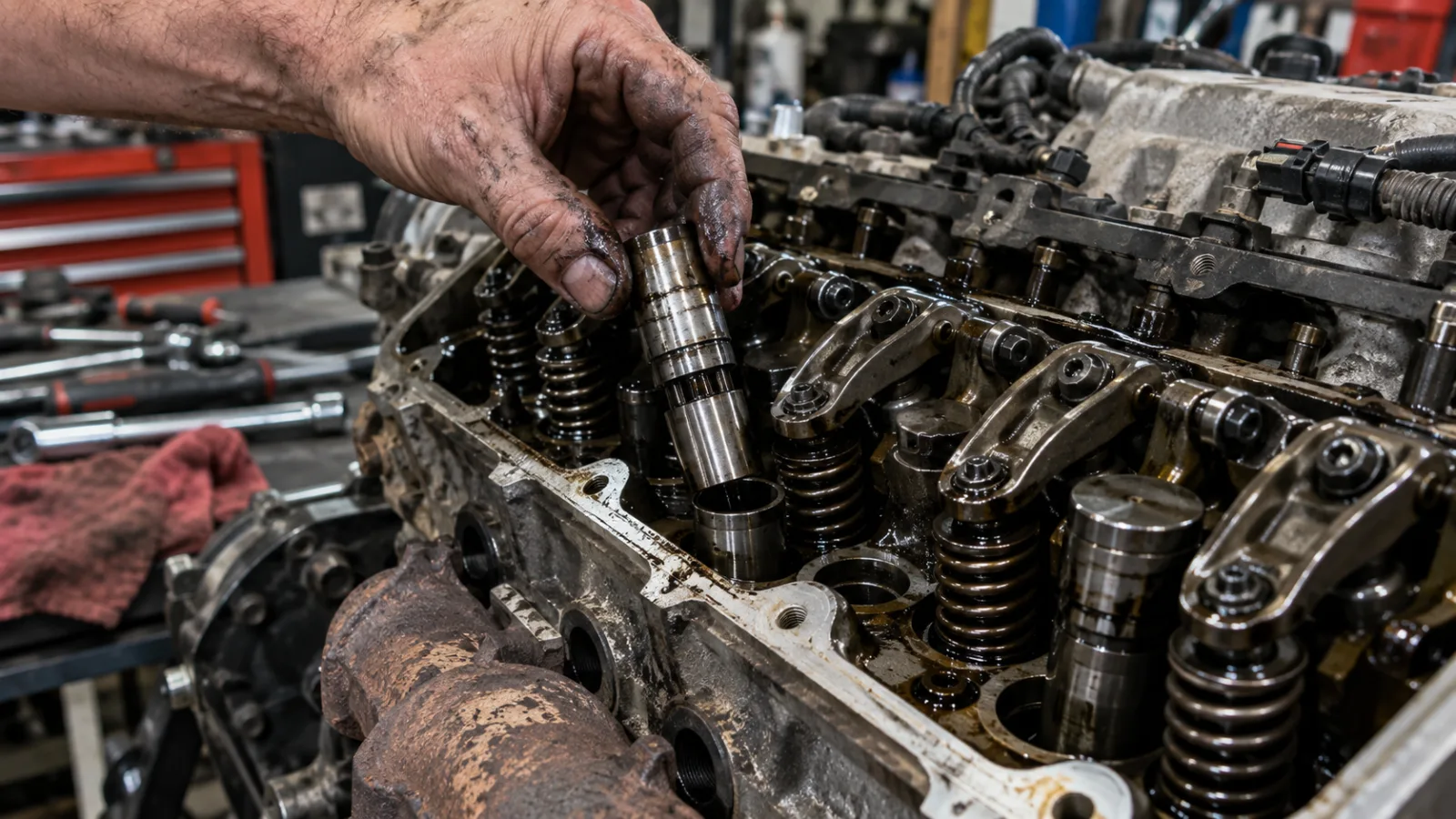
Inside a deactivating lifter there are springs and locking elements that move every time the system changes state. Those parts have a fatigue life, and that life is counted in engagements. A spring that has been compressed and released ten thousand times is a different object from a new one regardless of what it was bathed in, and a locking element that has been asked to seat and unseat that many times accumulates damage from the seating itself.
This is the route that makes a maintenance record feel beside the point, because the record and the mechanism are measuring different quantities. The oil was fine on every one of those ten thousand engagements, and the part still got closer to its limit on every one of them.
One caution before leaving the family: these routes are not an excuse to stop caring about oil. A part at the edge of its fatigue life will usually survive longer in good oil than in bad, and the first family can still arrive on top of the second. What they rule out is the stronger claim — that a disciplined schedule makes the second family unlikely.
Why a clean record and a failed lifter coexist
This is where most of the frustration lives, and it comes from a single misread: a maintenance record is treated as evidence about a mechanism it was never measuring. Once you separate the two, the situation stops being contradictory.
The reasoning goes like this. The schedule was followed, so the oil was always fresh, so the oil-driven routes were closed, so a failure must mean the schedule did not work. Every step is true except the inference at the end — because closing three routes does nothing to the other three. A clean record is genuinely evidence that the first family was managed well. It is not evidence about the second family at all, and treating it as though it were is what produces the feeling of having been misled.
There is a second, subtler version of the same error. When a part fails, people look back for the thing that went wrong. If the maintenance was flawless, the search shifts to the oil anyway — a different brand, a different grade, a filter from the wrong supplier — because there has to be something in that column. Usually there is not. The column that would have told them something is the one about load and cycles, and it was never being watched.
What the record does tell you
Quite a lot, as long as you ask it the right question. A consistent schedule with the level checked and held tells you the first family was under control, which means a failure that arrives points harder at the second. That is useful information — it narrows the field rather than exonerating everything.
It also tells you something about what happens next. A route that was already closed by good practice stays closed by good practice. Whatever work follows, there is no reason to change a maintenance habit that was doing real work in the first family, and every reason to keep it while the second family is being considered.
And it tells you where the remaining uncertainty sits. If you do not know which family you are in, you do not yet know whether tightening the schedule would change anything — which is a question about evidence, not about effort, and it is the reason the readings below come before any decision about doing something differently.
Three clocks, and which failure runs on which
Distance, time, and cycle count. The dashboard tracks the first, the oil ages on the second, and the second family wears on the third. Knowing which clock a failure is running on is the single most useful piece of framing in this whole subject.
The three are correlated enough that they usually agree, which is why the confusion persists. A vehicle that is driven normally ages its oil roughly as fast as it covers distance, and cycles its lifters roughly as fast as it ages its oil. Under those conditions one number is a fair stand-in for the other two and nobody notices the difference.
They come apart under two common conditions, and both are worth being able to recognise. Long steady runs at temperature age oil faster than distance suggests while cycling the lifters relatively slowly. Short cold trips age oil slowly in distance terms while doing almost nothing for the parts that need the oil to reach temperature before they work at all. Same odometer, different reality on both counts.
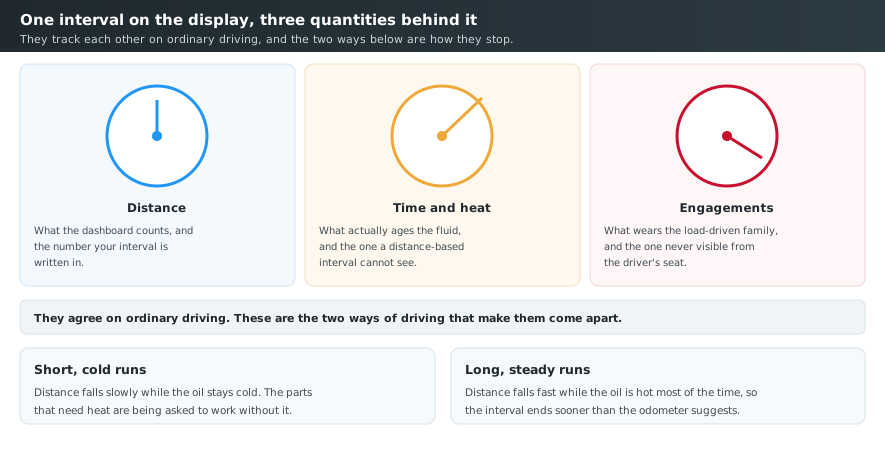
It is worth being concrete about how far apart they can get, because that is where a schedule quietly stops meaning what its owner thinks. A truck that spends its life on short cold runs can cover a scheduled distance while the oil has barely warmed, and its lifters have engaged comparatively few times. A truck that spends its life on long steady runs can cover the same distance with oil that has been hot for most of it. One of those two is being under-protected by its interval and the other is not, and neither driver would see the difference from the odometer alone.
| What you can observe | Which clock it points at | What it does not settle |
|---|---|---|
| The schedule was held and the level stayed put | Distance and time, managed | Whether the failure you are worried about was ever running on those |
| The engine does mostly short, cold runs | Time ahead of distance; the second family barely affected | Whether the oil reached the condition the first family reacts to |
| The engine does mostly long, steady runs | Distance behind the oil's actual age | Anything about cycle count, which is unaffected by how the distance was covered |
| One cylinder keeps coming back | Cycle count and geometry, not the calendar | Whether the medium was ever a factor in that cylinder |
The practical consequence is that there is no single interval that is right for the question, because the question is not single. An interval set to protect the oil is protecting the first family. It cannot be set to protect the second family, because the second family does not run on a clock the interval is measuring. That is not a flaw in how the schedule was chosen; it is a property of the mechanism.
The three readings worth taking
These do not diagnose anything — that is a different exercise with a different owner. They answer a narrower and more useful question: which of the two families you are actually exposed to, so that your effort goes somewhere it can move the outcome.
All three are things you can take yourself without opening anything, and none of them requires you to interpret a sound. Each one is a number or a fact you write down, which means it can be compared against the same reading taken later rather than against how the engine felt on the day.
| What you are considering doing | What it actually changes | What it leaves alone |
|---|---|---|
| Shortening the interval further | How far the oil has degraded before it is replaced — the whole of the first family | Contact load, guide geometry, and every internal part's cycle count |
| Changing the grade instead of the interval | How the oil behaves under shear and how well it fills the lifter chamber | The same three mechanisms, untouched |
| Checking and holding the level properly | Air ingestion and aeration — a real member of the first family, and the cheapest one to close | Nothing in the second family, but it is the cheapest risk reduction available |
| Treating a part that has already failed | Nothing until the family is known | Both families equally — which is why the readings come first |
The three readings themselves, in the order they are worth taking. First, the level trend: measured the same way each time, cold and on level ground, with the distance driven between each reading recorded. A level that is falling has consequences well beyond the lifters, and it is the one reading that changes what the other two mean.
- Level across at least two intervals. Not one top-up — a trend. A falling level is a separate problem that arrives on top of whatever family you are in, and it is also the input to the aeration route above.
- Age of the oil in time, not distance. How long since it went in and what kind of running that has been. Distance alone hides the short-trip case completely.
- Whether the fault has ever repeated on the same cylinder. Repetition on one cylinder points at a part and its geometry; a fault that moves around points at the medium. This is a fact you can establish from records rather than a sound you have to judge.
Taken together, those three place you on one side of the line or the other without requiring you to interpret anything mechanical. If the level is steady, the oil is fresh by time as well as distance, and the fault has never fixed itself to one cylinder, you are largely in the first family and the schedule you are already running is doing real work. If one cylinder keeps returning, or the level is falling, neither of which an interval closes, then the effort belongs somewhere else.
One thing the readings deliberately do not do is tell you whether a noise matters. That is a judgement about symptoms and codes, and it has its own page — the symptoms page works through it in the order it is worth working through. Keeping the two questions apart is what stops you from buying a diagnosis you did not need.
What this page covers, and what it does not
This page answers one question: what a change interval is capable of protecting against in an engine that deactivates cylinders, and what it was never in a position to protect. It does not cover symptoms, diagnosis, or what any particular oil brand does.
What it covers: the mechanism by which an interval influences a lifter, the three failure routes that respond to it and why they respond, the three that do not and why they cannot, the reasoning error that makes a clean record look like a broken promise, the three clocks and which family runs on which, and the readings that place you on one side or the other.
Three questions come up constantly alongside this one, and all three have somewhere better to go than here:
- Is the noise I can hear worth acting on? That is a diagnostic question, and the symptoms page owns it properly.
- What does stopping the deactivation change about any of this? the device problems page and the disabler guide set that out between them.
- Which oil should I be using? Not here at all. Brand and grade are a purchasing question, and nothing on this page turns on which one is in the sump.
Keeping them apart is not tidiness for its own sake. The first of those three is the question people most often bring to a maintenance discussion, and answering it here would be answering it worse than the page that was written for it.
There is a boundary on the recommendation itself worth stating. Nothing here says a strict schedule is unnecessary — the first family is real, it is common, and the effort spent on it is not wasted. The boundary is that the schedule has a scope, and believing it is larger than it is leads people to conclude that maintenance failed when what actually happened is that maintenance was asked about a mechanism it does not govern. Understanding the difference is worth more than another thousand miles shaved off the interval, and getting it right costs nothing at all.
Frequently asked questions
Can changing oil more often prevent lifter failure?
It can prevent the failures that the oil's condition causes, which is a real and worthwhile set. It cannot prevent the failures caused by load, geometry, or an internal part reaching its cycle limit, because none of those are functions of the fluid. Whether more often is worth it depends on which family you are exposed to.
I followed the schedule and my lifter still failed. Did the schedule do nothing?
It did the job it was in a position to do — the oil-driven routes were closed while you ran it. What it could not do is touch a mechanism running on cycle count or geometry. The record and the failure are not contradictory; they are answers to different questions.
Which lifter failures are actually oil-related?
Blocked feed passages, air in the oil, and viscosity that has drifted out of grade. In each of those the part was sound and the fluid became the problem, which is exactly the shape of a failure an interval can address.
Which lifter failures are not oil-related?
Contact damage on the roller and its pin, a lifter that has turned in its bore because the guide let go, and internal springs or locking elements at the end of their fatigue life. Those run on load and on engagements, neither of which a fluid change alters.
Is it worth changing oil earlier than the stated interval on a deactivation engine?
It buys more margin in the first family and nothing in the second. Whether that trade is worth making depends on your exposure, which is what the three readings are for — otherwise you are paying for protection against a mechanism you may not be near.
Does the oil life monitor measure what actually matters?
It estimates the state of the oil, which is the first family's variable, and it does so from how the vehicle has been driven. It says nothing about cycle count. It is a good proxy for one of the three clocks and a poor one for the others.
Do short trips damage lifters differently than highway miles?
They age the oil slowly over distance while spending far more time below the temperature at which everything works properly. So the oil ages on a different schedule than the odometer suggests, and the parts that need the oil hot before they function are being asked to work cold. Both are first-family effects, and distance alone will not show you either.
Will a thicker oil stop a lifter from ticking?
It can quiet a noise while the underlying condition stays exactly as it was. If the cause is viscosity that has fallen out of grade, restoring the grade is the right move; if the cause is a worn part or a blocked passage, the noise is a reading rather than a fault, and moving the reading does nothing for it.
Is there a maintenance step that guarantees a deactivating lifter will not fail?
No. The second family has no maintenance-controlled input at all, so any schedule leaves it open. What maintenance does is close the routes it can close, which is worthwhile without being a guarantee, and conflating the two is where most of the disappointment comes from.
Should I change oil more often after a lifter has been replaced?
There is no new reason to, if the schedule was already sound. The replaced part does not make the first family worse; if anything the inspection that went with it tells you something about which family you are in, which is more useful than a shorter interval would be.
Does towing or idling change the answer?
It changes how fast the oil reaches the end of its useful life without changing distance much, so the first family needs watching more closely. The second family is indifferent — it counts engagements, and how you accumulated them does not change what an engagement does.
Can I tell which family I am in without taking the engine apart?
You can get a long way with the three readings: the level trend, the oil's age in time rather than distance, and whether a fault has ever stuck to one cylinder. That is enough to decide where your effort belongs, which is the decision this page is actually about.
Is a strict schedule still worth it if it cannot prevent everything?
Yes, and for the ordinary reason: the first family is common, it is entirely within the schedule's reach, and closing it costs what maintenance already costs. The only thing worth giving up is the belief that it also closes the rest.