The Short Answer
A misfire code tells you a cylinder did not fire. It does not tell you why, and on a GM V8 the cylinder that misfires is usually one of the four that the deactivation system cycles — which is why the code alone is the weakest piece of evidence in this whole subject.
| What you have | What it means | What it does not mean |
|---|---|---|
| A misfire code, no noise | A cylinder did not fire under some condition. Ignition, fuel and mechanical causes are all still open | Not proof of a lifter. Most codes on these engines turn out to be something cheaper |
| A tick that tracks engine speed | The valvetrain is making noise in step with the cam. This is the single most useful symptom on the page | Not necessarily a failed lifter — a cam, a roller, a plug or an exhaust leak can sound the same |
| A misfire code on 1, 4, 6 or 7, plus a tick | Both signals point at the same hardware. This combination is what the rest of this page is built around | Not a diagnosis. It tells you where to measure, not what you will find |
| Low compression on one cylinder only | That cylinder is not sealing. The question is whether it is the valves, the rings or a lifter that is stuck | Not automatically a lifter. A valve that has been stuck open looks identical from a compression gauge |
| No code, no noise, consumption rising | The earliest signal there is, and the easiest to miss for years | Not proof of anything on its own, and not something a device changes |
What follows is the order to work in: what the codes mean and what they do not, the symptom pattern that raises suspicion, the eleven symptoms with the check that gives each one meaning, the four distinct ways a deactivating lifter fails, and the tests in the order they are worth running. The goal is not a verdict from a symptom list. It is knowing which measurement comes next.
What the misfire codes actually tell you
The misfire family is a set of one general code and seven specific ones, and the difference between them matters more than it first appears.
| Code | What the engine computer is reporting | What it rules in | What it rules out |
|---|---|---|---|
| P0300 | One or more cylinders misfired, and the computer could not attribute it to a single cylinder | A combustion event was missed somewhere | Nothing. It carries no cylinder information at all |
| P0301 through P0308 | A specific cylinder misfired — P0301 is cylinder 1, P0304 is cylinder 4, and so on | That cylinder missed at least one combustion event | Nothing about why. The computer detects the event, not the cause |
| Flashing check-engine lamp | Misfire severe enough that the computer is asking you to stop | Continuing to drive risks downstream damage, and the reason is not the lamp | Nothing. A flashing lamp is a priority, not a diagnosis |
Three things follow from that table, and they are the most useful things on the page.
A code is evidence of an event, not of a cause. The engine computer knows a cylinder did not fire. It does not know whether the plug did not spark, the injector did not deliver, the valve did not open, or the compression was not there to be ignited. Every one of those produces the same code. Anyone who tells you a code identifies a failed lifter has skipped the part that requires a measurement.
The cylinder number is a location, not a verdict. It is genuinely useful, because a specific code points at a place on the engine rather than at the engine. What it does not do is tell you the part. Cylinder 4 could have a failed plug, a failed coil, an injector, a stuck valve, a head gasket or a lifter, and the code is the same in all six cases.
The bank matters more than the number. On a V8, a misfire reported on one of the four cylinders the deactivation system cycles is a materially different signal from one on the other four. The reason is structural rather than statistical: those four lifters do something the other four do not, so a fault on that side has one more candidate cause than a fault on the other side does. Which four they are on your engine is not always the same four, and the section below covers how to establish it rather than assume it.
Two practical points about the codes themselves. Read them before clearing them, because clearing destroys the freeze-frame data that records the engine speed, load and temperature at the moment the misfire was counted — which is frequently the only thing that narrows a cold-start-only misfire down to a circuit or a valve. And if the lamp is flashing rather than steady, stop driving before continuing to read this page: a flashing lamp means the misfire is severe enough that the fuel the unburned charge represents is being sent into the exhaust, and that is a damage question, not a diagnostic one.
The pattern that raises lifter suspicion
A single symptom is weak evidence. A pattern is not, and the pattern in this category has a recognisable shape: the problem is present at part load, absent at full load, and it comes and goes with temperature and time rather than with distance.
| What you observe | What it points at | What it does not point at |
|---|---|---|
| Noise that tracks engine speed, present at idle and part throttle | The valvetrain. This is the strongest symptom in the category | An exhaust leak, which hisses and does not track RPM |
| Noise that disappears under load | Something mechanical in the valvetrain that load changes — a lifter, a cam, a roller | Ignition, which usually gets worse under load, not better |
| Misfire on a cold start that clears once warm | Several candidates, including a lifter that unlocks immediately and a circuit that is temperature-dependent | Nothing on its own. A cold-start-only misfire is a pattern that needs two more observations |
| Misfire that appears on a deactivating bank and not the other | Something specific to the bank that cycles. This is the observation that separates hardware from a generic fault | A fuel or ignition fault, which is rarely bank-specific |
| Oil consumption that has moved over months | An engine that has been changing internally for a while | Nothing specific. It is the earliest signal and the least specific one |
What the pattern does not include is as important as what it does. A misfire that is equally bad at idle and at full load is unlikely to be valvetrain. A noise that comes and goes with the road surface is not this. A code that appears once and never again without a pattern is usually transient, and a transmission shift problem that is mistaken for a misfire at part load has a different fix entirely.
Eleven symptoms and the check that gives each one meaning
Each of these is presented with the check that turns it from an observation into information. A symptom with no check attached is a guess, and a guess is what leads to a part being bought.
| Symptom | What it means on its own | The check that gives it meaning |
|---|---|---|
| 1. The check-engine lamp returns after the codes are cleared | Nothing. A code that comes back means the condition is still there, and that is all | Read the freeze-frame data before clearing. If the misfire is counted at the same speed and load every time, the cause is repeating; if the conditions vary, they are the clue |
| 2. A repeatable misfire on one cylinder | That cylinder did not fire, repeatedly, under a repeatable condition | Swap the ignition components between that cylinder and a neighbour and re-drive. If the misfire follows the part, it is the circuit; if it stays on the cylinder, it is the cylinder |
| 3. A misfire code together with a valvetrain tick | Two signals. The second is the one carrying the weight | Watch the valve movement with the cover off while cranking. A valve that does not move is a mechanical result, and it ends the argument |
| 4. A steady tick that follows engine speed | The valvetrain, and the tick is the symptom most worth chasing | Change load without changing RPM, and change RPM at a steady load. A sound that stays locked to RPM is mechanical; one that changes with load is usually airflow or exhaust |
| 5. A brief tick only after the vehicle has been standing | Very often normal, and very often mistaken for a fault | Time it from start to silence. A short noise that disappears as oil reaches the lifters is oil drain-back, not wear |
| 6. Rough idle or a shake that stays with the engine | Usually a vacuum, ignition or balance issue rather than a lifter | Check for a vacuum leak around the intake before anything else, because it produces a shake that mimics a mechanical one |
| 7. Hesitation or power loss under load | Several candidates, and fuel is usually ahead of valvetrain on the list | Check for a vacuum leak and for fuel delivery under load before assuming the engine has lost a cylinder |
| 8. The lamp is flashing rather than steady | Severe misfire. This is a stop-driving condition | None. Do not run a check; the next step is to stop and have the cause found |
| 9. One cylinder has low running compression | That cylinder is not sealing. Which part is a separate question | Compare against its neighbours on the same bank. One low cylinder against a normal bank is a local fault; a whole bank low is an engine-level fault |
| 10. A rocker or valve stops moving | The most decisive observation available, and it is the one that ends a diagnosis | Already the check. Nothing further is needed to know the valve train is damaged on that bank |
| 11. Oil-pressure warnings alongside a misfire | The oil supply is now part of the problem, and that changes which mechanisms are candidates | Measure oil pressure hot at idle and rule out a restriction or a failing pump before treating a lifter as the cause |
Read down the second column and notice how little any of it proves. That is not a criticism of the symptoms; it is the reason each one is paired with a check. A symptom tells you where to look, and the check tells you what is there.
The four ways a deactivating lifter fails
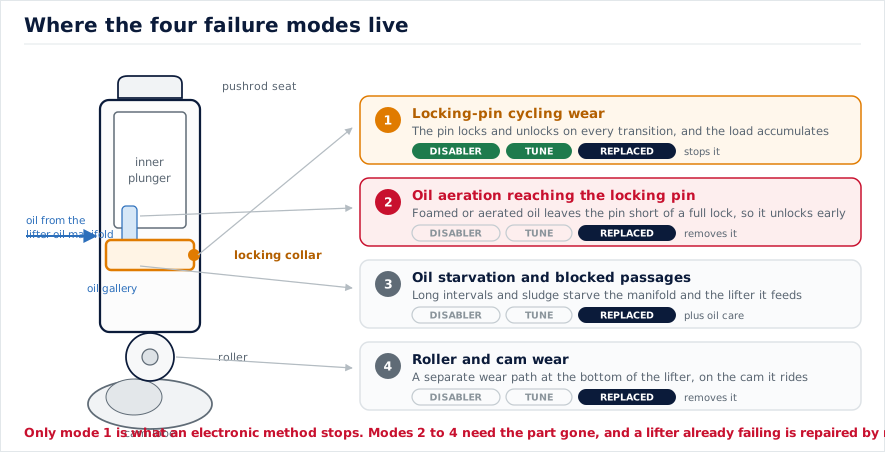
"A lifter failed" is a conclusion, not a description. There are four distinct mechanisms behind that conclusion, they produce different symptoms, and — the part that matters for a purchase — only one of them is something an electronic method can do anything about.
| # | Mechanism | How it presents | What reaches it |
|---|---|---|---|
| 1 | Locking-pin cycling wear. The pin inside the lifter locks and unlocks on every transition, and the wear is cumulative rather than sudden | The softest of the four, and the one that most often only ever shows as the transition itself becoming more noticeable | A disabler or a tune stops it, because both stop the cycling. Replacing the hardware removes it, because there is no longer a pin in the lifter |
| 2 | Oil aeration reaching the locking pin. Foamed or aerated oil leaves the pin short of a full lock, so the lifter does not hold the way it should when the system releases it | A lifter that unlocks as soon as the engine starts, or one that will not re-lock reliably. Often with a misfire and frequently without a tick | Neither an electronic method nor a software change reaches it, because the cause is the oil arriving at the pin. Replacing the hardware removes the part that had the problem |
| 3 | Oil starvation and blocked passages. Long intervals and sludge reduce what reaches the lifter oil manifold and what reaches the lifter through it | Compression that varies between tests, a lifter that is slow rather than dead, and behaviour that changes with oil age | Not reached by an electronic method, because the cause is supply rather than command. Replacing the hardware removes the deactivating path, and oil care still matters afterwards |
| 4 | Roller and cam wear. A separate path at the bottom of the lifter, where the roller runs on a cam lobe that was ground for a deactivating application | The loudest of the four. A tick that tracks RPM, often with a misfire on the same cylinder | Not reached by an electronic method. Replacing the hardware replaces both the lifter and the cam, so the path is gone |
Three conclusions come out of that table, and each of them prevents a specific and common mistake.
A disabler is not a repair. It addresses mode 1 and nothing else, and mode 1 is the least consequential of the four. Every purchase justified by "it stops the AFM lifter failing" is a bet on the least urgent mechanism, and it does nothing at all for the three that produce the symptoms people actually complain about.
Oil is not an aside. Modes 2 and 3 are about what is arriving at the lifter rather than what the lifter is being told to do. Which is why oil condition and oil pressure appear in the symptom list and why a pressure reading belongs in the diagnostic order.
Noise and codes point at different mechanisms. Mode 4 is the loud one, and mode 2 is often the quiet one — which is why a lifter problem can exist with no noise at all, and why a compression test is worth more than listening in a specific set of cases.
Why the cylinder numbers carry the argument
On a GM V8 the deactivating lifters sit on one bank, and the bank that stops reads as cylinders 1, 4, 6 and 7 on some engines and as 1, 3, 4 and 6 on others, because the firing order changed across generations. Neither pattern is a mistake; the numbering belongs to the engine, and copying it from a different truck is how people end up chasing a cylinder that was never involved.
There are three ways to establish the set for your own engine, in increasing order of effort.
- Read it from a scan tool while the system is engaging. This is the direct answer and it takes about a minute.
- Read it from a stored code. A specific misfire code on one of these four, repeating, is a strong signal. A single code is weaker, and a code on the other four is a different investigation entirely.
- Watch the valve movement with the cover off while the system is engaging. Cylinders that stop moving are the deactivating ones, and this is also the check that tells you whether a valve is stuck.
Once you know the set, the argument gets much easier. A misfire on a deactivating cylinder with a tick has a set of candidates that a misfire on the other bank does not, and a compression result that is low on one of those four is a different finding from one that is low on a lifter that never collapses.
Not every tick is an AFM lifter
Noise is the most common reason people arrive on this page, and it is the least specific thing they bring with them. Four sounds account for most of it, and only one of them is the lifter.
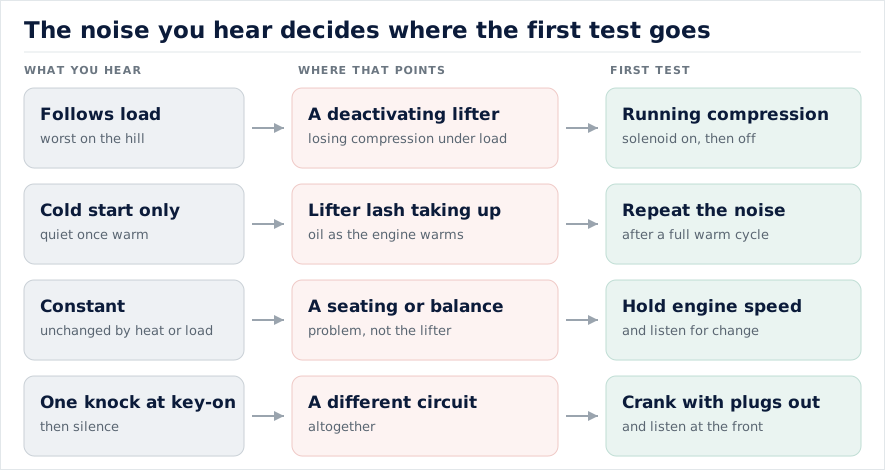
The distinction that catches people most often is the one between a noise that tracks engine speed and a noise that tracks load. A lifter is a rotating-tolerance problem, so its sound is locked to RPM and changes with load. An exhaust leak is an airflow problem, so it hisses hardest at low load and quietens under throttle. If your noise is quietest when you are on the throttle, it is not the lifter, whatever its pitch suggests.
The tests, in the order they are worth running
This is the section to come back to. The order matters because each test costs progressively more and each one eliminates a group of candidates rather than confirming a single answer.
- Read the codes and the freeze-frame data. Before anything is cleared or unplugged. The freeze-frame records the speed, load and temperature at the moment the misfire was counted, and it is the cheapest evidence available.
- Check the oil. Level, condition and age, and the pressure reading hot at idle. Two of the four lifter failure modes are about what is arriving at the lifter, and this is where that gets ruled in or out.
- Run compression, and run it in the state you actually use the vehicle in. A normal compression test on a deactivating engine is measuring the engine in its held-open state. The version that separates the two is a running compression test, which is what makes this item the centre of the diagnostic order rather than a preliminary.
- Watch the valve movement with the cover off, while cranking and while the system is engaging. This is the check that ends a diagnosis: a valve that does not move is a mechanical result, and no further speculation is useful.
- Swap the ignition components between the suspect cylinder and a neighbour and re-drive. This is the cheapest way to separate a circuit from a cylinder, and it is skipped more often than any other step.
- Only then open the engine. By this point the candidate list is short and the parts are known, rather than being whatever happened to be on the bench.
One more thing about the order: steps one through five are all things that can be done by the owner with a code reader, a compression gauge and a screwdriver. Step six is the point at which the vehicle is on a lift, and reaching it without the first five having been done is the most common way this category wastes money.
How to use scan data before opening the engine
Scan data is worth more than a symptom list in this category, and it is worth most when it is used to look at conditions rather than at codes.
| What to look at | What it tells you | How it changes the diagnosis |
|---|---|---|
| Freeze-frame data at the moment of the misfire | Engine speed, load, temperature and gear at the moment the event was counted | A misfire counted only at one speed and one temperature is a very different problem from one counted everywhere |
| Which cylinders appear across several events | Whether the fault is on one cylinder, on a bank, or spread around | One cylinder repeated is local. A whole bank is a system-level question. Spread around is usually ignition or fuel |
| The reduced-mode cylinder list | Which cylinders the deactivation system is using on this engine | Turns "a deactivating cylinder" from an assumption into a fact, and it is the list a low compression result should be compared against |
| Whether the system is engaging at all | Whether the cylinder deactivation is active in the state you are testing | A compression test run while the system is holding a bank open is not the same test as one run with it commanded on and off |
| Short-term and long-term fuel trim | Whether the engine is being asked to add or remove fuel, and over what period | Trim that moves with a temperature pattern is an air or fuel delivery question before it is a valvetrain one |
And one warning about the tool itself. A code reader that clears codes on the moment it connects will destroy the evidence before you have read it, and most of the useful part of a scan is the state behind the code. Read first, write down, and only then clear if you are clearing at all.
Where a disabler fits, and where it does not
A disabler is a reasonable purchase in this category and an unreasonable one in another, and the difference is entirely about which of the four modes you are worried about. This is worth stating plainly because the two are constantly sold as one thing.
| Situation | What a disabler does for it |
|---|---|
| The engine is healthy and you want to reduce future transitions | That is exactly what it does. It stops the cycling that mode 1 is made of, and it does it without writing anything to the vehicle |
| You are worried about mode 1 — pin wear accumulating over the years | This is the one mode it addresses. Whether that produces a measurable change in how long the engine lasts is not something any seller can measure for you |
| The engine is already making a noise | Nothing. It reduces transitions from here on and does not repair a lifter that has already moved |
| There is a specific misfire code on a deactivating cylinder | Nothing, and worse than nothing: holding the system off can make the diagnosis slower, because the code will not reproduce in the state the fault occurs in |
| Oil pressure or oil condition is in question | Nothing. Modes 2 and 3 are about what is arriving at the lifter, and no electronic method reaches that |
| The engine has a roller or cam wear problem | Nothing, and this is the mode people most often buy against |
The third row has a consequence worth stating separately, because it is counter-intuitive. A disabler fitted on an engine that is being diagnosed can remove the condition that produces the symptom. If a fault appears when the deactivating bank is released and the system is held off, the bank never releases — so the fault never happens and the code never comes back. That is a mechanism for a misdiagnosis, not just a lost symptom, and it is a good reason to finish the diagnosis before fitting anything.
Everything about what a disabler changes, what it costs and what it leaves behind is on the decision page, and the case for a fitted device that is not doing what you expected is on the troubleshooting page.
The four repair boundaries
There are four things a workshop will not do, and knowing which one you are looking at tells you what the conversation is going to cost.
| Boundary | What it means in practice | What decides it |
|---|---|---|
| A valve that does not move gets a valve train, not a part swap | One lifter is rarely the end of it. The bank, the guides and the oil manifold that fed it are part of the same question | The valve movement check, which is why it comes before any teardown |
| A compression problem is not repaired with a stronger part | A cylinder that does not seal because a valve is stuck open will not be fixed by a new lifter, because the lifter is not what is leaking | Whether the valve moves. Everything else is speculation |
| Oil pressure is a finding, not a symptom to be treated | A low reading is a question about the supply, and it is answerable before any parts are chosen | The pressure measurement, hot at idle |
| A code is a starting point, not an instruction | Replacing the part named by a code is how a misfire becomes a bill. The code names a cylinder, not a component | The swap test and the compression comparison, in that order |
AFM and DFM are not interchangeable diagnoses
Almost everything on this page holds for both generations, with one difference that matters when you are reading a result: a later-generation engine may deactivate a different combination of cylinders than the earlier one, and in some configurations the pattern can change between firing sequences.
What that means practically is small but real. The four cylinders you identified on an earlier engine are not automatically the four on a later one, which is why reading the list from the vehicle is worth the minute it takes. A specific misfire code still points at a specific cylinder, and that is still the strongest single piece of evidence you can have.
The third name in the family is the one that catches people out: displacement on demand, usually written DOD. General Motors used it before Active Fuel Management, so a DOD lifter and an active fuel management lifter are the same part, and a DOD lifter failure and an AFM lifter failure are the same failure. If a symptom list or a repair quote has been written under the older name, it applies to the newer one without change, and every test on this page works the same way on both.
The mechanism behind the system, and the full explanation of why the request travels between two controllers and why the cylinders are held hydraulically, is on the mechanism page, along with the vehicle list.
After the repair: how to know it worked
A repair is a claim, and this is the part of the page that tests the claim. It is skipped more often than any other step, and skipping it is how a second visit happens.
| When | What to check | What a good result looks like |
|---|---|---|
| Before paying | Ask for the readings taken during the job, not a description of it: the compression figures, the valve movement observation, and the oil pressure | Numbers, not adjectives. A description of what was found is not evidence that it was fixed |
| On the first drive out | The noise. The same road, the same speed, the same load | Silent where it was ticking. The transition noises of the system itself are expected and are not what you are listening for |
| Over the first few hundred miles | Consumption, and whether the lamp stays off | Consumption settling at the figure you recorded before the work, and no stored code |
| On the first cold start after a week | Time from start to silence, compared with the figure you noted before | Equal or shorter. A short noise that clears in a second or two is oil drain-back, and it is not a fault |
| At the next service | The readings again, on the same instrument if possible | Compression on the repaired cylinder matching its neighbours, and stable rather than varying between tests |
Two things to be careful about in the first week, both of which produce worry that turns out to be nothing. A rebuilt or reworked valvetrain sometimes produces a tick that is not present before the work and settles as it beds in; and a repair that has changed how a cylinder compresses can shift idle and throttle behaviour slightly until the engine computer re-learns. Neither is a reason to go straight back, but a note of the figures on the day you collect the vehicle makes the difference obvious later.
And one thing that should not be accepted as a result: a repair described as done, with the same code returning. The code returning means the condition is still there, and the second visit is avoidable by asking on the first one what was measured.
What to bring to a repair appointment
Six items, and the appointment gets shorter because of them. Each one is something that exists on the vehicle and cannot be recreated in a car park afterwards.
| Bring | Why it changes the conversation |
|---|---|
| The codes, read not written down from memory | A code plus its freeze-frame is a condition. A code on its own is a list of numbers |
| The oil pressure reading, hot at idle | It moves two of the four mechanisms in or out of consideration before any part is quoted |
| The compression numbers, all eight cylinders, and whether the system was engaged | One low number is a question. Eight numbers with a stated condition are a diagnosis |
| When the noise happens | Cold start, hot idle, part load, full load, or only when coasting. A recorded answer removes a round trip |
| Oil consumption between changes, over at least two intervals | It is the earliest signal there is and the hardest for anyone else to reconstruct |
| Which cylinders the deactivation system is using | It converts "a deactivating cylinder" from an assumption into a location |
The mistakes that make a repair more expensive
| The mistake | What it costs | What to do instead |
|---|---|---|
| Clearing the code before reading the freeze-frame | The evidence is gone. A cold-start-only or load-only fault becomes a guess | Read, write it down, photograph it, then clear |
| Replacing the part the code points at | A cylinder is not a component. The same code covers plug, coil, injector, valve and lifter | Swap test first, then compression, then open it |
| Fitting a disabler on an engine that is being diagnosed | It can remove the condition that produces the fault, so the symptom stops reproducing and the diagnosis stalls | Finish the diagnosis. Prevention is a decision for a healthy engine |
| Replacing one lifter and leaving the rest of the bank | The guides, the oil manifold and the neighbours are part of the same question | Ask what the repair covers on the bank, not just the one part |
| Driving on with a flashing lamp | Unburned charge reaching the exhaust, and the damage that follows | Stop. It is a priority, not an appointment |
| Running a compression test without saying what state the system was in | The number is uninterpretable, because a held-open bank compresses differently | State it, or run it in both states |
What this guide covers, and what it does not
This page stays on the diagnosis. It covers what the codes mean and what they do not, the pattern that raises suspicion, eleven symptoms each paired with the check that gives it meaning, the four distinct ways a deactivating lifter fails, the tests in the order they are worth running, and what to hand to a workshop.
It deliberately leaves three questions to their own pages.
| Question this guide does not answer | Where it is answered |
|---|---|
| How the system works, which engines and years carry it, and why the lifter is the weak point | Active Fuel Management explained, with the vehicle list |
| Why a fitted disabler is not doing what you expected | AFM disabler problems |
| Which of the three ways to turn the system off suits this vehicle, and what each one costs and leaves behind | Disabler, delete kit or tune |
What is left out is not less important, only better placed. If you arrived here because a lamp is lit and the engine is ticking, the section on the tests is the next step, not the rest of the page.
Frequently asked questions
The questions that come up with a lamp on and a noise under the bonnet:
Does P0300 prove that an AFM lifter has failed?
No. P0300 is the general misfire code and it does not even name a cylinder. It means a combustion event was missed somewhere. Plug, coil, injector, valve, gasket and lifter all produce the same code, and a specific code naming a cylinder tells you the location rather than the part. What raises lifter suspicion is a specific code on a deactivating cylinder together with a tick that tracks engine speed and a compression result that is low on that same cylinder.
Which P030x codes point toward the deactivating cylinders?
The ones that name a cylinder in the set the system is using, which is why the set is worth reading from the vehicle rather than assuming. A repeating code on one of those cylinders plus a tick is a strong combination. A code on the other four is a different investigation, because those lifters do not do anything unusual.
Can a spark plug or coil look like a bad lifter?
They can produce the same code, and they are cheaper to test than anything else. Swapping the ignition components between the suspect cylinder and a neighbour and re-driving is the cheapest way to separate a circuit from a cylinder, and it is the step most often skipped. A coil that has failed under the extra duty of a cylinder that is being commanded to fire when it should not can also be the reason a cylinder misfires only in reduced mode.
Will an AFM disabler fix a ticking lifter?
No, and this is the most expensive misunderstanding in the category. A disabler stops the cycling, which is the mechanism behind pin wear. It does nothing at all for oil aeration, for oil starvation, or for roller and cam wear — and a tick that tracks engine speed is usually one of those last two. It also cannot be fitted on an engine that is being diagnosed without risking the removal of the very condition you are chasing.
Does an AFM disabler prevent lifter failure?
It stops one of the four modes and no more. Holding the system off removes the cycling that wears the locking pin, which is the first of the four. It does nothing for oil arriving at the pin short, nothing for blocked passages, and nothing for roller and cam wear — and on an engine that is already making a noise it does nothing at all, because prevention is a decision made before a part has moved rather than after. Whether it changes how long an engine lasts is not a number any seller can measure for you.
What does low running compression on a deactivating cylinder mean?
That the cylinder is not sealing in the state you tested it in, and the two common causes are a valve that is stuck and a lifter that is being held open. Comparing the same cylinder in both system states is what separates them: a number that stays low regardless of the system command points at the valve, and a number that recovers when the system is commanded to close the lifter points at the lifter.
Can a lifter problem exist without a check-engine light?
Yes, and it is common. A lifter that releases early and holds compression perfectly may misfire enough to be counted on one drive and not on the next, and mode 2 in particular often arrives with a misfire and no noise at all. This is why consumption over time and the freeze-frame data matter more here than the lamp does.
Are cylinders 1, 4, 6 and 7 the deactivating cylinders on every GM V8?
No. That is the set most often quoted and it is not universal — the other common bank pattern reads as 1, 3, 4 and 6, because the firing order changed across generations. Read the list from the vehicle, or watch which valves stop moving with the system engaging, rather than copying it from another truck.
What should I do if the malfunction lamp is flashing?
Stop driving and have the cause found. A flashing lamp means the misfire is severe enough that the unburned charge is being sent into the exhaust, and continuing to run the vehicle is a damage question rather than a diagnostic one. Nothing on this page should be read before that is resolved.
Is low oil pressure itself an AFM lifter code?
No, and it is not a code at all — it is a measurement, and it is the one that decides whether two of the four mechanisms stay in the picture. A low reading at hot idle changes the candidate list, and it is answerable before any part is chosen.
When is an AFM disabler the right product?
When the engine is healthy, out of warranty, and you are being kept for years. It is the wrong product when the engine is already making a noise, when a code has appeared on a deactivating cylinder, or when oil pressure is in question — because it addresses the cycling and not the failure.
What is the first test worth running on an AFM lifter problem?
Read the freeze-frame before clearing anything, then check the oil and the pressure, then run compression in a stated state. The valve movement check comes after that and it is the one that ends the argument. Opening the engine comes after all of them, and the order is what keeps the cost proportionate to what is actually wrong.
Is AFM lifter replacement the right repair, or does it need the whole bank?
Not reliably, because the guides, the oil manifold that fed it and the neighbouring lifters on the same bank are part of the same question. A cylinder that is not moving is a bank-level observation, and the repair worth agreeing is the one that covers the bank rather than the single part.
Why does my engine misfire only when cold?
Several candidates, and a cold-start-only pattern is a clue rather than an answer. Oil viscosity before the lifter has filled, a circuit that is temperature-dependent, a valve that is stuck and releases as things warm, and a lifter that unlocks as soon as the engine starts are all consistent with it. The freeze-frame data is what tells you whether the misfires are counted at one temperature band or across all of them.
Does an AFM disabler cause a check-engine light?
It can, because a device on the diagnostic port changes what the engine computer sees during its own checks, and the readiness monitors can be left in a state that fails an inspection. Unplug it and re-drive: if the lamp goes away, the device provoked it. If it stays, the condition predates the device and belongs to a diagnosis.
Is the shudder a sign of a failing lifter?
No. The shudder at a low-speed crawl is the exhaust valves on the inactive bank opening and closing, and it is the system working. A lifter problem does not clear when you open the throttle; a shudder does.
Do I need a scan tool to diagnose this?
It helps more than it is essential. With one you can read the set of deactivating cylinders for your engine, see whether the system is engaging during the test, and compare a low compression result against the right set. Without one, the valve movement check gives you the same set visually, and the compression comparison in both system states still works.
How do I know the difference between an oil problem and a lifter problem?
The pressure reading and the oil condition take the supply out of the question, and the comparison of the same cylinder in both system states takes the lifter in or out. A number that is low in both states points at a valve or a ring. A number that recovers when the system closes the lifter points at the lifter. That single comparison is the most informative measurement in this whole page.