The Short Answer
What is AFM? On a Chevy or a GMC, Active Fuel Management is the name GM gives to switching part of the engine off under light load — a V8 runs on four cylinders instead of eight, a V6 on two instead of six. It is a normal fuel-economy feature, and it is also the reason a truck that makes more power than it needs will still shudder at a stop.
| The question | The answer |
|---|---|
| What is active fuel management? | A cylinder deactivation system. The engine holds the lifters of the inactive cylinders down so their valves stay shut and nothing fires in those bores, then releases them again the moment you ask for power. On a V8 that is four of eight cylinders; on a V6, two of six |
| What does AFM stand for? | Active Fuel Management. The system is also described as GM V8 cylinder deactivation, and on later engines the same idea runs under the name Dynamic Fuel Management, usually shortened to DFM |
| Which cylinders switch off? | A complete bank. The bank that keeps running is the one carrying the work, and the numbering people quote for the stopped bank differs between engine families, so the numbers in a stored code are worth reading rather than assuming |
| Who decides when it happens? | The engine computer decides and the transmission controller has to agree. Nothing happens from a switch on the dash, and nothing happens on a fixed schedule — the sequence runs in the background on every light-load moment |
| Is AFM the same as DFM? | No. Same idea, different generation and a different control interface. That is the main reason a module built for an earlier engine does nothing at all on a later one, and why a 10-speed truck is a different problem from an 8-speed one |
| Does every GM engine have it? | No. The fitment list behind this site covers the 3.0, 3.6, 3.9 and 4.3 litre V6s and the 5.3, 6.0 and 6.2 litre V8s. The 2.7 litre turbo four, the 3.0 litre Duramax diesel and the 4.8 litre V8 are not on that list |
Everything below is worked out from how the system is built rather than summarised from a manual: the module-by-module sequence, what each step costs the valvetrain, the engine families it actually appears on, and the three places in the chain where a solution can sit.
Already know the system and want to compare the ways to turn it off? →
What Active Fuel Management actually is
Ask what is active fuel management and the useful answer is not a definition, it is a mechanism. A V8 with a full complement of cylinders has more capacity than it needs to move a truck through a parking lot, so the system takes four of them out of the picture and runs on what is left. Fewer cylinders firing means less fuel burned per unit of distance, because the cylinders that stop are not merely idling politely, they are shut completely: their intake valves stay closed, their exhaust valves stay closed, and nothing is pumped in or out of that bore.
That last detail is what separates cylinder deactivation from an ordinary four-cylinder mode. When a V6 runs on two cylinders, or a V8 runs on four, the inactive cylinders are not firing on a thin mixture and they are not burning anything. They are held, and the oil that would have lubricated a working valve train is directed somewhere else. A system that switches cylinders by leaving them running at a lean mixture would be simpler to build, and it would also be a much smaller fuel-economy gain, so the version GM uses is the one that actually closes the valves.
General Motors calls it Active Fuel Management, and the same idea is also sold and searched for as GM V8 cylinder deactivation, cylinder deactivation system, and simply cylinder deactivation. The naming matters when you are searching for an answer, because the same hardware is called four different things depending on whether you are reading a vehicle listing, a parts listing, or a forum thread. Chevrolet and GMC versions exist side by side and share everything except the badge.
There is also an older name in the same family: displacement on demand, usually written DOD, as in a DOD lifter or a DOD delete. DOD and AFM are the same hardware under two names, because General Motors used the first before it became Active Fuel Management — which is why a lifter problem reported under either name is the same problem, and why the advice written for one applies to the other. DFM is the generation after that. Three names, one goal, and an interface that changed between them, which is the reason a solution written for one generation can be completely inert on another.
What it looks like from the driver's seat
The system announces itself in three ways, and all three are normal.
The first is the exhaust note. When the engine drops to its reduced set the exhaust note changes pitch and volume because the flow through the system changes, and on a V8 the difference is not subtle — the truck sounds like a different vehicle for a second and then a half.
The second is a small shudder, usually at low speed or a stop-start crawl. This is the exhaust valves on the inactive bank opening and closing at a rate the exhaust system was not tuned to be as quiet about, and it is the part that convinces most owners something is broken. It is the system working.
The third is the transition back. When you ask for power the lifters refill, the valves reopen and the exhaust note returns to normal, and there is a brief hesitation in that transition that is felt as a half-second of softness before full power arrives. Owners usually notice this one only after it has gone away.
Why an engine that can make three hundred kilowatts shuts off half its cylinders
Because the alternative is a large engine running a small job, and a large engine is inefficient at a small job. The cylinders that stop are the ones that do not need to be running, not the weak ones, and the system decides on load, not on a calendar: cruise at a steady light load and the reduced set stays; press the throttle and the full set returns before the throttle is even fully open.
There is a design logic underneath it that explains the whole architecture. The engine computer and the transmission are both watching the same operating condition, and neither one is willing to change the cylinder count on its own. An engine that changes its breathing while the transmission is deciding whether to change gear produces a torque step at exactly the moment the driver cannot predict it. So the request goes out, gets agreed to, and only then does anything mechanical happen. That two-party arrangement is the reason the system feels slightly late, and it is the reason a device that intercepts one half of the conversation is enough to change the outcome.
What this feature is not
It is not a mode that improves performance, it does not add power under any circumstance, and it does not engage while the engine is cold. It is also not the only cylinder-shutdown idea in the market. The same "run on fewer cylinders" idea appears on other vehicles under other names, and the details of how a cylinder is held differ enough between manufacturers that a solution designed for one brand does nothing for another. The mechanical principle is shared; the interface is not.
What is genuinely useful to know before anything else is which of the three systems your engine carries, because that single fact decides which solutions are even candidates and which are dead ends. That is what the rest of this page works through.
The three names that cause purchases to go wrong
Chevrolet and GMC badges do not make a different system — those are the same hardware under two badges, and a question about either one has the same answer. Three distinctions are worth making once, because getting any of them wrong is what a wasted purchase looks like.
| The distinction | What actually differs |
|---|---|
| AFM against DFM | Same behaviour, different control hardware. A device built for one generation has nothing to say to the other, and that is the reason a module can fit, power up and change nothing |
| AFM against DOD | DOD is the older name for the same arrangement, and the mistake is reading it as an unrelated system. What decides whether a solution fits is the command structure the vehicle carries, not which name appears in the listing |
| Disabler, bypass module, delete, deleter | The first two are the removable part that writes nothing; the last two are a permanent change. The test is simple and it is the only one that matters: does the vehicle go back to how it behaved when something is unplugged |
What AFM parts are actually involved
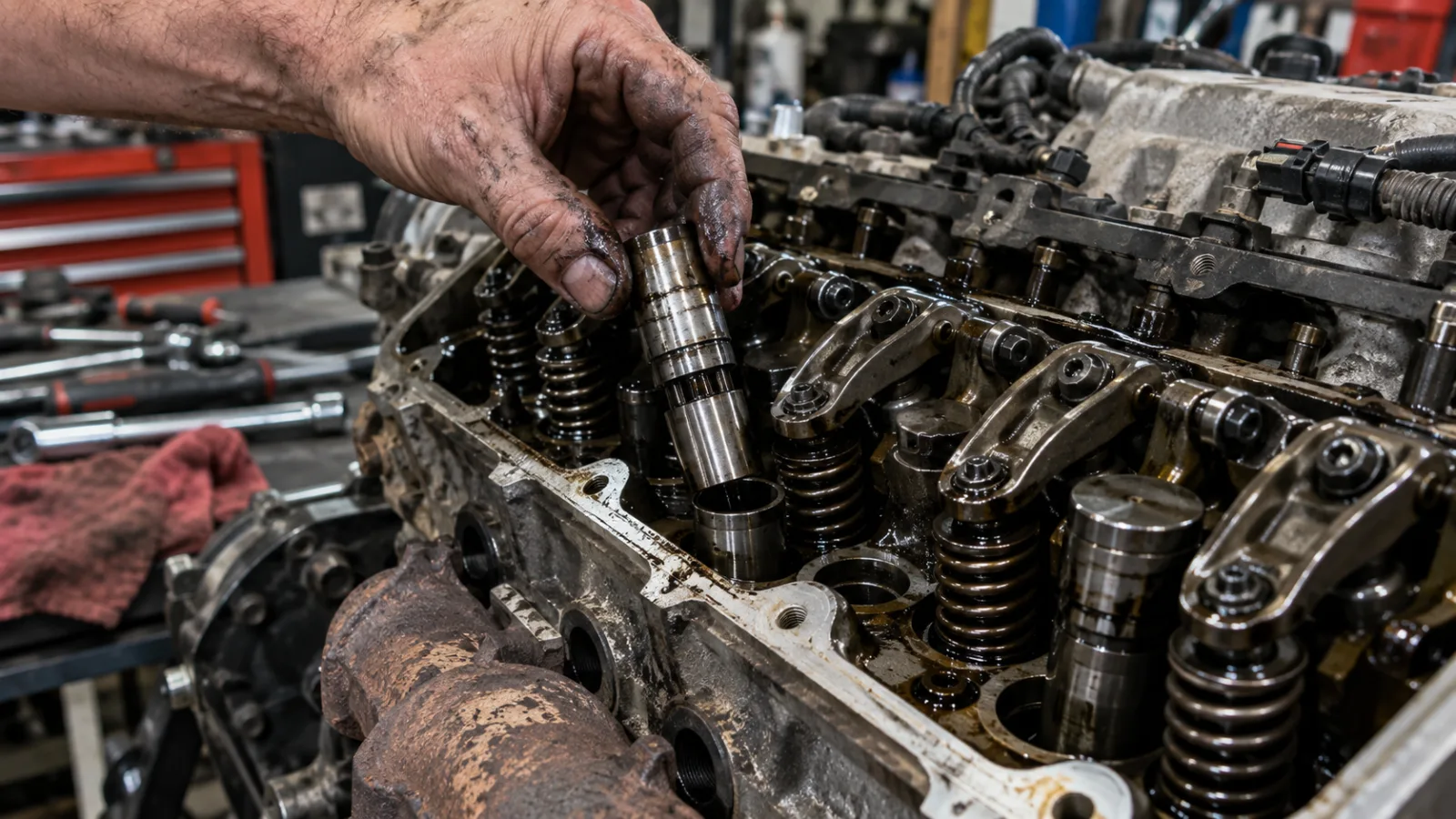
Searches for the parts converge on four things, and knowing which is which saves a lot of guessing. The control solenoids on the deactivating bank receive the command and hold the lifters down. The deactivating hydraulic lifters themselves are the parts that collapse and refill, and they are the ones that wear. The cam lobes those lifters ride are ordinary cam lobes being used unusually often. Underneath all of it is the oil supply, because a lifter that cannot fill collapses slowly and loses contact with the cam.
There is no motor in the system. The search term "AFM motor" is used for both the control solenoid and the oil control valve that feeds the deactivating bank, and on some engines for the lifter itself — three different parts, three different prices, one shared name. Anyone shopping for an AFM motor should be asking which of the three they actually need, because a module is a diagnostic aid and a lifter is a mechanical repair.
How the system decides to switch cylinders off
How does active fuel management work? The whole sequence is short, and every step in it is a place where a different kind of answer fits. The chain runs like this.
| Step | What happens | Can a solution interrupt it here? |
|---|---|---|
| 1. The operating condition is read | Vehicle speed, engine load, throttle position, transmission state and gear are all taken into account. Light load, closed throttle, warm engine, the right gear | No. This is observation, and observation cannot be blocked without breaking something else |
| 2. The engine computer asks | A request goes to the transmission controller asking to run on the reduced cylinder set. The request is a message, not a physical connection | Yes. A plug-in module can sit on this message and never agree. This is the simplest place to intervene and the only one that can be undone by unplugging |
| 3. The transmission controller agrees | If the transmission is in a state where a torque change would be felt, the request is declined and the system stays at full cylinders | Partly. Holding the transmission in manual above the deactivation threshold stops the request being satisfied without touching anything electronic |
| 4. The deactivating lifters are commanded | Solenoids on the inactive bank receive their command and the lifters are held down. The valves stay shut and those cylinders do not fire | Partly. An ECU change can alter what is commanded here, and a mechanical delete changes what the hardware is physically able to do |
| 5. The engine runs on the reduced set | Fuel is only delivered to the live cylinders, the exhaust note changes, and the transition you feel is the exhaust valves on the inactive bank opening and closing | No. By the time the engine is running this way, the hardware has already been committed |
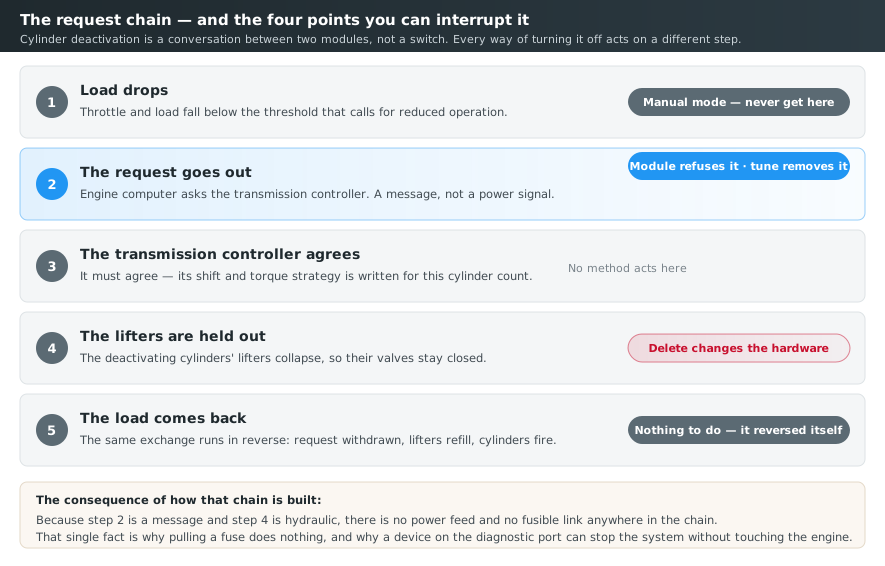
Two things about that chain explain most of the confusion people have with this system. The first is that step 2 is a conversation, not a wire. There is no power feed running from the engine computer to the lifters, because the lifters are hydraulic and the command that reaches them is electrical only in the last few millimetres. A part of the system you can unplug has to be a message you can ignore, and a part of the system you cannot unplug has to be a physical link.
The second is that step 3 is not a formality. The transmission can decline, and when it does, the system simply does not engage. This is why a truck that is obviously capable of running on fewer cylinders sometimes never does, and why the same truck will do it happily on a different drive. It also means the system can look "broken" on a vehicle where nothing is broken, because the request is being made and declined on every single light-load event.
That is also why the common shortcut of "disabling" the system with a switch, a wire, or a fuse either does nothing at all or takes a circuit the engine needs for something else. The chain has no interruption point that a switch can reach. What it has is a decision point, and a solution has to speak the same language as the decision.
Which cylinders switch off, and which stay on
The answer is a complete bank, and the bank that keeps running is the one carrying the work. On a V8 that means four cylinders stay live at any moment; on a V6 it means two. Nothing about the system is partial in the sense of a cylinder here and a cylinder there — it takes a whole bank, and the reason is mechanical: a bank that has four valves per cylinder needs its cam, its intake manifold and its exhaust manifold to be running as a set, and a single stopped cylinder in the middle of that bank makes the flow uneven in a way the exhaust system is not designed to absorb.
The numbering is where people get caught, and it is worth being precise about it rather than repeating a number that belongs to a different engine. Depending on the engine family, the bank that stops reads as cylinders 1, 3, 4 and 6, or as cylinders 1, 4, 6 and 7. Both patterns are bank-one patterns on small-block V8s; the difference is the firing order of the engine, and the firing order changed across generations. A stored code, a scan tool's reduced-mode readout and a compression test can each show you the pattern for your own engine, and any of them is worth more than a number copied from a different truck.
| Engine family | What stops | What the driver notices |
|---|---|---|
| 5.3L / 6.0L V8 | One bank, four cylinders | The classic V8 exhaust-note drop and low-speed shudder, and it returns on every launch from a stop |
| 6.2L V8 | One bank, four cylinders | Same pattern, and on the vehicles where it is fitted the reduced set is used more often because the engine spends more time at light load |
| 4.3L V6 | One bank, two cylinders | Much less obvious than a V8. On a V6 two cylinders out of six is a smaller change in the exhaust note, and the shudder is easily missed |
| 3.6L / 3.9L V6 | One bank, two cylinders | Often mistaken for a misfire. The change is a note and a slight vibration rather than a stumble, and it clears on throttle |
How to tell which cylinders are AFM on a 5.3 is the same question from the other direction, and the answer is a scan readout or a running compression test rather than a list. The 5.3 AFM cylinders and AFM cylinders on a 5.3 are the same bank as on any other V8: four cylinders off, and the numbering read from your own engine.
Two questions follow from this and both are worth answering in the same place. The first is how to tell which bank is inactive on your own engine: put the truck in a steady, light-load cruise, note the exhaust note as it changes, and the bank that is running is the one doing the work — the sound comes from the live side. The second is how to know the cylinder numbers, and that one needs a tool rather than an ear. A scan tool that reports the reduced-mode cylinder list, or a running compression test with the system left alone, gives you the actual numbers instead of a remembered pattern. Both are covered in detail on the symptom and code page, because once a code is stored the same numbers start to matter for a different reason.
Reading the cylinder numbers off your own engine
How GM AFM deactivates which cylinders is the same on every V8 and is worth saying plainly before the exceptions: it takes one bank, four cylinders, and it takes it at the same moments on every engine in the family. Which cylinders a GM V8 deactivates is the narrower question, and it has a narrower answer: the bank that stops reads as 1, 4, 6 and 7 on some engines and as 1, 3, 4 and 6 on others, so the pattern you read off another truck is not a reliable starting point. The same holds for the 6.2 in a Camaro or a Corvette.
Searches about which cylinders deactivate nearly always end with the same question — which cylinders are deactivated on a 5.3, what are the AFM cylinder numbers, or which cylinders does GM deactivate on a V8 — and the answer is not a fixed list. It is a bank, and the numbering of that bank belongs to the engine.
Where the numbers do get stated, they are usually given as cylinders 1, 4, 6 and 7, and on a GM V8 that is a real bank pattern rather than an error. The reason it is not universal is the firing order, which changed between engine generations, so the same physical bank reads differently on two engines of the same displacement. The 5.3 in a truck, the 5.3 in an SUV from a later year, and the 6.2 litre in a Camaro or Corvette — the engine usually designated L86 — each need to be checked rather than assumed.
| What you want to know | How to get the actual numbers | |
|---|---|---|
| Which cylinders are AFM on a 5.3 | A reduced-mode readout from a scan tool, or a running compression test with the system left alone. Both show the bank for your engine rather than for another one | |
| What cylinders are AFM on a 5.3, and what are the 5.3 AFM cylinder numbers | The same two methods. A stored code that names specific cylinders is also worth reading before anything is replaced, because the number in the code is the engine's own | |
| Which cylinders does the 6.2 deactivate, and which cylinders does a 6.2L AFM deactivate | ||
| What the L86 in a Camaro or Corvette deactivates | One bank, four cylinders. Which cylinders does a 6.2L AFM deactivate, and which cylinders a 6.2L L86 AFM deactivates, is the same bank read by a scan tool rather than from a list — and the 5.3 active fuel management cylinders question has the same answer: a bank, with the numbering set by the engine | One bank, four cylinders, and the same check applies. The 6.2 spends more of its life at light load, so it is also the engine where the reduced set shows up most often in practice |
| How many cylinders are active fuel management cylinders | Four of eight on a V8, two of six on a V6. The count is the simple part; the numbering is what varies |
The reason this matters beyond curiosity is that the cylinder numbers are the thread that connects a sound to a fault. A tick that follows a specific cylinder, a misfire code that names a specific cylinder, and a compression reading that is out on one side of the bank are all the same information arriving by three different routes — and all three are handled on the symptom and code page.
Why the transmission controller has to agree
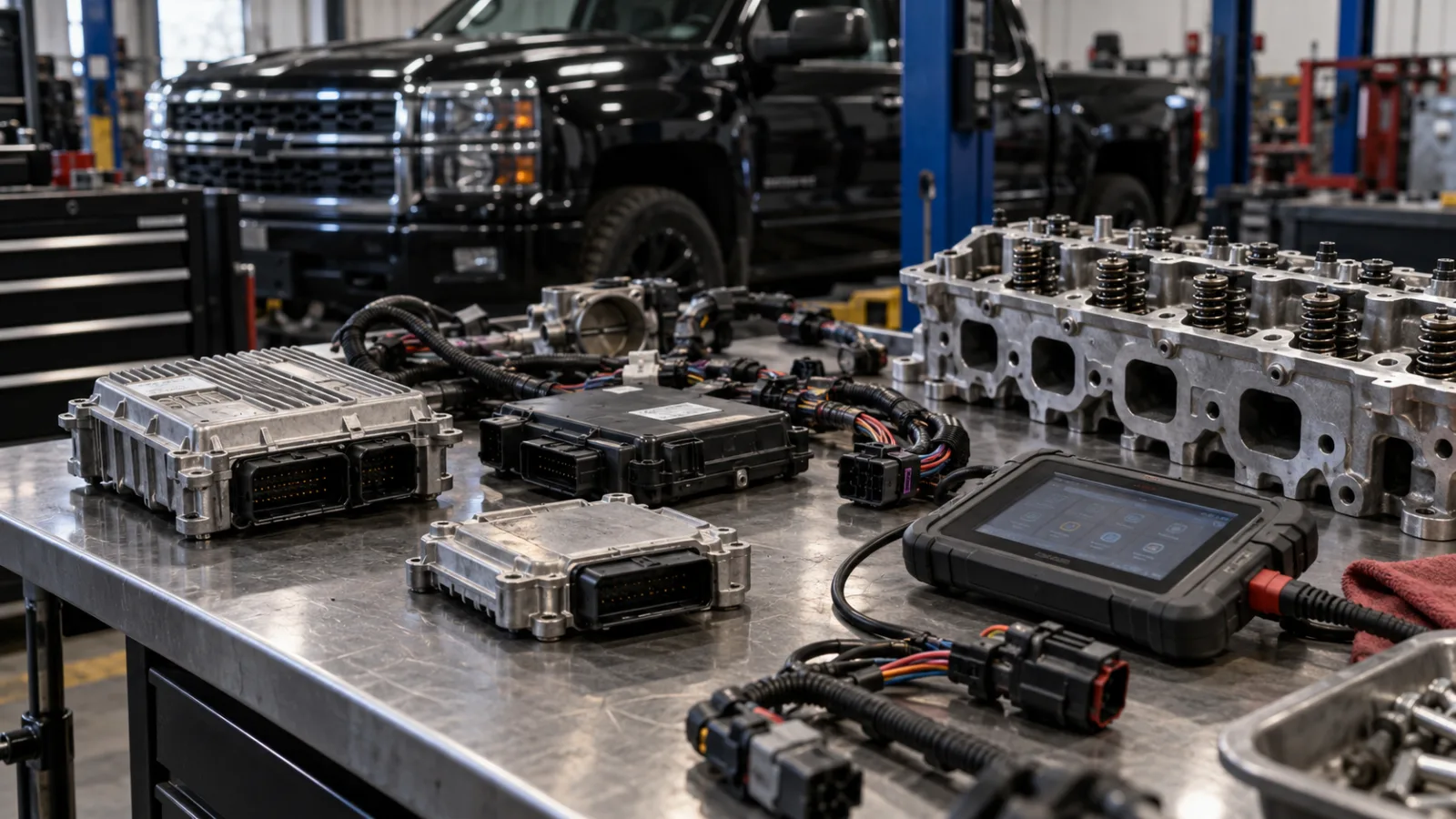
Cylinder deactivation is an engine function, and it sits inside a drivetrain decision. The engine computer proposes the reduced cylinder set; the transmission controller checks whether the moment is a safe one to change the engine's output, and if it is not, the request is declined. This is why the system can sit on a truck that clearly has it and appear to do nothing.
The transmission's objection is practical. Changing the number of firing cylinders changes torque output, and a torque change during a shift or a torque-converter event is felt as a jolt. The same logic applies to wide-open throttle, to reverse, and to the moment the converter is unlocking. None of those are times to drop four cylinders, so the system declines them and stays at full count.
There is a second, less obvious reason. The engine and the transmission in these trucks share information constantly — engine output, transmission state, drive mode, and the driver's own selection. A solution that only understands the engine's side of that conversation is working with half the information the vehicle is using to decide. This is not a theoretical objection; it is why the same product behaves differently on an 8-speed truck and a 10-speed truck even when the engine is the same shape of thing.
It also gives you the only genuinely free method of holding the system off. Put the transmission in manual mode and keep it in a gear above the threshold at which deactivation would engage. The request still goes out, the transmission keeps declining it, and the engine stays on all its cylinders. Nothing is changed, nothing is written, and the behaviour ends the moment you return the transmission to automatic — which is a genuinely useful thing to know, because it lets you decide whether the system is the cause of something you are chasing before you spend anything finding out.
AFM and DFM are not the same system
Dynamic Fuel Management, usually written DFM, is the same idea as Active Fuel Management running on a different generation of hardware. Both are GM cylinder deactivation. Both take a V8 down to four cylinders under light load. The difference is in how the request reaches the lifters, and that difference is large enough to decide whether a given device does anything at all.
The practical tells for which system an engine carries are the transmission and the model year rather than the badge. The earlier generation pairs with the older automatic transmissions; the later generation is the one that arrives alongside the ten-speed, and a ten-speed truck is a different fitment problem from an eight-speed one. That pairing is why "DFM disabler" and "10 speed" turn up together so often in search terms, and why an owner with a 5.3 in a later truck can end up with a module that fits the connector, powers up, and changes nothing.
| Question | Earlier generation (AFM) | Later generation (DFM) |
|---|---|---|
| Same goal? | Yes. Fewer cylinders at light load, closed valves, reduced fuel burned at light load | |
| Typical pairing | Older automatic transmissions, earlier platform years | The ten-speed automatic, later platform years |
| Control interface | The earlier deactivation command structure | A different command structure, and a different answer to the same request |
| Why it matters to you | A module built for one generation generally has nothing to say to the other. Correct engine family and transmission are both needed before a purchase makes sense | |
There is a third name still in circulation: displacement on demand, usually written DOD. It is what General Motors called the arrangement before it became Active Fuel Management, so it belongs in the same family, and a delete kit or a module described for one name is often described for the other. The distinction worth keeping is not the name but the command structure. A vehicle built before the electronic arrangement has no request to intercept and no solenoid to convince, and any solution sold on the assumption that one exists will fit nothing and do nothing.
The search terms for this are genuinely muddled, which is exactly why this page exists. You will see Active Fuel Management, Dynamic Fuel Management, GM V8 cylinder deactivation, DOD and DFM used as if they were synonyms, sometimes in the same sentence, sometimes on the same product page. They are not synonyms, and the practical consequence of treating them as if they were is a purchase that arrives, installs, and leaves the truck behaving as though nothing was done.
Reliability comparisons between the two generations are worth handling carefully, because the defensible position is that the difference is a matter of architecture rather than of a track record. The later generation does fewer transitions for the same work in some conditions and has a different failure profile, and a vehicle that has run the later system is not carrying the accumulated duty of one that ran the earlier one for years. What neither generation has is a published long-term figure, so any confident ranking of the two is somebody's impression rather than a measurement.
Which vehicles carry it, and which years
The vehicle list behind this page is the most reliable answer available, because it is built to be checked against a specific truck rather than quoted generally. It covers Chevrolet, GMC, Cadillac, Buick, Pontiac, Saturn, Isuzu, Saab and Suzuki vehicles built in North America, and for each one it records the make, the model, the year and the engine the system is fitted to. The three GM engine families that appear most often in it are the 5.3 litre V8, the 6.2 litre V8 and the 3.6 litre V6.
What follows is that list, grouped so it can be read rather than scanned. It is a fitment list, not a failure list, and the distinction is dealt with at the end of this section because it is the one people get wrong most often.
Trucks and full-size SUVs with the V8
| Vehicle | Engines on the list | Years |
|---|---|---|
| Chevrolet Silverado 1500 | 5.3L V8, 6.0L V8 | 2007–2013 |
| Chevrolet Silverado 1500 | 4.3L V6, 5.3L V8, 6.0L V8 | 2014–2018 |
| GMC Sierra 1500 | 5.3L V8, 6.0L V8 | 2007–2009 |
| GMC Sierra 1500 | 5.3L V8, 6.0L V8, 6.2L V8 | 2010–2013 |
| GMC Sierra 1500 | 4.3L V6, 5.3L V8, 6.0L V8, 6.2L V8 | 2014 |
| GMC Sierra 1500 | 4.3L V6, 5.3L V8, 6.2L V8 | 2015–2017 |
| GMC Sierra 1500 | 4.3L V6, 5.3L V8 | 2018 |
| Chevrolet Suburban | 5.3L V8, 6.0L V8 | 2007–2009 |
| Chevrolet Suburban | 5.3L V8, 6.0L V8, 6.2L V8 | 2010–2013 |
| Chevrolet Suburban | 4.3L V6, 5.3L V8, 6.2L V8 | 2015–2017 |
| Chevrolet Suburban | 4.3L V6, 5.3L V8 | 2018 |
| Chevrolet Tahoe | 5.3L V8, 6.0L V8 | 2007–2009 |
| Chevrolet Tahoe | 5.3L V8, 6.0L V8, 6.2L V8 | 2010–2014 |
| Chevrolet Tahoe | 5.3L V8, 6.2L V8 | 2015–2017 |
| Chevrolet Tahoe | 5.3L V8 | 2018 |
| GMC Yukon / Yukon XL 1500 | 5.3L V8, 6.0L V8 | 2007–2009 |
| GMC Yukon / Yukon XL 1500 | 5.3L V8, 6.0L V8, 6.2L V8 | 2010–2014 |
| GMC Yukon / Yukon XL 1500 | 5.3L V8, 6.2L V8 | 2015–2017 |
| GMC Yukon / Yukon XL 1500 | 5.3L V8 | 2018 |
| GMC Denali XL / Yukon Denali / Sierra Denali | 6.0L V8, 6.2L V8 | 2007–2017 |
| Chevrolet Avalanche | 5.3L V8, 6.0L V8, 6.2L V8 | 2007–2013 |
Cars, crossovers and the smaller trucks
| Vehicle | Engines on the list | Years |
|---|---|---|
| Chevrolet Silverado 1500 (4.3 V6 variant) | 4.3L V6 | 2014–2018 |
| Chevrolet Colorado | 3.6L V6 | 2015–2019 |
| GMC Canyon | 3.6L V6 | 2015–2018 |
| Chevrolet Camaro | 6.2L V8, 3.6L V6 | 2010–2018 |
| Chevrolet Corvette | 6.2L V8 | 2012–2019 |
| Chevrolet SS | 6.2L V8 | 2014–2018 |
| Chevrolet Caprice PPV | 6.0L V8 | 2011–2019 |
| Chevrolet Impala | 5.3L V8, 3.9L V6 | 2006–2009 |
| Chevrolet Monte Carlo | 5.3L V8 | 2006–2008 |
| Chevrolet Trailblazer | 5.3L V8 | 2005–2009 |
| Chevrolet Traverse | 3.6L V6 | 2018 |
| Chevrolet Equinox Sport | 3.6L V6 | 2008–2009 |
| Chevrolet Malibu / Malibu Maxx | 3.6L V6, 3.9L V6 | 2006–2012 |
| Chevrolet Uplander | 3.9L V6 | 2006–2008 |
| Cadillac CTS | 3.6L V6, 6.0L V8, 6.2L V8 | 2004–2018 |
| Cadillac Escalade / ESV / EXT | 6.2L V8 | 2010–2017 |
| Cadillac SRX / ATS / XTS / XT5 / STS | 3.6L V6 | 2004–2019 |
| Cadillac CT6 | 3.0L V6, 3.6L V6 | 2016–2018 |
| Buick Enclave / LaCrosse | 3.6L V6, 5.3L V8 | 2005–2018 |
| Buick Rainier / Rendezvous / Terraza | 5.3L V8, 3.9L V6, 3.6L V6 | 2004–2009 |
| Pontiac G8 / G8 GXP / G8 GT | 6.0L V8, 6.2L V8, 3.6L V6 | 2008–2010 |
| Pontiac Grand Prix / G6 / Montana | 5.3L V8, 3.9L V6, 3.6L V6 | 2005–2009 |
| Saturn Aura / Outlook / Red Line / Relay / Vue XR | 3.6L V6, 3.9L V6 | 2006–2009 |
| Isuzu Ascender / Saab 9-7X / Suzuki XL-7 | 5.3L V8, 3.6L V6 | 2005–2009 |
What the years tell you
The search phrasings for this section are worth pre-empting, because they are the same question asked repeatedly. When did GM start AFM, when did GM start active fuel management, when did GM start using AFM, when did Chevy start AFM, when did Chevy start active fuel management and what year did Chevy start active fuel management all resolve against the same list. So do the narrower ones: what year did AFM start on the 5.3, when did GM start AFM on the 5.3, what year did GM start AFM on the 5.3 and when did AFM start on Chevy are all answered by the 2007 truck programme below, as is when GM start cylinder deactivation Silverado 1500 — the half-ton programme picks it up with the 2007 model year. What year a Silverado does not have AFM is the other side of the same line: before 2007 it does not, whatever the badge says. A 2010 Silverado or Sierra is also worth singling out, because it is the first year the 6.2 litre appears in the truck fitment.
Chevy active fuel management and Chevrolet active fuel management are the same question, and so is chevrolet cylinder deactivation: all three are asking when a particular truck got the system. Active fuel management years, when GM started AFM and what year Chevy started active fuel management all resolve against the list above — 2004 and 2005 for the earliest cars and crossovers, 2007 for the half-ton trucks, and the 5.3 continuing through 2018 on the pickup programme.
Two patterns are worth pulling out of that list, and both of them answer the questions people actually search for: what year did GM start using AFM, and which years are worth being careful with.
The first pattern is the start date. On that list, the earliest GM vehicles carrying the system are 2004 and 2005 model years — the Cadillac CTS, the Buick Rendezvous and the Chevrolet Trailblazer are all on it from 2004 or 2005, and the truck programme picks the system up from 2007. So the defensible answer to when GM started cylinder deactivation in North American cars is the middle of the last decade, and for the half-ton trucks it is 2007.
The second pattern is where the deactivating-bank duty is concentrated, which is the part that matters if your question is which years to be careful with. Duty accumulates with transitions, and the number of transitions follows how much of the vehicle's life is spent at light load in a gear the transmission allows.
| Group | Why the duty concentrates here |
|---|---|
| 5.3 AFM years to avoid, 6.0 AFM years to avoid, 2007–2013 | The heaviest towing and commuting use of this engine sits in this window, and it is where the system is cycling constantly between a towing load and a stop. Stop-and-go is the worst case for the feature |
| 6.2 AFM years to avoid, 2010–2017 | The most powerful engines on the list spend the most of their time at a light load relative to their capacity, which is the condition the feature is looking for |
| 3.9L V6, 2006–2009 | A short-lived, lightly sold engine that appears on the list in a narrow window. If you own one, it is old enough that age, not the system, is the dominant variable |
| 4.3L V6, 2014–2018 | Two cylinders stopping out of six is the mildest version of the system, and the one where the whole thing is easiest to live with |
Two details in that list are worth flagging because they generate a lot of confusion. A 3.0 litre engine appears in it, in a Cadillac CT6 from 2016 to 2018 — and that is a petrol V6 with cylinder deactivation, which is a completely different machine from the 3.0 litre Duramax diesel in a Silverado, which has no such system. People search for one and buy for the other with some regularity. And a 4.8 litre V8, which turns up in a lot of the same searches, is not on the list at all, which saves anyone looking at one a purchase they did not need.
How to confirm what your own engine has
The fitment list narrows it down. Four things settle it, in increasing order of effort, and the first one is usually enough.
How to tell if a vehicle has active fuel management without opening anything: the exhaust note on a steady light-load cruise is the whole test. Four fewer cylinders firing is audible on every V8 in the list, and the low-speed shudder arrives with it. Where a build is ambiguous — an unlisted year, a market variant, a swapped engine — a GM active fuel management VIN code check settles it outright, because the engine code in the build record names the generation as well as the presence.
The build sheet. The engine code on the door jamb, the VIN, or the build record for the vehicle answers the question outright. On these engines the code is the useful part, because it tells you not only whether the hardware is present but which of the two generations it belongs to.
The reduced-mode test. Take the vehicle onto a steady light-load cruise and let the transition happen. A V8 dropping to four cylinders is unmistakable in the exhaust note, and the shudder at low speed comes with it. If the note never changes on a steady cruise, the system is either absent or permanently held off, and those are very different starting points.
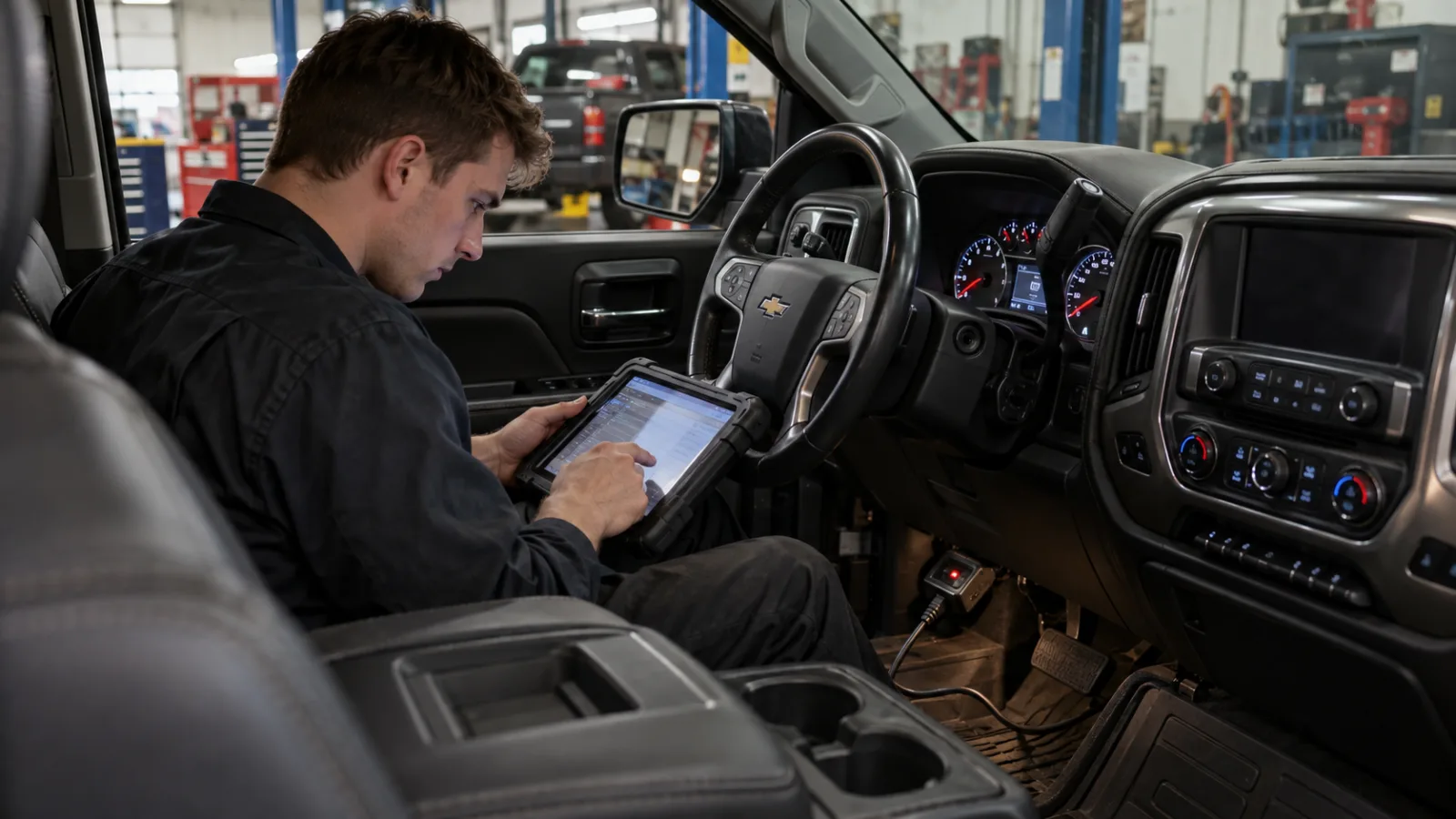
Which cylinders drop out. A scan tool that reports the reduced-mode cylinder list, or a running compression test with the system behaving normally, gives the actual numbers for your engine instead of a remembered pattern. This is the step that also produces the data a later diagnosis needs.
What you find when you look for a solution. This is the practical test, and it is worth doing before a purchase rather than after. If the interface does not match the generation, the module fits, powers up, and changes nothing — and the cheapest way to find that out is to compare the engine family and transmission against the list above, not to discover it on a driveway.
That list is also the shortest route to the other question, which is which GM engines do not have AFM. The 2.7 litre turbo four, the 3.0 litre Duramax diesel and the 4.8 litre V8 are all absent from it — does GM 4.8 have AFM, does the Chevy 2.7 have cylinder deactivation and does the 3.0 Duramax have it all have the same answer — and a search for cylinder deactivation on a 5.3 or a 4.3 or a 6.2 leads to a positive answer. Where a build is not clear from the outside — an unlisted year, a swapped engine, a market-specific variant — the engine code on the door jamb settles it, and the reduced-mode test confirms it in a minute.
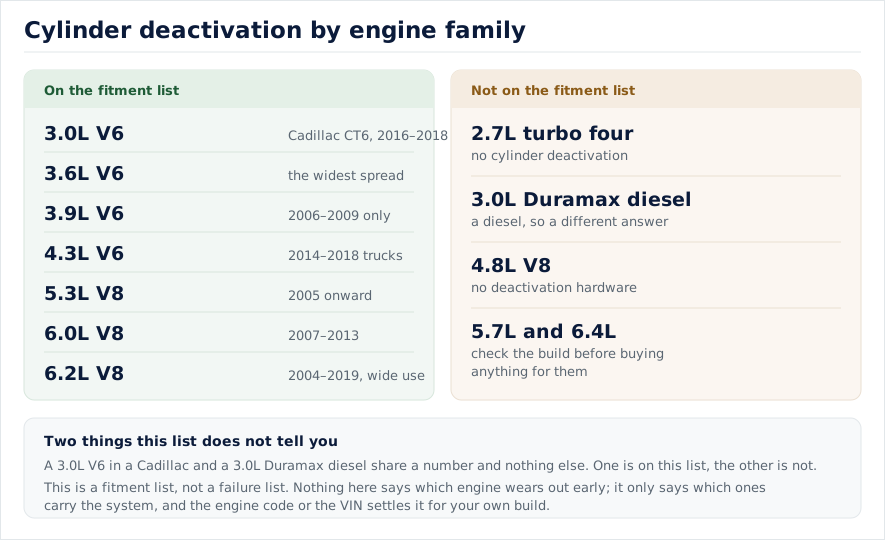
Why your truck or car has it, what it does to the engine while it is off, and whether a stored code means anything are all separate questions, and the moment the answers start to blur is when a correct purchase turns into a wasted one. If the system is present and behaving, the next thing worth knowing is not how to remove it but where the wear actually happens, which is the subject of the next section.
Why the lifter is the weak point
Everything else about cylinder deactivation is designed around one component. The lifter on the inactive bank is the part that has to move twice as often as it would otherwise, and it is the part that has to do it under conditions it was not designed for: without combustion above it, without a pressure wave in the bore, and with its own oil supply being reassigned somewhere else.
What a transition actually costs the hardware
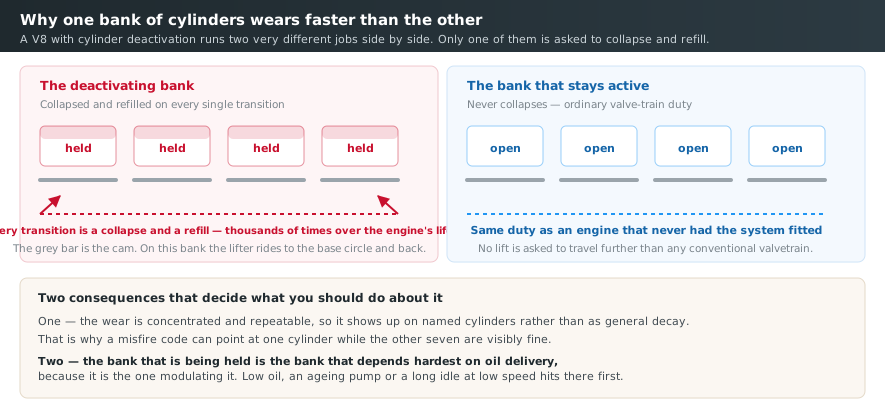
Every time the engine changes between the full set and the reduced set, the deactivating lifters collapse and refill. Collapsing means the lifter body has to release its hold on the cam and let the bucket down; refilling means the lifter has to fill with oil and push the bucket back up against the cam. Neither of those is a free movement. Both involve oil moving somewhere it was not sitting a moment earlier, and both happen at a rate set by how often the vehicle spends its life at light load.
That last part is the whole story. The hardware is not fragile in the sense of being weak; it is exposed in the sense of being asked to do more cycles than a non-deactivating lifter would ever do. An engine that spends its life towing spends a small fraction of its time in the condition that triggers the system, and an engine that spends its life in traffic spends a large fraction of it there. Same engine, same lifters, very different number of transitions.
What the system does not stress
It is worth being equally clear about the parts of the engine that the system leaves alone, because most of the anxiety around this feature points at components it does not touch. The live bank does exactly what it would do in an engine without the system, all the time. The pistons, rods, crankshaft and the entire fuel and ignition system run the same three-quarter duty as always. The exhaust valves on the inactive bank open and close at low frequency, which is not a wear concern.
The genuine concentration is in three places: the deactivating lifters, the oil passages that feed them, and the cam lobes those lifters ride. Oil is the connective tissue here — a lifter that is not properly filled collapses slowly and loses contact, and a lifter running aerated oil behaves the same way. That is why oil condition and oil pressure belong in any conversation about this system, and why an oil change interval is a bigger lever on this hardware than anything you can buy to switch the system off.
Where this leaves the diagnosis
If the hardware has done a lot of transitions, the failure that eventually shows up points at a specific cylinder, and it shows up in one of a small number of ways: a misfire code that returns, a tick that follows engine speed, or compression that does not match the rest of the bank. Deciding which of those is happening is a diagnostic problem, not a purchase problem, and the reasoning behind it is set out on the symptom and code page. What belongs on this page is the mechanism, because the mechanism is what tells you whether the hardware is a plausible explanation for what you are seeing at all.
What the system is actually saving
The feature exists to reduce fuel burned at light load, and it does that by making the inactive cylinders consume nothing. The saving comes from two places: less fuel is injected into cylinders that were not going to contribute, and the pumping losses that would come with drawing air through a closed throttle are avoided by closing the valves rather than leaving them open.
That last point is the more interesting half. A closed valve is a much better off-idle state than an open one, and the reason the system bothers with lifters and solenoids instead of just cutting fuel is that it removes the pumping work as well. The cost of that arrangement is the valvetrain duty described in the previous section, which is the trade the design makes and the reason the trade is discussed as often as the benefit.
Two things follow that are worth stating plainly. The first is that the saving only exists while the system is active, which means a truck with the system permanently held off is a truck with no off-idle efficiency feature at all. The second is that the saving is largest exactly where the system is doing its job — light load, part-throttle, low speed — and smallest where people tend to measure. A vehicle used mostly for towing and highway running has relatively little of the benefit to lose; a vehicle used mostly for city and suburban driving has a great deal. That is a usage question, not a vehicle question, and it is the fair way to answer whether holding the system off costs you anything.
The three places a solution can sit
There are three ways to keep the deactivating bank on, and they differ in where they act, in what they change on the vehicle, and in how you get them back.
Holding the transmission in manual
The free method, and the one most people never try. Put the transmission in manual and hold a gear above the deactivation threshold, and the request is made and declined on every light-load event. Nothing is written, nothing is fitted, and the behaviour stops the moment you shift back to automatic. It is a diagnostic instrument as much as a solution: if the shudder, the exhaust note or a drivability complaint disappears while you hold it, the system is involved, and if it does not, you have just saved yourself a purchase.
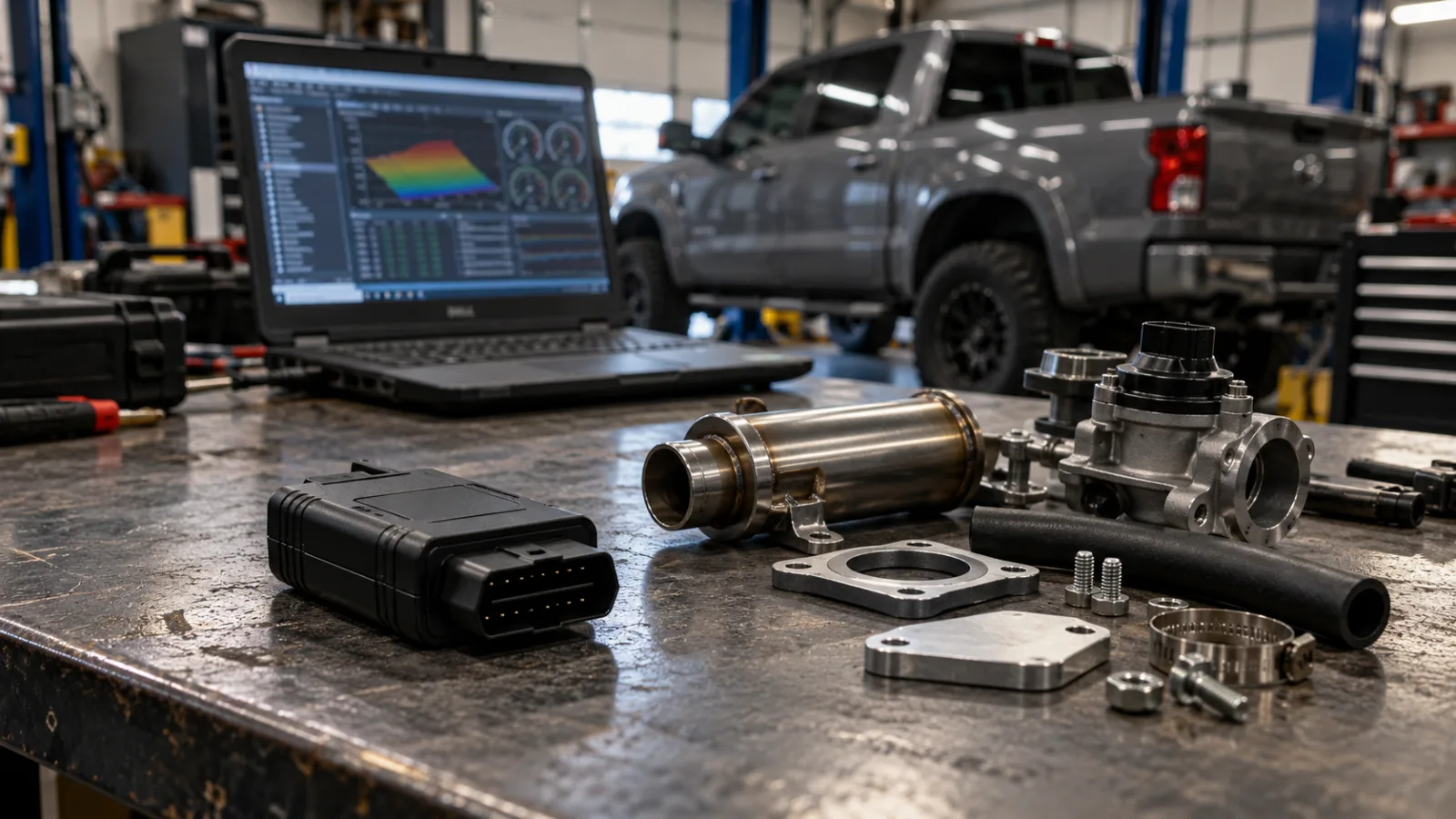
A plug-in module
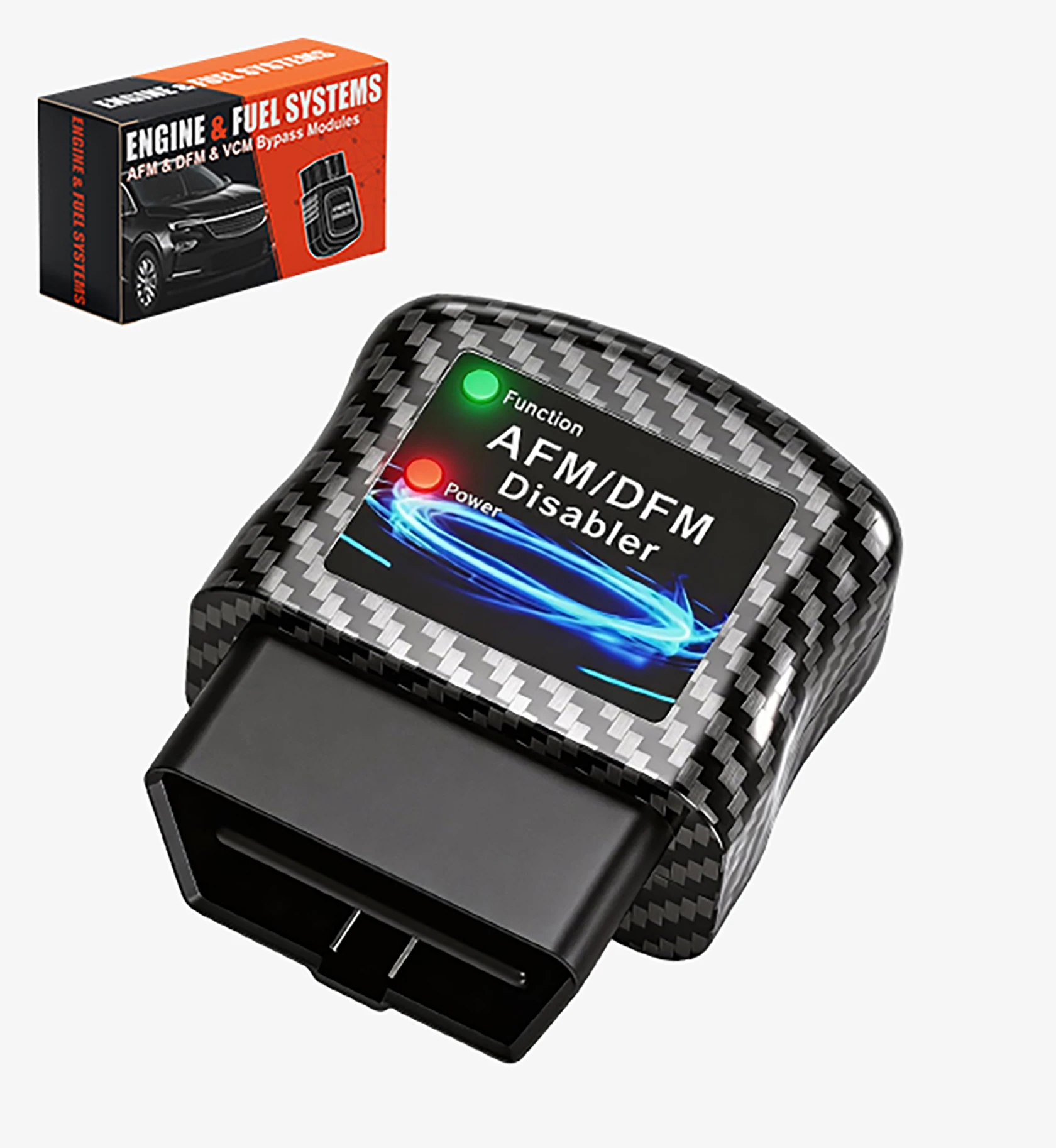
A device on the diagnostic connector that intercepts the deactivation request and never agrees to it. This is the only solution that can be removed without a trace: unplug it and the truck behaves exactly as it did before, because nothing was written to anything. It also sits at the cheapest point in the chain to intercept, and it is the only approach that does not require knowing which generation of the system the engine carries beyond confirming that the interface matches.
The limitation is equally clear. It only holds the system off while it is fitted, it does nothing to hardware that has already worn, and a stored code that appears afterwards is not evidence that it failed. What a plug-in device does and does not do to a truck that is misbehaving is covered in full on the troubleshooting page.
A change to the engine software or to the hardware
Two further routes sit further down the chain. A software change alters what the engine commands, and a mechanical delete changes what the hardware can physically do — neither of which can be undone by unplugging anything, and both of which change the vehicle's behaviour permanently. They are permanent solutions with permanent consequences, and they are the right answer for a vehicle being kept for a long time, built a particular way, rather than for a single truck that is going to be sold on.
Which of the three is right for a particular vehicle depends on what problem is actually being solved, how long the vehicle is being kept, and what happens to it when it is sold. The costs, the reversibility and the trade-offs of each are compared side by side on the decision page, which is written for someone who already knows what the system is.
What a solution is actually called
A disabler, a bypass module and an OBD plug-in are the same removable part under three names: it sits on the diagnostic connector, sees the deactivation request come through, and does not agree to it. A delete and a deleter are a different category, because the name belongs to a permanent change. Reading the description rather than the label is the only reliable way to tell which one is on offer, since the word disabler in particular gets used for everything from a removable module to a software change.
One question comes up constantly and it has a concrete answer. If a vehicle that should have the system shows no reduced-mode event in the scan data, no exhaust-note transition on a steady cruise and no transition noise at a stop, then the system has already been switched off permanently. All three absent means the change was made. All three present means it was not.
What the system does not do
Most of the confusion around this feature is a repetition of six specific beliefs, each of which is either wrong or half true in a way that causes expensive mistakes.
| The belief | What is actually true |
|---|---|
| A fuse disables it | There is no fusible link in the chain. Step 2 is a message and step 4 is hydraulic, so a body fuse changes nothing about the system and only removes something else the vehicle needs |
| The shudder means a lifter is failing | On a vehicle with the system the transition shudder is the exhaust valves on the inactive bank working. A lifter problem does not sound like that, and it does not clear on throttle |
| Turning it off improves fuel economy | It cannot. The system saves fuel by running fewer cylinders at light load, so removing it removes the saving. A consumption figure that does not change afterwards is the expected result |
| A code after a delete means the delete failed | A stored code after a software change is common and means the change is visible, not that it is broken. What matters is whether the system is being held off, and how the engine runs |
| The 3.0 Duramax has it too | It does not. The 3.0 litre V6 in a later Cadillac is a petrol engine with cylinder deactivation; the 3.0 litre Duramax is a diesel without it. Same displacement, opposite answer |
| Delete, disable and tune are the same thing | They act at different points in the chain and differ in what they leave behind on the vehicle. A delete is permanent, a module is removable, and a software change is a third thing again |
Two near-misses deserve a line each. A Dodge cylinder deactivation system does not exist in the GM sense: what comes back is a different manufacturer's variable-displacement engine, which is a different mechanism under a different name. And cylinder deactivation alongside i-stop, or stop-start, is one idea applied to two separate systems, which is why a solution for one does nothing for the other.
Two more things are true and worth stating, because they are the ones people most often want to hear.
A healthy engine does not need the system switched off. The system is a fuel-economy feature doing what it was built to do, and most vehicles with it never have a problem at all. What is true is that the deactivating lifter's duty keeps accumulating, so the exposure grows with age and with how the vehicle is used.
And nothing about the system, on its own, is what makes a vehicle need a repair. The part worth watching is the lifter on the deactivating bank, and the part worth doing about it is knowing what the engine currently consumes and whether that figure is drifting — because a change in consumption shows up as a trend, and a trend is the only warning that arrives before a code does.
What this guide covers, and what it does not
This page stays on the mechanism and the fitment. It covers what the system is, how the request travels from the engine computer to the lifters, which cylinders stop, which engines and model years carry the hardware, and the four ways of confirming what a specific engine has.
It deliberately leaves four other questions to their own pages, because answering them here would mean restating facts that are already written once and would then drift out of date on a separate schedule.
| Question this page does not answer | Where it is answered |
|---|---|
| What a misfire code or a ticking valve train actually means, and how to confirm the cause | AFM lifter failure symptoms and codes |
| Why a device is not doing anything, and how to tell which of the causes it is | AFM disabler problems |
| Which of the three solutions suits a particular vehicle, and what each one costs and leaves behind | Disabler, delete kit or tune |
| What each vehicle on the list needs, and which product fits which build | The vehicle list behind this page |
What is left out is not less important, only better placed. If you arrived here because a lamp is lit and the engine is ticking, none of these four is the next step yet, and the first section of the symptom page is the right place to start.
Frequently asked questions
The questions that come up once the system exists on the vehicle is understood:
What is active fuel management?
It is cylinder deactivation: a V8 running on four of its eight cylinders, or a V6 on two of its six, when the load is light. The system holds the lifters of the inactive cylinders down so their valves stay shut and nothing fires in those bores. It is a fuel-economy feature, and the reduced set is the reason a V8 truck's exhaust note and vibration change at a stop.
What year did GM start active fuel management, and when did the 5.3 get it?
The earliest North American GM vehicles carrying it are the 2004 and 2005 model years — the Cadillac CTS, the Buick Rendezvous and the Chevrolet Trailblazer. The half-ton truck programme picks it up from 2007, which is where most owners meet the system, and the 5.3 litre V8 in those trucks is the engine most questions are about. The 5.3 itself does not stop there: it stays on the list through 2018 on the pickups, with the 4.3 litre V6 joining it from 2014.
What is the difference between AFM and DFM?
Same goal, different generation. AFM is the earlier electronic system; DFM is the later one. The goal, the visible behaviour and the group of cylinders that stop are the same, but the control interface is different, which is why a device built for one of them will generally have nothing to say to the other. Engine family and transmission are both needed to tell which you have.
Which cylinders are affected on a 5.3?
One bank of the V8, so four of eight cylinders. The specific numbers in that bank depend on the engine, and the reliable way to read them for your own truck is a reduced-mode readout from a scan tool or a running compression test, rather than a pattern quoted for a different 5.3.
Do all GM V8s have cylinder deactivation?
No. On the fitment list behind this page the V8 families are the 5.3, 6.0 and 6.2 litre engines. The 4.8 litre V8 is not on that list, which is worth knowing because it appears in a lot of the same searches as the ones that are.
Does the Chevy 4.3 have AFM?
It appears on the list for 2014–2018 in the Silverado 1500, the Suburban, the Tahoe and the Yukon. It is the mildest version of the system, because two cylinders out of six is a smaller change than four out of eight, and it is the version owners most often do not notice at all.
Does the 6.2 have AFM, and which cylinders does it deactivate?
It does, and it is one of the families where the reduced set is used most often. It appears across a wide spread of vehicles between 2004 and 2019, including the Camaro, the Corvette, the CTS, the Escalade, the SS and the Denali models. As with any V8 it is a whole bank that stops, and the numbers for that bank are engine-specific.
Does the 3.0 Duramax have cylinder deactivation?
No. It is a diesel and it has no such system, so a Duramax owner is looking at a different problem from the same search. The confusion comes from the 3.0 litre V6 in a later Cadillac, which is petrol, carries the system, and shares only the displacement figure.
Does the Chevy 2.7 have cylinder deactivation?
No. The turbo four is not on the fitment list behind this page. If a vehicle with one is behaving as though the system is switching cylinders off, the noise is coming from something else, and the exhaust-note test described above is the fastest way to rule the system in or out.
Does the Chevy 5.3 Ecotec have cylinder deactivation?
Yes — does the 5.3 Ecotec have AFM? Where the 5.3 is in the fitment list, it does — that is the 2007 to 2018 half-ton truck, the Trailblazer and the Envoy-era 5.3, and the 5.3 in the Impala, Monte Carlo, LaCrosse and Grand Prix. The fitment list behind this page records the engine per vehicle rather than the badge code, because the same badge covers engines with and without the system.
Does Silverado active fuel management run in every year?
On the list behind this page the Silverado 1500 carries it from 2007 to 2018, first with the 5.3 and 6.0 litre V8s and then, from 2014, with the 4.3 litre V6 alongside them. What year a Silverado does not have it is the question to answer first: a truck built before 2007, or one whose engine has been changed, is not on that list at all.
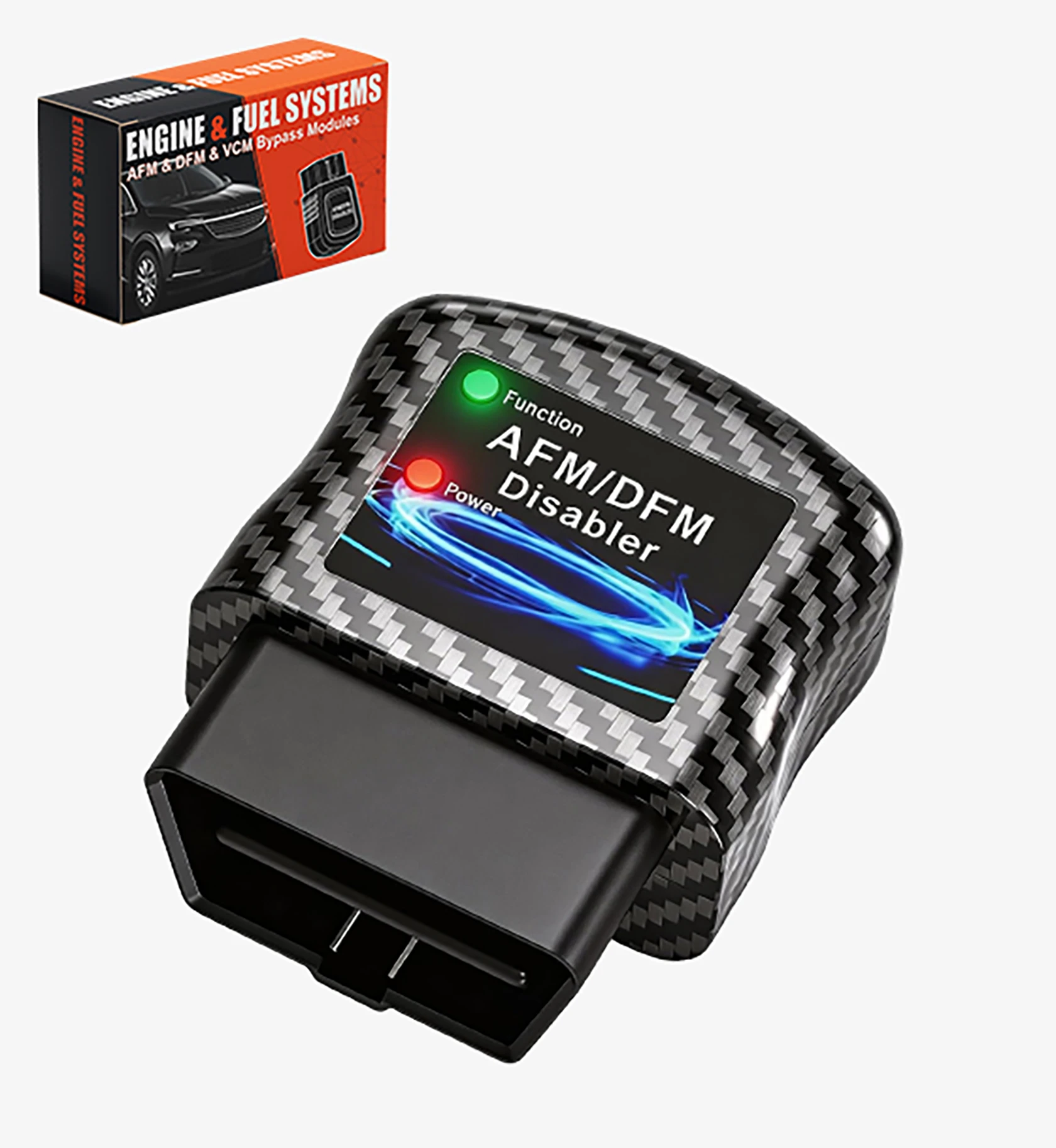
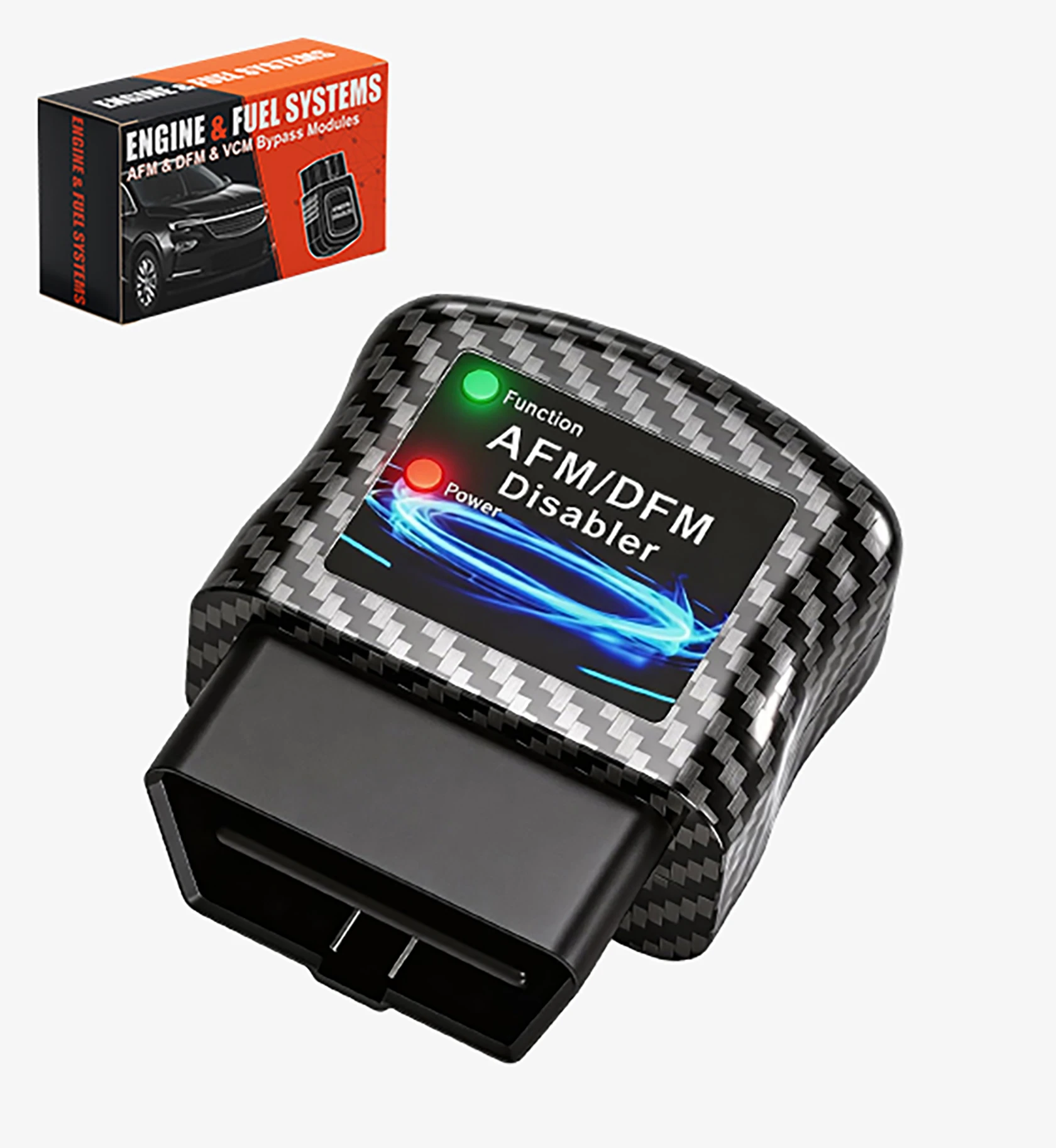
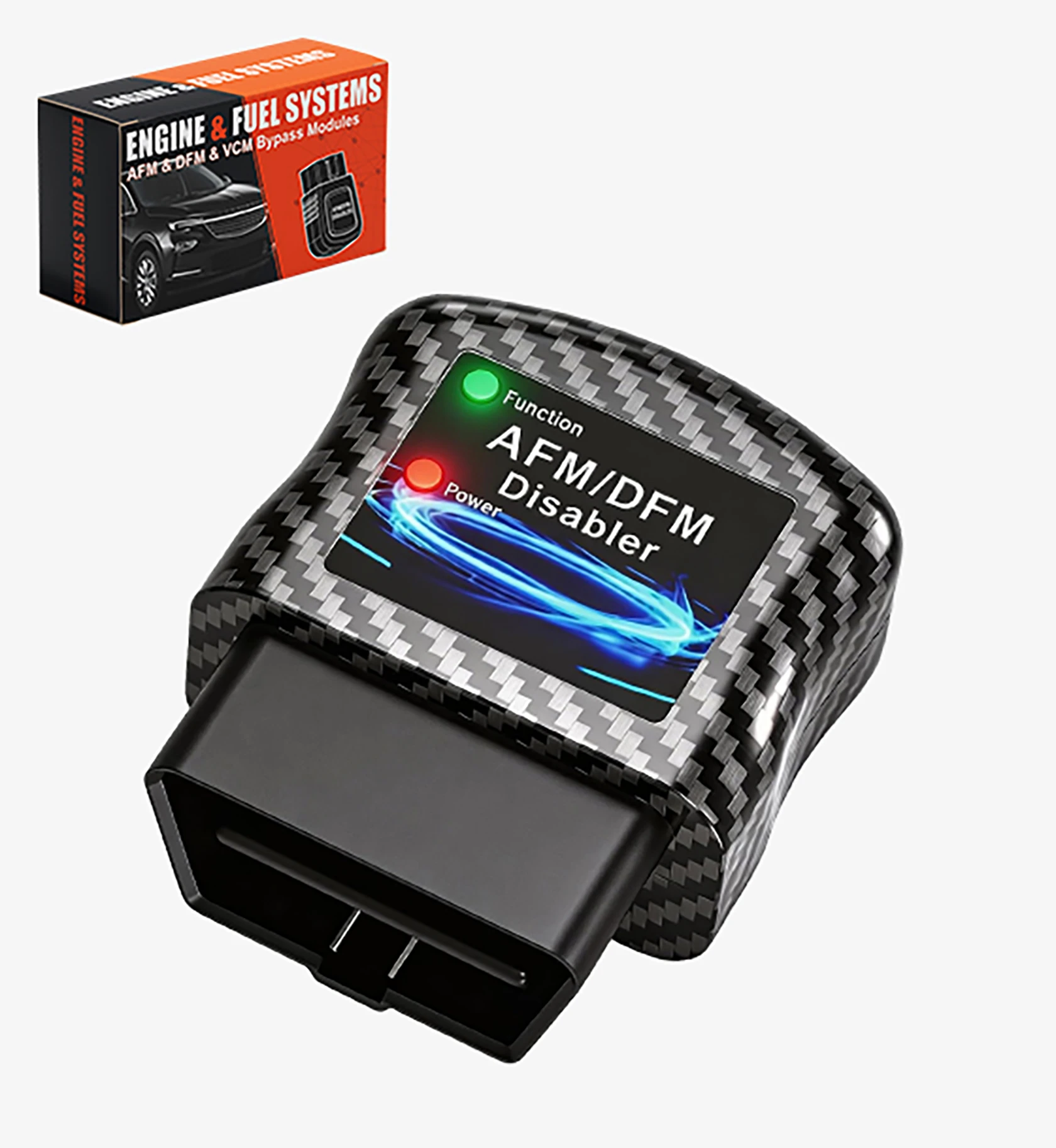
What does an AFM or DFM disabler do, and is a DFM disabler the same part?
It plugs into the diagnostic connector, sees the deactivation request come through and does not agree to it, which is why nothing is written and why unplugging it puts the truck back exactly where it started. A DFM disabler does the same job against the later generation, so it is the same kind of part pointed at a different interface — and that is the whole reason the engine family and the transmission have to match before either one is worth buying.
How do I turn off active fuel management?
Three ways, depending on how permanent you want it. Hold the transmission in manual above the deactivation threshold, which is free and ends when you stop. Fit a plug-in module, which holds the system off while it is plugged in and leaves no trace when it is removed. Or change the engine software or the hardware, which is permanent and changes the vehicle for good. The third option is the only one that survives a sale.
Can AFM be turned off by hand, with a switch or a wire?
Not by anything that only touches power. There is no fuse in the chain, because the request between the two controllers is a message and the cylinders are held hydraulically. What you can do by hand is refuse to let the request be satisfied — manual mode in the transmission does exactly that, for free.
Does turning AFM off improve fuel economy?
It cannot, and the logic runs the other way. The system saves fuel by running fewer cylinders at light load, so holding all cylinders on removes the thing that was saving it. A consumption figure that does not change after a module goes in is the expected result, not evidence of a fault. The saving is largest in exactly the driving that involves the most transitions, which is also the driving where the system is working hardest.
Is the shudder and vibration at low speed caused by the system?
On most vehicles that have it, yes — the exhaust note change and the vibration are the transition itself, not a fault developing. The transition back to full cylinders is also where the brief hesitation before full power arrives comes from. Both stop when the system is held off, which is the quickest way to tell a system behaviour from a mechanical one.
Why does my truck have the system but it never seems to activate?
Three likely reasons, in order. The transmission is declining the request, which happens whenever the vehicle is in a gear or a manoeuvre where a torque change would be felt. The operating conditions are outside the window — cold engine, high load, or a mode that suppresses it. Or the system has already been held off, either by a device or a previous change, and what you are hearing is the truck running on all its cylinders permanently.
Which 5.3, 6.0 and 6.2 model years are worth being careful with?
The years where the deactivating bank does the most transitions: 2007–2013 for the 5.3 and 6.0 litre trucks, and 2010–2017 for the 6.2 litre, because those engines spend the most of their life at a light load relative to their capacity. That is a statement about accumulated duty, not a prediction about which engine will fail, and the fitment list behind this page carries no failure data at all.
 Chevrolet Silverado 1500
 GMC Sierra 1500
 Chevrolet Tahoe
 GMC Yukon