The Short Answer
P0420 reports a comparison, not a part. It says the signal after the converter looked like the signal before it — and that is consistent with three entirely different faults, only one of which is the converter. Testing the order before you order the part is the whole decision.
| What you are looking at | Establish this first | What the result tells you |
|---|---|---|
| Code alone, engine otherwise healthy | Whether the signal after the converter is copying the one before it | Mirroring means the buffer is gone. A flat line means the reading, not the part, is at fault |
| Code with misfire or trim codes | Which codes are stored together, and whether they are pending or set | The converter is a casualty. Replacing it alone puts a new part in front of the same cause |
| Code with oil going missing between fills | How the level moves across two or three measured intervals | The substrate is being coated from inside the exhaust. A replacement runs on a clock |
| Code after exhaust or sensor work | Whether anything was disturbed between the two sensors | Introduce false oxygen and the computer reads it as a failing converter |
What this page is for. It takes the code apart — what the computer actually compared, and what it can and cannot prove — then gives the testing order that settles which of the three faults you have, and finishes with the conditions a replacement needs before it will last. If your engine's question is about oil rather than a code, how cylinder deactivation works is the background that explains where the oil comes from.
What P0420 is actually reporting
The code is a sentence about two waveforms, and it has been shortened to a part name in almost every place you will read it. The full sentence matters, because the part is only one of the three things that can complete it.
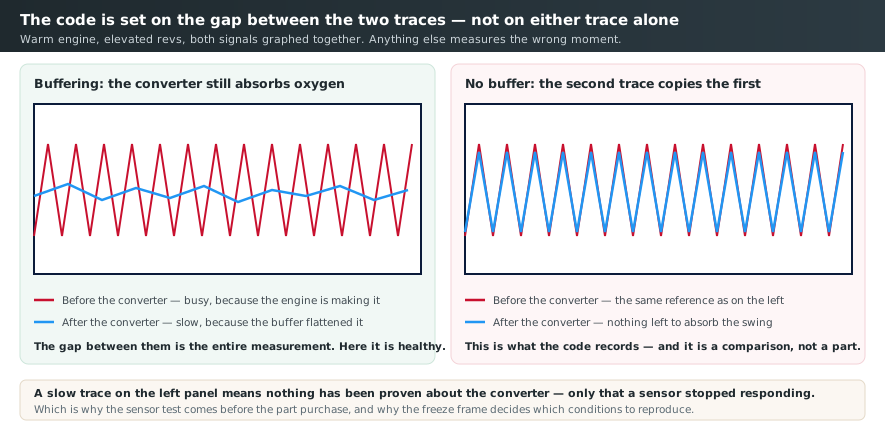
There are two sensors in play. The one before the converter is watching exhaust that the engine has just produced, and it moves constantly — the computer trims fuel back and forth against it, so its signal looks like a busy waveform with a rhythm you can see. The one after the converter is watching the same exhaust after it has passed through a ceramic block that absorbs oxygen and releases it on demand. That block is the buffer. While it still has capacity left, what comes out the far side is smoother than what went in, and the rear sensor therefore moves slowly, sitting in a narrow band without following the front one.
That difference between the two signals is the entire measurement. The computer either compares how long each signal spends above and below its threshold, or it deliberately depletes the stored oxygen and watches how long the rear sensor takes to notice it coming back. Either way it is measuring one property: how much the buffer still buffers. When the buffer is worn or coated, the rear signal starts to resemble the front one, and the code sets.
What the rear sensor is really reporting
A flat rear signal is the healthy finding, and it is worth being precise about why, because it explains everything else here. The rear sensor is not measuring how clean the exhaust is in any absolute sense. It is measuring what is left over after the buffer has done its work, and a buffer that still has capacity will flatten almost any exhaust you feed it. A converter that has been lightly degraded can still flatten the signal on a steady cruise and only show the problem when the computer runs its deliberate test.
The consequence is that the code does not describe a moment of driving. It describes the result of a specific test performed under specific conditions, which is why the freeze frame matters more than the symptom. What the engine was doing tells you what the computer was able to observe, and what it was not able to observe.
What the comparison proves, and what it cannot
What it proves: the rear signal was not flattening the front one at the moment of the test. That is all. It does not identify the converter as the cause, because a sensor that does not respond correctly produces the same comparison, and a leak that puts fresh oxygen between the two sensors produces it as well.
Holding on to the distinction between what the computer measured and what caused it is the difference between buying a part that holds and buying a second one. The measurement is a symptom with three possible authors, and the rest of this page separates them.
Three families of cause, and they are not interchangeable
Everything that produces this code belongs to one of three groups, and the groups need completely different work — so much different that one of them does not involve the converter at all. Misidentifying which group you are in is how people buy parts twice.
The grouping is not by how common each one is. It is by what the repair looks like: one group is a reading problem, one is a contamination problem, and one is a heat problem. You cannot fix a reading problem by replacing a part that was reading correctly, and you cannot fix a contamination problem without stopping whatever is doing the contaminating.
Family one: the measurement itself is wrong
The rear sensor has aged and responds slowly, so it no longer distinguishes a working buffer from a dead one — it reports the same flat line either way, or reports a slope where none exists. The front sensor can be at fault too: a slow front signal feeds the computer a distorted picture of what the engine is doing, and the comparison is built on a signal that was never accurate. Wiring, connector corrosion and a heater circuit that no longer brings a sensor to temperature quickly enough all land here.
The third member of this family is the exhaust itself. A leak anywhere between the two sensors lets outside air into the stream, and the rear sensor sees oxygen the converter never put there. The computer reads extra oxygen as a buffer with no capacity. A leak ahead of the front sensor instead distorts the fuel strategy, which arrives at the same place by a longer route.
What makes this family distinct is that no converter replacement addresses it. The converter may be perfectly healthy, and the new part will set the same code.
Family two: the converter was poisoned
Poisoning means something physical is sitting on the coating and blocking the exhaust from reaching it. It is not wear and it is not damage from heat. The coating is still there; it simply cannot be touched by the gas it is supposed to treat.
The common sources are things the engine burns and then sends downstream: oil, which leaves ash behind when it burns, and coolant, which leaves residue that behaves the same way. Deposits from fuel and oil additives do it too, and so do sealants that were applied where they should not have been. This family is silent — the engine runs normally, there is no noise, and the only evidence is the code plus whatever is making the engine consume the material in the first place.
Family three: the converter was overheated
Unburned fuel arriving in the exhaust burns inside the converter instead of the cylinder, and the temperature rises above what the coating was built to survive. When it only runs hot, the coating goes inert and stops storing oxygen. When it runs hot enough, the substrate melts and restricts flow, which presents as a loss of power rather than a code.
Misfires are the usual delivery vehicle for this, because a cylinder that is not burning fuel is sending raw fuel out of the exhaust port. A mixture that is persistently rich does the same thing without any single cylinder misbehaving. What matters is that the code here reports a consequence of an ignition or fueling fault that has already been running for some time — the converter did not fail first.
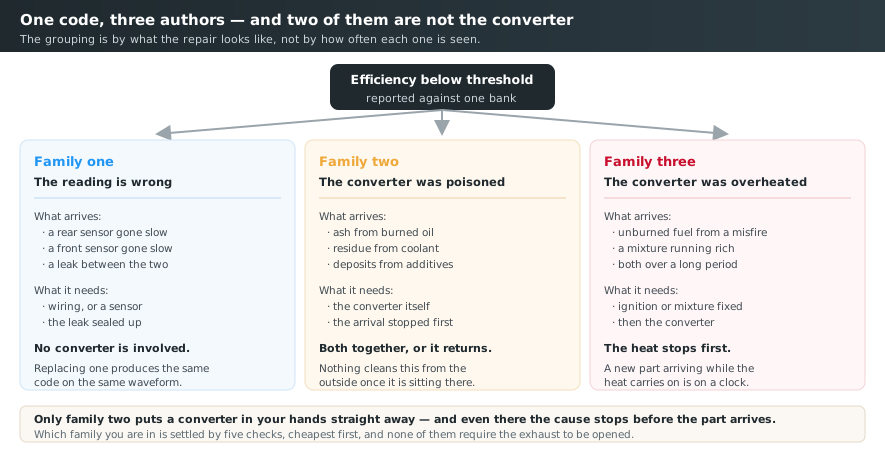
| What arrives with the converter code | Which family that puts you in | What it settles first |
|---|---|---|
| A sensor code on either position | Family one — the measurement cannot be trusted | The reading before the part. Nothing about the converter is knowable on a signal that does not respond |
| Trim codes on the affected bank | Family three, by the rich route | Why the temperature rose. The converter arrived after the mixture did |
| Misfire codes, current or historic | Family three, by the fuel route | Whether raw fuel has been reaching the converter, which dates the fault rather than naming it |
| Nothing else at all | Family two, or a genuinely worn converter | That the exhaust and the readings are clean, and that the arrival route is the dipstick rather than the scanner |
Two things are worth noticing about that table. The first row is the only one that removes the converter from the conversation entirely, and it is the one most often skipped. The last row is the one that looks like good news and is not: a clean scan with a failing converter means something physical has been arriving in the exhaust without producing any fault of its own, which is exactly what consumption does.
- Family one fixes nothing about the converter, because the converter was reading correctly the whole time. Replacing it produces the same code on the same waveform.
- Family two needs the converter and the arrival stopped together, because the material on the coating will treat the next one identically.
- Family three needs the ignition or mixture fixed before the converter, because heat does not stop when the part is swapped.
The families are distinguishable without opening anything, which is the point of the testing order later on. Each one leaves a different signature in the data, and one of them leaves a signature in the dipstick rather than in the scanner.
Why a converter dies of something else
The part that gets replaced is almost never the part that failed, and once you see the route the cause takes, the testing order stops feeling like caution and starts feeling like arithmetic.
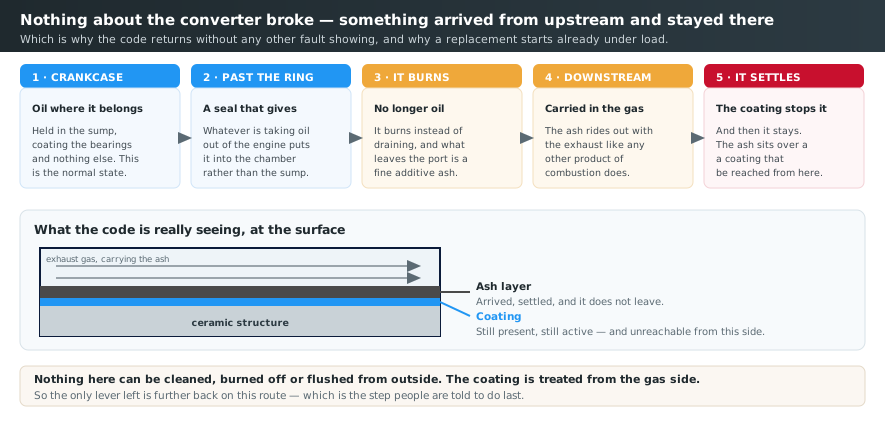
A converter is a passive object with a coating on a ceramic structure. It has no failure mode of its own that is not triggered by something arriving from the engine. What arrives is always one of three things: material it cannot treat, heat it cannot survive, or a reading that misrepresents it. Families two and three are both stories about arrival — and the arrival point is the same place the engine produces everything else it produces.
How oil gets from the crankcase to the substrate
Oil that reaches the combustion chamber is burned rather than drained, and what leaves the cylinder is not oil any more. It is a fine ash of the additives that were in the oil, and it travels in the exhaust gas until the coating stops it. From there it stays. It cannot be burned off, it cannot be washed out, and a converter cleaner cannot reach it through a structure designed to be treated from the gas side. The coating is still chemically present under the ash and simply cannot do its job.
The route matters because it tells you where to look. If oil is being consumed, the same route that feeds the converter also feeds the plugs, so a converter code arriving alongside fouled plugs or a misfire is not two events. It is one event with two observers at different distances from it.
Why a replacement dies the same way
This is the part of the conversation people are rarely told before the work is booked. A replacement converter installed while the engine is still consuming oil, still misfiring, or still running a mixture the computer is correcting for, inherits the exact conditions that removed the previous one. The new part begins its life already under the load that ended the last one, and the code returns.
That is not a case against replacement — in families two and three the converter really does need replacing. It is a case for ordering the work so that the cause stops before the new part arrives, rather than after. On an engine where cylinder deactivation is the reason oil is being consumed in the first place, the sequence is visible: how cylinder deactivation works describes the mechanism, and stopping that mechanism is what changes the timeline for the replacement.
The order to test in
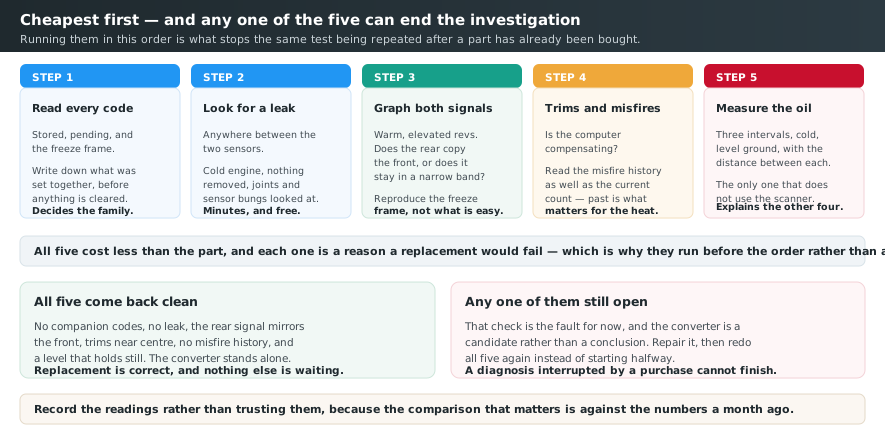
Five checks, cheapest first, and each one can end the investigation. Skipping to the expensive part is not a shortcut — it is the same investigation done at full price, and sometimes twice.
The ordering has a logic rather than a habit behind it. Everything in the first three steps costs nothing but time and can completely exonerate the converter. Step four is where you start to learn whether the engine has been running properly, and step five is where you find out whether anything is arriving in the exhaust that should not be. Only if all five come back clean is the converter standing alone as the fault.
- Read every stored and pending code, and the freeze frame. Write down what was set together, not just the headline. Codes that arrive with the converter code — trim, misfire, sensor, temperature — decide which family you are in before you touch anything, and the freeze frame records what the engine was doing at the moment of the test rather than how it behaves parked.
- Look for an exhaust leak between the two sensors. A cold engine, a listen around the joints, flanges and the sensor bungs, and a look at anything recently disturbed. Fresh oxygen entering here is read as a dead converter, and this is the only one of the five steps that can be completed in a couple of minutes.
- Compare the two signals side by side. Warm engine, steady revs, graph both. This is the single reading that tells you whether the converter is buffering at all, and it separates a genuine failure from a sensor that has stopped reporting accurately.
- Read fuel trims and the misfire counters. Trims that are pulled well away from centre mean the computer is compensating for something, and a misfire history means the converter has been running on unburned fuel whether or not the lamp recorded it at the time.
- Measure the oil across intervals. Cold, level ground, three readings with the distance driven between each. If the level is moving, you have found the arrival route and everything upstream of the converter now follows from it.
- Ordering the part before the leak check. The check costs nothing and can end the whole repair, so putting it first costs the same as putting it last — except when it ends things.
- Clearing the codes before recording them. What was set together is the fastest route to a family, and once cleared it has to be driven back into existence to be read again.
- Testing on a cold engine and calling it done. The comparison that matters only runs once everything is at temperature, so an early reading is not a result — it is a delay.
- Replacing the converter while one of the five is still open. Every one of them is a reason the new part fails, and none of them gets cheaper after the work is booked.
Two habits make those five reliable. Do all of them before any part is ordered rather than in the middle of the work, because a diagnosis interrupted by a purchase cannot be completed afterwards. And record the readings rather than trusting them to memory, because the comparison that matters is against what the numbers said a month ago, not what they say right now.
If all five come back clean — no companion codes, no leak, a rear signal that mirrors the front, trims near centre, no misfire history, and a level that holds still — then the converter is genuinely standing alone and replacement is the correct action. That conclusion is worth arriving at rather than assuming, and it is the difference between a repair that holds and a second appointment.
Reading the two waveforms
The graph answers this faster than anything else available to you, and it answers four different questions at once — provided you know which shape means which conclusion.
Everything below assumes a warm engine held at a steady elevated revs with both signals graphed together. The patterns are consistent across engines because they are a property of the measurement rather than of any manufacturer's calibration: what you are looking at is whether one signal is still flattening the other.
| What the rear signal does | What that means | What it rules in, and out |
|---|---|---|
| Slow, narrow band, barely moving | The buffer is still absorbing what the engine produces | Rules the converter out for now. Points at the reading instead — a historical or intermittent fault |
| Follows the front signal closely | The buffer has no capacity left to flatten anything | Rules in a genuinely ineffective converter, and points at why — poisoning or heat |
| Front signal is also slow to react | The reference signal itself is unreliable | Rules out the conclusion entirely. You cannot compare against a signal that does not respond |
| Both signals sit high or low together | The engine is running rich or lean and the computer is correcting | Rules in a fueling fault. The converter is downstream of a mixture problem |
The second row is the one people look for and the fourth is the one that actually saves money, because a mixture fault produces a converter code over time without the converter ever being the first thing to go wrong. A signal pair where both are sitting away from centre is describing the engine, not the exhaust.
There is a fourth question the graph answers that is easy to miss, and it is the one the freeze frame points at. The code does not set during ordinary driving — it sets when the computer deliberately runs a test on the buffer. So the conditions in the freeze frame tell you what the engine was doing at the moment of that test, and a graph taken under different conditions can disagree with the code without either being wrong. Reproduce the freeze frame conditions rather than the conditions that are convenient, and the two readings stop contradicting each other.
That also explains why a converter can set the code and then behave perfectly on the way home. A buffer with capacity left on a steady cruise may have none left when the test demands it, which means a flat signal at idle tells you almost nothing. The graph is only evidence if it was taken warm, at elevated revs, and ideally under the conditions the freeze frame recorded — anything else is a measurement of the wrong moment.
The reason this reading is placed third rather than first is worth saying plainly. It is the most informative single check available, but the two checks before it are cheaper and can end the file on their own, and a waveform taken on an engine with a leak or a code you never recorded will send you looking for a fault that was already written down. The order protects the reading as much as it protects the wallet.
One caution about the reading: a converter that has been replaced recently and sets the same code is not automatically a faulty part. A replacement that was installed with a leak still present, or on an engine still consuming oil, will produce the identical waveform — the graph does not distinguish between a part that arrived bad and a part that was ruined after it arrived. That distinction comes from steps four and five of the order.
What a replacement needs before it will last
The part is the last thing that happens in this repair, not the first, and the conditions it needs are knowable before it is ordered — which is the entire point of running the five checks first.
Those conditions are simple to state and easy to skip under the pressure of a lamp that is already on. No ongoing oil loss across measured intervals. No misfire history, current or past. Fuel trims close to centre without the computer compensating. No leak between the two sensors. Nothing recently disturbed that has not been re-checked. Each of those was a step above, and each one is a reason a replacement would fail.
Notice that none of them requires the converter to be tested twice. They are all conditions on the engine and the exhaust, which is the point: the part is not the thing being diagnosed, the environment it is about to be installed into is. Two vehicles with the same failed converter and opposite readings on that list are not having the same repair, and only one of them is finished after the bolts go back on.
If one of them is present, the correct sequence is to fix that first and re-run the checks, because the converter is not yet the fault. If none of them is present, replacement is the right action and there is no reason to delay it.
On engines where cylinder deactivation is the route by which oil reaches the exhaust, the last condition is the one that carries a decision of its own: whether to leave the system running or to stop it. That choice is set out in full on the disabler guide, and the reasons to take either route, with the trade-offs spelled out rather than asserted, are on the comparison of the three routes. What matters here is only the ordering — the cause stops before the part arrives, not after it.
A final note on symptoms worth mentioning in passing. A converter that has partially melted will restrict exhaust flow, which presents as a loss of power rather than a lamp, and that is a different conversation from the one this page covers. A vehicle that has lost power along with the code needs looking at on its own terms; a vehicle with the code and nothing else behaves exactly as described here.
What this page covers, and what it does not
This page takes one code apart: what the computer compared, the three ways that comparison can be produced, the order that separates them, and what a replacement needs to survive. It does not cover the other converter codes, the physical work, or the general diagnosis process.
What it covers: how the two-sensor comparison works and what it can prove, the three families of cause and how they differ in the kind of repair each requires, why a converter tends to be the casualty rather than the failure, the five-step testing order, the four waveform patterns and what each one concludes, and the conditions a replacement needs before it will hold.
What it does not cover: the companion codes on bank two, which are the same fault reported against a different bank, or how to physically remove and refit anything, which is work rather than diagnosis. It does not cover the general question of how to approach a diagnosis on a vehicle with several codes at once — the diagnosis guide handles that in a form that applies well beyond this fault. And it does not cover the symptom side of cylinder deactivation failures, which the symptoms page treats in detail.
There is one more boundary worth stating, because it is where most of the disagreement about this code comes from. Whether a converter should be diagnosed this way rather than replaced on the strength of the code alone is not a question about cost. It is a question about whether you want the code to stay away. A diagnosis that stops at the code answers a different question than one that stops at the cause, and the two produce very different visits to the same repair.
And a boundary on what you can conclude if the readings are not available to you. Without a graph of the two signals you can still complete the leak check, the codes, the trims and the oil measurement — which together will narrow the fault considerably and will frequently settle it. What you lose without the graph is the ability to say the converter itself is the fault rather than a candidate, and that distinction is worth having before a part is ordered rather than after.
Frequently asked questions
Does P0420 mean my catalytic converter is bad?
It means the signal after the converter stopped being flattened by it. That is consistent with a genuinely ineffective converter, but just as consistently with a sensor that no longer responds or a leak putting fresh oxygen between the two. Three causes, one code, and only two of them involve buying anything.
Can an exhaust leak cause P0420?
Yes, and it is the cheapest of the three to check. Air entering between the two sensors is read as oxygen the converter failed to store. A leak ahead of the front sensor distorts the fuel strategy instead, which reaches the same code by a longer route.
Can a bad oxygen sensor cause P0420?
Either of them can. A slow rear sensor reports the same flat line whether the converter works or not, and a slow front sensor feeds the computer a distorted view of what the engine is doing, so the comparison is built on data that was never accurate. Graph both before you conclude anything.
Will a new oxygen sensor fix P0420?
If the sensor was the fault, yes, and nothing else needed changing. If the converter was the fault, it will not clear the code at all. That is precisely why the sensor test comes before the part purchase rather than after it.
Can oil burning cause P0420?
Directly, and it is the route that matters most on engines where cylinder deactivation is consuming the oil. Burned oil leaves ash on the coating, the coating stops being reachable by the exhaust, and efficiency falls. The code is correct; the cause is somewhere ahead of it in the exhaust.
Can coolant cause P0420?
Yes, by the same route as oil. Anything the engine burns and sends out of the exhaust port ends up on the coating, and coolant that reaches the chamber leaves residue that blocks it. Unlike an oil loss you can see on a dipstick, a coolant problem often shows elsewhere first.
Will a converter cleaner fix P0420?
Not once material is sitting on the coating. The structure is treated from the gas side, which means anything already deposited there cannot be reached or burned off. A cleaner that promises otherwise is not addressing what the code reports.
Can a misfire cause P0420?
It is one of the more reliable ways to get there. Unburned fuel burns inside the converter rather than the cylinder, the temperature rises past what the coating survives, and the code arrives later as a consequence of an ignition fault that was already present.
Why did P0420 come back after I replaced the converter?
Almost always because something arrived after it: the oil is still being consumed, the misfire is still occurring, the leak is still present, or the sensor was never tested. The new part inherited the conditions that removed the old one. Re-run the five checks in the order above rather than assuming the part is faulty.
Can I drive with P0420 on?
The code on its own does not make a vehicle unsafe. What changes that answer is anything travelling with it — a flashing lamp, a misfire, or a loss of power. Those have failure modes that get worse with distance, and the code itself is a report about efficiency rather than about safety.
Is P0420 a fail on an emissions test?
It normally is, because the monitor that sets it is the one being measured. Clearing the code does not fix it either — the test needs the monitor to run again and pass, which is why a repair that only clears the lamp does not produce a passing result.
How long does a new converter take to set P0420 again?
It depends entirely on whether the cause stopped. With the cause removed, it should behave like any other converter. With the cause still running, the interval is a direct measurement of how fast it is arriving, which makes that interval worth recording rather than waiting on.
Should I replace the converter if the oil is still being consumed?
Not first. The converter is downstream of a cause that will treat the new one exactly as it treated the old one. Stop the consumption, re-run the checks, and replace afterwards — that order is the whole argument of this page.