The Short Answer
The VTM-4 light on a Honda Pilot reports a condition somewhere along the rear torque path, or a mode the system has been put into — and the decision that comes first is whether it is travelling with the check engine light, because that changes the order of everything after this.
| Your situation | Establish this first | What the result tells you |
|---|---|---|
| Light on by itself | What changed right before it: tire work, a service, a cold snap | A trigger you can name is one you can reverse. No trigger needs a read first |
| Light on with the engine light | Whether the engine has changed how it runs | The engine fault drives the pair. Nothing about the rear is settled until that code is in your hand |
| Display says VTM-4 LOCK | Whether you pressed the button | A mode you chose is not a fault. The same words appearing without you are |
| Came on and left again | Speed, temperature and load at both moments | A marginal condition that has not hardened. The cause did not leave with the light |
What this page is for. It puts the cheap and common explanations ahead of the expensive and rare one, and it tells you where to stop. Work the order below and you settle most reports without buying a part. If the lamp bothering you is the tire pressure lamp rather than this one, that is a different system with different answers, and the tire pressure guide is the right place to start.
What the VTM-4 system is actually doing while you drive
VTM-4 is a demand system: the rear axle is disconnected most of the time, so everything it does is produced by a chain of input, decision and actuator — and the light can be lit by a break anywhere along that chain. Symptom alone never identifies the cause.
What is VTM-4, and what is VTM-4 LOCK? One system written three ways: VTM-4 with the hyphen, VTM4 without it, VTM 4 in plain text. A VTM4 Honda Pilot runs the same arrangement as a Honda Ridgeline, so the VTM-4 Honda Pilot light on and the VTM-4 light on a Honda Ridgeline are one report rather than two variants sharing a badge. What does VTM-4 mean in a Honda Pilot therefore has the same answer it has anywhere else.
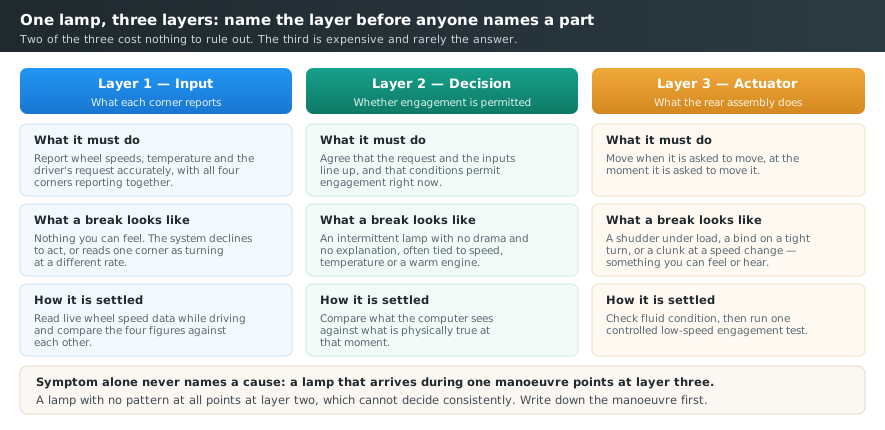
Input: what each corner reports
Every corner has to be reported accurately — wheel speeds, temperature, the driver's request. A break here is the quietest of the three: nothing you can feel, only a system that declines to act. Live data while driving settles it by comparing four readings against each other.
Decision: whether conditions permit engagement
The computer has to agree that the request and inputs line up and that conditions permit engagement. When that fails you get an intermittent lamp with no drama and no explanation, often tied to speed, temperature or a warm engine. The test is comparison: what the computer sees against what is physically true.
Actuator: what the rear assembly actually does
The rear assembly has to do what was asked, when it was asked. A break here is the one you can feel or hear — a shudder under load, a bind on a tight turn, a clunk at a speed change. Physical checks settle it: fluid condition and an engagement test.
Which Hondas carry this system
The system is common to the larger platforms and absent from the smaller ones, so the first question is whether you have it at all. A Honda Pilot has the full feature set including the selectable mode and plain lamp; a Honda Ridgeline carries the same arrangement with the lock reading on its own line of text. Front-drive platforms have no rear torque path to report on. The only reliable identifier is the exact text your own dash displays — see the Honda page for the model list.
What the light reports, and four things it does not
The lamp reports one of two conditions only — the system is not performing as commanded, or it has been placed somewhere it cannot perform — and everything else people assume it means is a different lamp on a different circuit.
The two conditions have opposite implications. A system that is not performing as commanded has a real break to find, and you should go looking for it. A system placed where it cannot perform is working exactly as intended: told not to engage, it declined, and the lamp is the notification rather than the problem. Nothing is broken in that second case until you find out who placed it there.
Four things the lamp does not cover are worth naming, because each sends a whole day of work in the wrong direction:
- Low tire pressure. A separate monitoring system with its own lamp and thresholds. If that is the lamp on, the answers live in the tire pressure guide, where solid and flashing are genuinely different reports.
- Brake trouble. The brake lamp is its own circuit and does not route through the driveline indicator. Treat it as its own event.
- A broken all-wheel system. Only sometimes. The same lamp is lit by an engine fault, by a selected mode, and by an input the system cannot trust — so the engine code comes first.
- A workshop visit just to clear it. Clearing a report is not the same as clearing a condition, and neither needs special permission. Read why a reset does not hold before paying anyone to perform one.
Why the wording is not enough. One lamp covers two opposite conditions, and you supply the missing half of the message: what else changed, and what else is lit. Answering those two questions takes thirty seconds, and it resolves the Honda Pilot VTM-4 light on and check engine light combination before you have touched anything.
Solid, flashing, or gone by morning: three separate reports
Before any diagnosis, settle what the display actually did, because solid, flashing and self-clearing are three different reports and the first action for each is different.
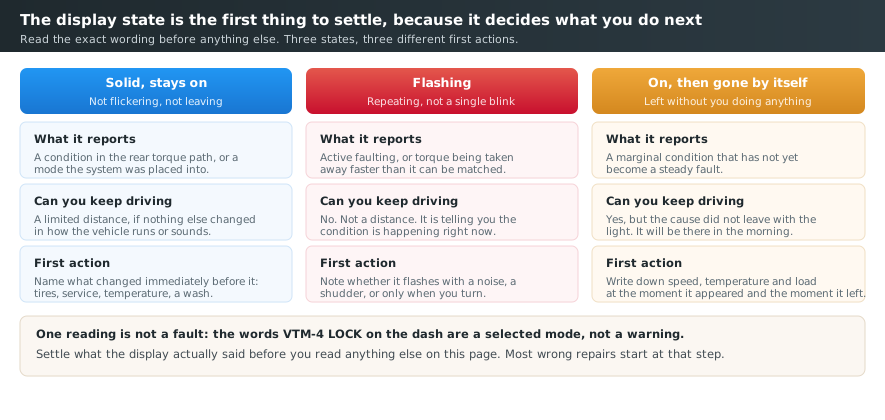
The middle row is the one people get wrong most often, because a flashing lamp reads as less serious than a steady one: steady feels deliberate, flashing feels like an alarm going off and then stopping. It is the other way round. A steady lamp reports that the system is not doing something; a flashing lamp reports that something is happening right now while you drive. One is a status, the other is an event, and the distance you can cover differs accordingly.
The left-hand row is the one you are in when the VTM-4 light on in a Honda Pilot appears with nothing else changed, and the right-hand row is not a row at all until you have confirmed the wording. Everything turns on reading the display precisely rather than approximately: how many words, which of them, and whether the plain lamp ever appeared at all. A display read loosely sends the investigation down the wrong column, and the difference between two of these rows is a single word — so the wording goes into a phone note before anything is looked up, before the memory of it softens, and before anyone offers their version of what it said.
| What the display did | The report | Distance | Your first action |
|---|---|---|---|
| Solid, does not leave | Not performing as commanded, or placed where it cannot engage | Limited, if nothing else changed | Name what changed immediately before it appeared |
| Flashing, repeatedly | Active faulting, or torque withdrawn faster than it can be matched | None. End the trip | Record whether it flashed with a noise, a shudder, or only on a turn |
| On, then gone by itself | A marginal condition that has not yet become steady | Normal, with attention | Speed, temperature and load at both moments, written down |
| Only when you press the button | A mode you asked for, executed correctly | As normal | Nothing. Confirm the wording says LOCK rather than the plain lamp |
The self-clearing case deserves its own warning. A light that leaves on its own is the most reassuring and the least useful of the three, because it invites you to do nothing. The cause is still there. What cleared was the report, and reports clear when the condition that triggered them stops being present: a temperature returns to range, a transient passes, a value that was marginally out of tolerance comes back within it. The next cold morning reproduces the whole thing and you have lost a week.
The button, and what LOCK is telling you
LOCK is a command you gave and the system carried out; it is not a warning, and reading those words as a fault is the fastest way to invent a repair the vehicle does not need.
Mode display and warning lamp are easy to confuse, because both appear in the same place, in the same colour family, and both stay on while the vehicle moves. The reliable test is not where it appears but whether you caused it. A display produced by pressing something reports the state you requested. A lamp you did not produce reports a state you did not request.
There is a legitimate reason to care about the first case even so. A mode display that appears without you pressing anything deserves as much attention as a warning, because the system entered a state through a route you do not know about. The mode itself is harmless; the route needs explaining, and the first place to look is whatever else was done to the vehicle in the days before: a service, a battery disconnect, a reader left plugged in.
The wording matters as much as the behaviour. VTM-4 LOCK on a Honda Pilot means the same thing it means on a Honda Ridgeline — a mode you selected, executed correctly, with no report attached — but on the Ridgeline those words sit on their own line of text, which is why that question keeps being asked. What does VTM-4 LOCK mean on a Honda Ridgeline? The same test as everywhere else: check whether you pressed the button.
Everything above assumed you pressed nothing. If the plain lamp is the one on, the next section is the only one that matters.
Is it safe to drive with the VTM-4 light on
Drive a limited distance with the plain lamp alone; do not drive at all if the lamp flashes, if the engine lamp is with it and the engine has changed, or if anything about how the vehicle behaves has changed — and the reason each case lands where it does is about what you would lose if it got worse away from home.
The judgement is not about the lamp, but about whether the vehicle still does what you expect of it and whether you can reach somewhere that can take it. A system that quietly declined to engage is not dangerous: the vehicle is simply less capable, and less capable where you would notice — a low-traction start or a hill. A system actively faulting has no such boundary, because a fault that changes while you drive cannot be planned around.
The single question that resolves most of it: has anything else changed? If the answer is no — same idle, same acceleration, same noises, same steering — you are deciding how far to go, not whether to go. If the answer is yes, the distance is zero and the decision has already been made for you.
| Your situation | Drive | Why it lands there | Before you set off |
|---|---|---|---|
| Plain lamp, nothing else changed | Yes, a limited distance | The system declined to do something. Less capable, not unsafe | Note the trigger, keep the trip short, avoid low-traction starts |
| Plain lamp, and you know the trigger | Yes, normally | A named cause is a known boundary | Deal with the trigger itself: uneven wear, a spare, a recent service |
| Lamp with a shudder, clunk or bind | No | Feelable symptom means the actuator layer, where use does the damage | Record the manoeuvre that produces it |
| Lamp flashing | No | An event, not a status. It is happening while you drive | Record how it behaves cold versus warm |
| Both lamps, and the engine has changed | No | A running fault, which does not improve with distance | Record codes, arrange transport, do not test it on the highway |
Three cases where you stop driving now, each with a failure mode that gets worse with distance:
- A flashing lamp with a noise, shudder or bind. Metal moving against metal does its damage while it moves. Pull over, note the manoeuvre, and do not test it again to see whether it repeats.
- Both lamps lit, and the engine no longer runs as it did. A running fault does not heal over distance. Record the codes and arrange how the vehicle gets home.
- Fluid on the ground, a burnt smell, or heat from the wheel area. Loss of fluid and a dragging assembly both escalate with minutes. Note where it is, then stop.
A plain steady lamp with nothing else changed is not on that list. Treating it as one costs a tow and a diagnosis with no evidence attached; treating a flashing lamp as plain costs considerably more.
When the VTM-4 light and the engine light come on together
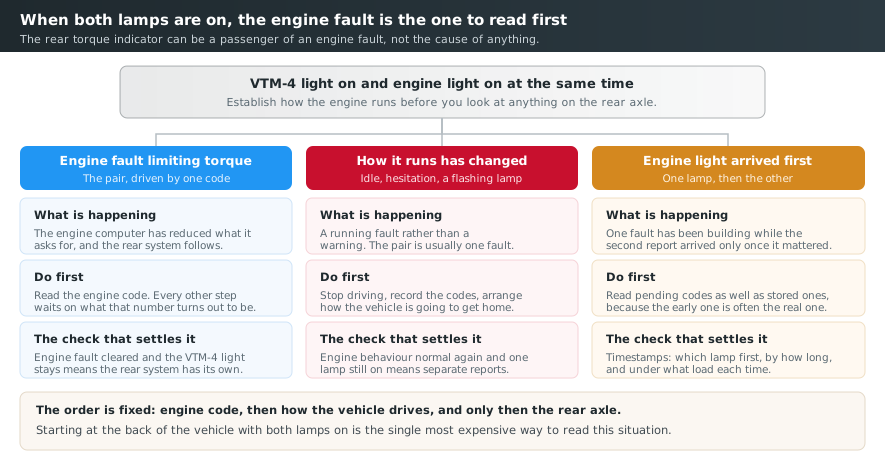
With both lamps lit, the engine fault is the driver and the rear indicator follows it — so read the engine code first, because the second lamp is very often a passenger.
Write both phrases down exactly as they appear, and keep the order they arrived in: the check engine and VTM-4 light on a Honda Pilot arriving together is one event until proved otherwise, while a Honda Pilot engine light and VTM-4 lights are on again a full drive cycle later are two events that only look like one.
The logic is counter-intuitive, and it sends people to the wrong end of the vehicle. An engine computer that has given up on something reduces what it asks for. A driveline told to expect less torque has no reason to engage fully, and reports that through the one lamp it has. Nothing about the rear assembly failed; it answered a message.
| Combination | What it usually is | Where to start |
|---|---|---|
| Both, engine runs normally | One fault reported through two lamps | The engine code, including pending ones |
| Both, rough idle or hesitation | A running fault with the driveline following | Stop, record codes, do not drive it further |
| Both, engine lamp flashing | An active misfire, the one case where distance causes harm | End the trip immediately |
| One lamp first, the other later | Two events close enough in time to look like one | Separate them by timestamp before combining them |
The test that separates a passenger lamp from a second problem
Resolve the engine fault, then look at the remaining lamp. If the rear lamp survives an engine fault that has been resolved, it has its own report and you have a genuine second problem. If it does not, you never had two problems — you had one with two lamps on it, which is why the engine code always goes first.
Where this matters for a Honda specifically
If the engine computer has reduced what it is asking for, the driveline's answer is correct and the lamp is doing its job. This is the situation where a second opinion about the rear assembly arrives before the engine code has been read, and where that ordering costs more than the actual fault.
The boundary worth stating
This reasoning holds only while the engine actually runs normally. The moment the idle changes, the vehicle hesitates, or the engine lamp flashes, you are dealing with a running fault and the comparison is off the table until that is settled. The same discipline on the engine side sits at the cylinder deactivation mechanism page.
The order to check things in, before anyone quotes a repair
Work top to bottom: establish what the display did, then what changed, then whether the engine has anything to say, then the cheap physical checks — and buy nothing until you are past the third step.
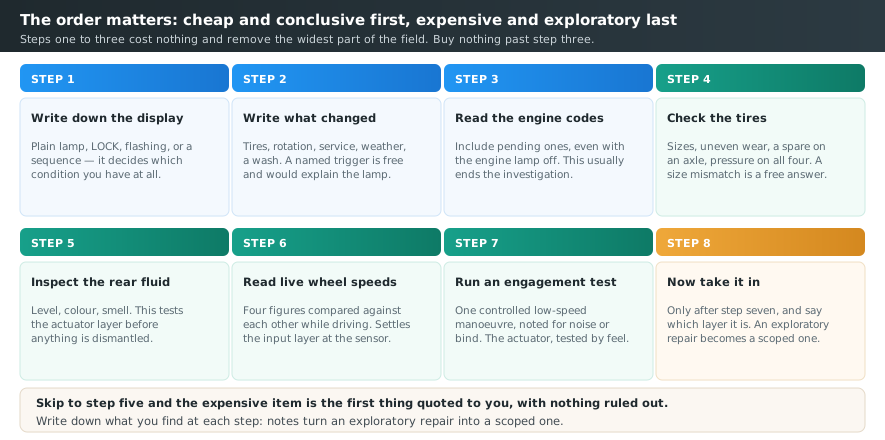
- Write down the exact display. Plain lamp, LOCK, flashing, or a sequence — this tells you which condition you are dealing with.
- Write down what changed in the days before. Tires, rotation, service, temperature, a wash. A named trigger is free and would explain the whole thing.
- Read the engine codes, including pending ones, even if the engine lamp is not on. This sits above the physical checks because an engine report costs one reader to settle while the checks cost an hour.
- Check the tires. Sizes fitted, uneven wear, a spare on an axle, pressure on all four — a size mismatch is a common free answer.
- Inspect the rear fluid. Level, colour, and whether it smells burnt: the actuator layer tested before anything is dismantled.
- Read live wheel speed data while driving, comparing corners. This settles the input layer at the sensor rather than at the part.
- Run an engagement test. A controlled low-speed manoeuvre, noted for noise or bind — the actuator tested by feel rather than by part number.
- Only now, with the layer named, take it in and say which layer it is. That converts an exploratory repair into a scoped one.
Why codes come before the physical checks. The cheap conclusive test goes first, and the ordering only looks wrong if you assume the lamp is about the driveline — the same discipline sits at the troubleshooting guide.
The six facts to write down before anyone looks at it
A shop with no facts starts from the most expensive plausible explanation and works down, because that is the only direction available when nothing has been eliminated. A shop with your facts starts from the layer you have named — so record:
- The wording on the dash, word for word, including whether it says LOCK — separates a mode from a warning.
- How it displayed: solid, flashing, or on and gone — separates a status from an event.
- When it started, and cold or warm, moving or stationary — timing separates cheap causes from expensive ones.
- What changed before it: tires, service, weather, washing, a long trip.
- Whether anything else joined it, and in what order.
- What a reader showed, codes including pending, written down rather than remembered.
The causes, sorted by how often they actually matter
Four causes account for nearly everything you will meet, three of them are cheap to test and common, and the one everyone fears is both rare and the last place you should be looking.
1. An input problem at a corner
Common, and the first thing worth settling. The system's picture of what each corner does comes from wheel speed readings, and one corner reporting differently makes the whole picture unusable — so it declines to engage and reports that through the lamp. Nothing you can feel accompanies this one, which is why it survives so long undiagnosed.
2. Fluid condition at the rear
Common and ignored. Look at it and smell it before anything is removed: darkened fluid, a burnt smell, or a level below where it should be all point at the actuator layer, and all three are visible in under a minute. This is also the cheapest point at which the expensive cause starts to become real.
3. Something changed at the wheels
Common, and self-inflicted — the only cause on the list you cause yourself. It produces a lamp within a day, and one that no amount of clearing will shift while the mismatch is still fitted. Compare all four sizes and pressures and look for a spare on an axle.
4. An engine fault wearing this lamp
Common enough to check third, and cheap to close. Read engine codes including pending ones. The signal it leaves is specific: a rear lamp that leaves once the engine fault is resolved, which is the same test used to decide whether you ever had two problems at all.
5. The rear assembly itself
Rare, and last. It arrives on the list when a feelable symptom exists — bind, clunk, shudder — when the fluid shows evidence, or when the first four have each been closed properly rather than skipped. Two of those three you can establish yourself in an afternoon. Until they are, the rare cause is a hypothesis, not a finding, and it should not be the first thing anyone quotes you. The same cheap-before-expensive discipline applies to the engine side, collected under troubleshooting.
Why it comes back two days after a reset
A reset clears the report, never the condition — so a lamp that returns quickly is not a failed reset, it is a successful one that has now told you the fault is live rather than historical.
This is the most commonly misread event in the subject, and it produces a specific frustration: the belief that something is wrong with the clearing process itself. Nothing is. The process erased the record of a condition, and when the condition is still present the record is rewritten as soon as the vehicle has enough information to write it — which is why the second lamp never looks like the first one failed. The interval between those two events is the one piece of evidence the lamp itself never gives you, and it is worth more than the fact of the return.
Read that interval rather than the fact of the return. Within the same trip means the condition is present continuously, so go to the physical checks and do not clear again. On the next cold start means temperature-dependent, and the difference between warm and cold behaviour is the finding. After a specific manoeuvre means load or speed dependent, pointing at the actuator layer, so record speed, direction and steering angle. After tire work means a mismatch at the wheels, which means comparing all four corners before anything else happens. Not returning at all means the trigger was transient, or you removed it without noticing — in which case what you did in that window is the most valuable fact you have.
Stop clearing after the second attempt. Each clear discards the timing and the state the vehicle had built up, and timing is most of what separates the cheap causes from the expensive ones. The first clear tells you whether the report is current; the second wastes information; by the third you are destroying the evidence you would want if you did take the vehicle in. The same principle governs every lamp on this vehicle, and it is set out where the troubleshooting guide deals with clearing versus resolving.
Frequently asked questions
The questions that come up once the lamp is on and the answer has not arrived:
What does the VTM-4 light mean on a Honda Pilot?
One of two things, and telling them apart is the first job. Either the system is not performing as commanded, or it has been placed somewhere it cannot engage. Both light the same lamp, and the wording alone never separates them — only the two accompanying questions, what else changed and what else is lit, will.
Can I drive with the VTM-4 light on?
A limited distance, if the lamp is steady and nothing else has changed. In that state the system declined to do something and the vehicle is less capable rather than unsafe. Stop if the lamp flashes, if the engine lamp joins it and the engine has changed how it runs, or if there is any feelable symptom — those have failure modes that get worse with distance.
Why did my VTM-4 light come on after a tire rotation?
Because a rotation moves what each corner reports, and a differently sized or worn tire can end up on an axle the system watches closely. The lamp arrived because the inputs changed, not because anything failed. Compare all four sizes and pressures before anything else is done — a one-minute check, and the third cause on the list for exactly that reason.
What is the difference between the VTM-4 light and the VTM-4 LOCK display?
The light reports a state you did not request; LOCK reports a mode you did. Both stay on while moving and both appear in the same place, which is why they get confused, but the reliable test is whether you caused it. A mode you selected says nothing about system health — the same words appearing without you say a great deal.
Why does the VTM-4 light come on with the check engine light?
Usually one fault reported twice. When the engine computer reduces what it asks for, the driveline has no reason to engage fully and reports that through the one lamp it has. Read the engine code first: if the rear lamp survives that fault being resolved it has its own report, and if it does not, you never had two problems.
What does a flashing VTM-4 light mean?
That something is happening while you drive, rather than a status being reported. A steady lamp says the system is not doing something; a flashing lamp says it is actively faulting or having torque withdrawn faster than it can be matched. End the trip, and note whether it flashed with a noise, a shudder, or only on a turn.
Will the VTM-4 light go off by itself?
It can, and that is not good news. It means the condition stopped being present: a temperature came back into range, a transient passed, a marginal value returned within tolerance. The cause is still there and the next cold morning will reproduce it, so record what the vehicle was doing at the moment it appeared and at the moment it vanished.
Does low tire pressure turn on the VTM-4 light?
No. Low pressure has its own lamp on its own circuit. What can happen is that an unevenly worn or differently sized tire produces a wheel speed reading the driveline cannot reconcile, and that lights this lamp. If the tire pressure lamp is the one on, the answer is somewhere else entirely.
Can a wheel speed sensor cause the VTM-4 light?
Yes, and it is the most common single cause on the list. One corner reporting differently makes the system's whole picture unusable, so it declines to engage and reports through the lamp. Compare the four wheel speed figures against each other on the move: a single value sitting apart from the rest names the corner without anything being taken apart.
Why does the VTM-4 light come on in cold weather?
Because temperature sits outside the range the decision layer is comfortable acting in, and a condition that is marginal when warm can fall outside that range when cold. That pattern is itself a finding: compare warm and cold behaviour, and the difference tells you the report is temperature-dependent rather than a hardware failure.
Does the VTM-4 light mean I need a new rear differential?
It means a layer has been named and not yet an item. On most vehicles that report turns out to be an input problem, a fluid condition, or something introduced at the wheels — three causes that are common, cheap to test and nothing to do with the differential. The rare cause arrives only after the feelable symptoms and the fluid evidence both point that way.
What does VTM-4 LOCK mean on a Honda Ridgeline?
The same thing it means anywhere else: the mode you requested is active. It comes up most on that platform because the wording sits on its own line of text, which makes it look like a second warning beside the first. It is not. Check whether you pressed the button before treating those words as a confirmation.
Why are the tire pressure, ABS and VTM-4 lights on together?
Because those systems consume the same wheel speed readings, and one unusable reading takes all three down at once. That combination usually points at the input layer rather than at three separate faults, which collapses the field to a single check: read the four readings against each other before anything is replaced.
How do I turn the VTM-4 light off?
You do not switch it off, and there is no switch to find. You resolve the condition that lit it, and the lamp follows. A reset clears the report for a drive cycle or two, worth doing once to see how quickly it returns — that timing tells you whether the condition is live. By the second and third attempt you are only discarding it.