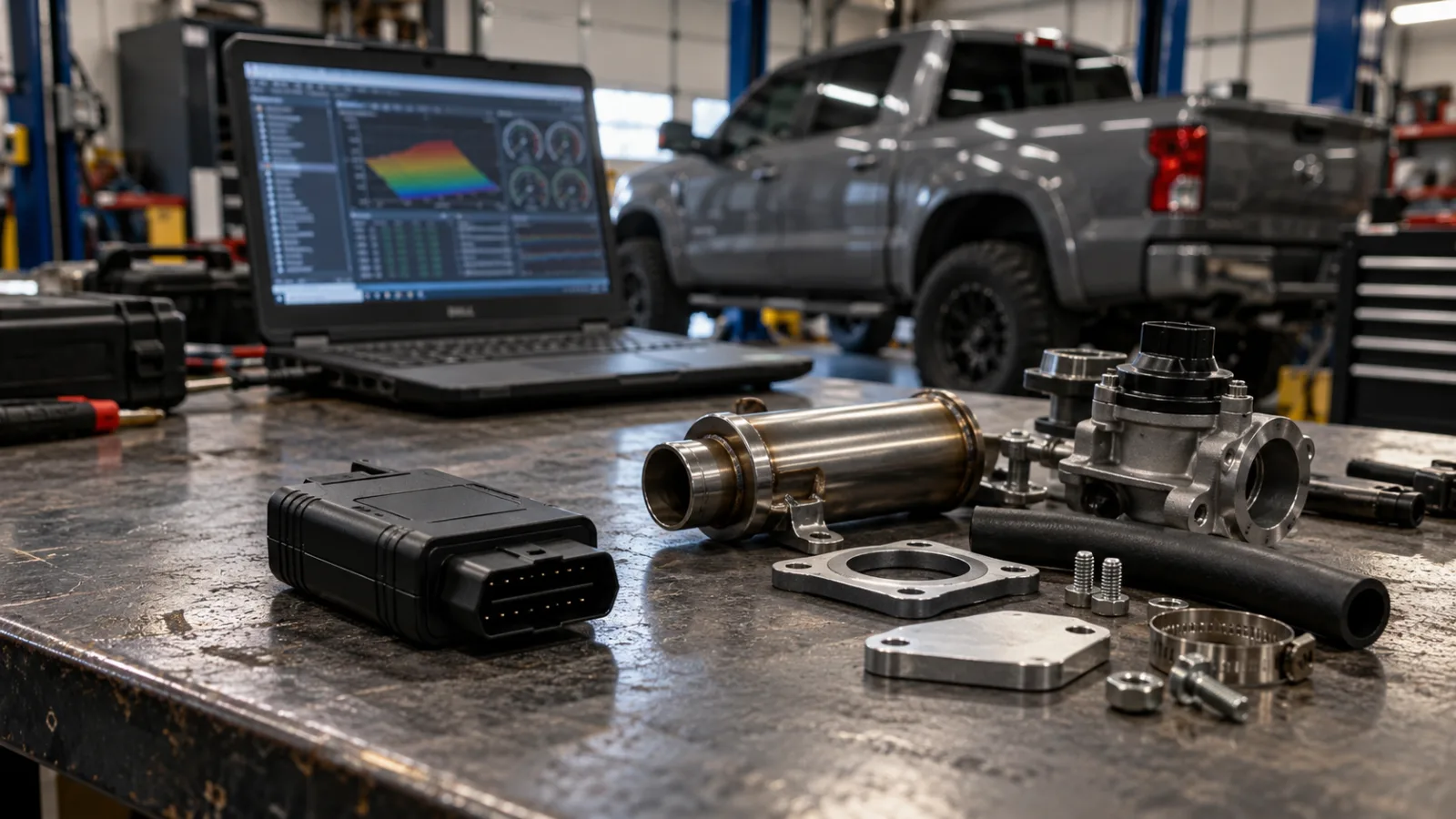
If you own a 2007 to 2014 GM truck or SUV with a 5.3L V8, you have probably heard the line at the parts counter: "Those AFM engines burn oil." Sometimes that is true. Sometimes the engine is perfectly healthy and the owner simply never checked the dipstick between changes. And sometimes the oil is leaving through a gasket, not the tailpipe.
This article sorts that out. We go through what General Motors itself told dealers in its oil consumption service bulletin, what the 2022 class action jury decided about the LC9 engine, how to measure your own engine's oil use properly, and which fixes match which cause. We also explain where an AFM disabler fits, because it is one of the most misunderstood parts in this whole conversation.
Key Takeaways
Oil consumption on GM's AFM V8s is real, documented by GM in a service bulletin, and has more than one cause. Measure it before you buy anything. A disabler changes how the engine runs from now on; it does not clean carbon out of piston rings or replace worn parts.
| Question | Short answer |
|---|---|
| Is AFM oil burning a real problem? | Yes. GM bulletin 10-06-01-008 covers excessive oil consumption on 2007 to 2014 AFM V8 trucks and SUVs and gives a repair procedure. |
| What does GM call "excessive"? | The bulletin uses more than 1 quart per 2,000 to 3,000 miles as the point where the repair is performed. |
| What causes it, according to GM? | Two things: oil pulled through the PCV system, and oil spray from the AFM pressure relief valve in the crankcase leading to carbon in the ring grooves. |
| Does a disabler fix it? | No. It keeps the engine out of four-cylinder mode from the day you plug it in. It cannot free stuck rings or undo wear that is already there. |
| What should I do first? | Run a measured oil consumption test over at least 1,000 to 2,000 miles and pull the spark plugs. The plugs tell you a lot. |
What GM's own bulletin says
The most useful document on this subject is not a forum thread. It is GM Service Bulletin 10-06-01-008, titled "Engine Oil Consumption on Aluminum Block/Iron Block Engines with Active Fuel Management (AFM)". The revision we reference here is 10-06-01-008M, dated December 2014, which NHTSA publishes in its public database. You can read the full PDF on the NHTSA server.
GM wrote the bulletin for technicians, so it is short and blunt. Here is what it covers.
| Bulletin field | What it says |
|---|---|
| Bulletin | 10-06-01-008M, December 2014 (an "M" revision means it had been updated many times since 2010) |
| Trucks and SUVs listed | 2007 to 2013 Chevrolet Avalanche and Silverado, 2007 to 2014 Chevrolet Suburban and Tahoe, 2007 to 2013 GMC Sierra and Sierra Denali, 2007 to 2014 GMC Yukon models, 2007 to 2014 Cadillac Escalade models |
| Other vehicles listed | 2010 to 2012 Colorado and Canyon, 2010 to 2015 Camaro, 2008 to 2009 Pontiac G8 GT |
| Engines (GM RPO codes) | Aluminum block AFM V8s: LH9, L94, LZ1, L99, LC9, LH6, L76, L92, LFA. Iron block AFM V8s: LMG, LY5 |
| Typical complaint | Oil use at roughly 30,000 to 40,000 miles, sometimes with a Service Engine Soon light or a rough-running engine |
| Threshold for repair | More than 1 quart per 2,000 to 3,000 miles, after the PCV system has been checked |
Two details in that table matter more than they look. First, GM put a number on "excessive." A quart every 2,000 to 3,000 miles is the line in the bulletin, and later in the procedure GM uses 1 quart in 2,000 miles as the point where pistons and rings get replaced if the first repair does not work. That gives you a yardstick that is not just somebody's opinion.
Second, the bulletin tells the technician to verify the PCV system before anything else. That is GM admitting that a good share of these complaints are not ring problems at all.
The bulletin also notes it no longer requires the customer to come back multiple times to have the usage verified. If you have ever been told "bring it back in 1,000 miles and we will see," that line tells you how common the complaint had become by 2014.
The two causes GM identified
The "Cause" section of the bulletin names two separate paths for oil to end up where it should not be. Understanding them helps you pick the right fix.
1. Oil pulled through the PCV system
The positive crankcase ventilation system pulls blow-by gases out of the crankcase and feeds them back into the intake to be burned. On these engines, GM found that oil could get pulled through the PCV path and into the intake manifold. The bulletin's fix for trucks built before February 1, 2011 is an updated left valve cover with a relocated PCV drain hole. GM lists part numbers 12570427 for 2007 to 2008 trucks and vans and 12642655 for 2009 to 2011.
The bulletin gives technicians a simple check: a healthy PCV system leaves only a film of oil in the intake manifold. If oil is puddling in the bottom of the manifold, the valve cover gets replaced. The same paragraph mentions that "PCV pullover or an overactive lifter" can pull oil through the PCV system even at low mileage, which is worth remembering if your engine is young and already using oil.
2. Oil spray from the AFM pressure relief valve
This is the one owners usually mean when they blame AFM. The AFM system uses engine oil pressure to collapse the special lifters on the cylinders it shuts off. On these engines there is an AFM pressure relief valve mounted in the oil pan. According to GM, under most driving the oil it discharges causes no trouble. Under "extended high engine speed operation," in combination with parts at the high end of their tolerance, the spray can be heavier than usual and reach the pistons. The result GM describes is "excessive deposit formation in the piston ring grooves," which leads to more oil consumption and cracked or fouled spark plugs on cylinders 1 and 7.
The fix for aluminum block engines is a shield, GM part number 12639759, installed over the AFM valve in the oil pan, combined with a piston soak to free the rings. Iron block engines (LMG and LY5) get the piston soak only, because GM says their different oil pump means the relief valve opens at a higher engine speed and they are "less prone to the AFM oil spray condition."
Notice what the AFM valve spray cause is tied to: GM links it to extended high engine speed, not to time spent in four-cylinder mode. That is why a disabler is not the fix for this specific cause. The shield is.
Plenty of owners and independent shops also believe that time spent in V4 mode adds to oil use, because the deactivated cylinders still move their pistons up and down with the valves closed. That theory gets repeated a lot. GM's bulletin does not say it, and we have not found a published GM document that does, so treat it as a theory rather than a fact.
The LC9 class action: what the jury actually decided
The bulletin is GM talking to its dealers. The courtroom side of the story is Siqueiros et al. v. General Motors LLC, case number 3:16-cv-07244 in the U.S. District Court for the Northern District of California. It is the case most people mean when they talk about "the GM oil consumption lawsuit."
| Item | Detail | Source |
|---|---|---|
| Engine | Generation IV Vortec 5300 LC9 (5.3L V8) | DiCello Levitt release |
| Vehicles | 2011 to 2014 Chevrolet Avalanche, Silverado, Suburban and Tahoe, and GMC Sierra, Yukon and Yukon XL with LC9 engines built on or after February 10, 2011 | Settlement agreement |
| Alleged defect | Piston rings that wear prematurely, leading to excess oil consumption | Case FAQ |
| Verdict | October 2022, about 38,000 class members in California, North Carolina and Idaho, $2,700 each, $102.6 million in total | CNBC |
| Settlement | $150 million settlement amount, with each class member's share stated as no less than $2,700 before expenses | Case FAQ |
| GM position | GM denies the vehicles are defective and denies liability | Settlement agreement |
A few things are worth saying plainly. The class was limited to three states and to the LC9 engine. If your 5.3L is an LMG, LY5, LH9 or a 2014-and-later Gen V engine, this case did not cover you. The jury verdict was about piston rings, which lines up with the "deposits in the ring grooves" language in GM's own bulletin, but a verdict about a class of vehicles is not a diagnosis of your engine.
What the case does tell you is that oil consumption on this engine family was common enough, and expensive enough, that tens of thousands of owners were part of the class. If you are shopping for a used 2011 to 2014 truck with an LC9, ask whether pistons and rings were replaced under warranty, because the settlement agreement excludes trucks that already received upgraded rings at no cost.
How to measure oil consumption properly
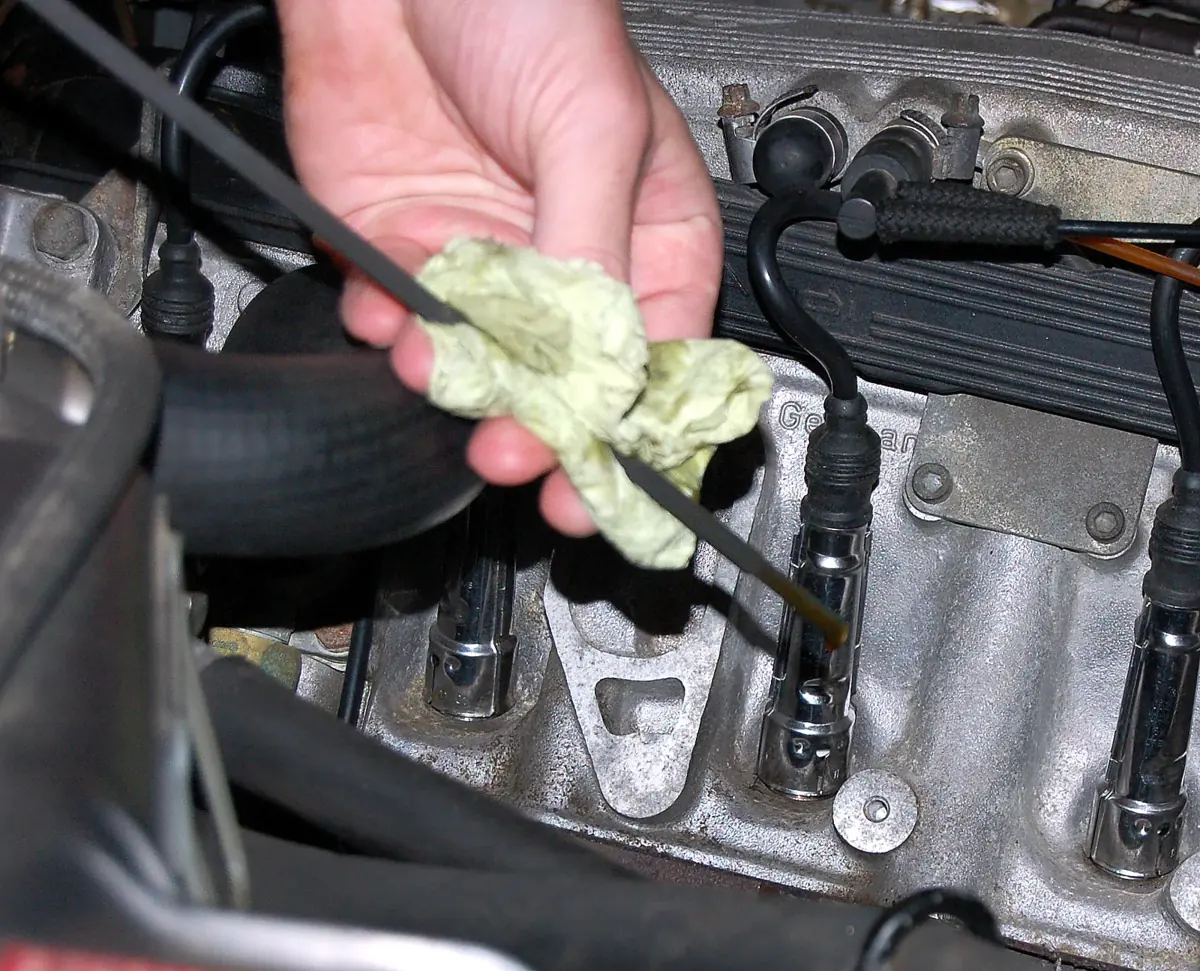
Before you spend a dollar, find out how much oil the engine is actually using. Topping off "a quart every so often" is not a number. Here is the method we suggest to customers who call us asking whether their engine has a problem. It mirrors the logic of the dealer test without needing special tools.
- Park on level ground with the engine warm, then shut it off and wait at least 10 minutes so the oil drains back to the pan.
- Fill the oil exactly to the full mark on the dipstick. Not a little over, not a little under. Write down the odometer reading.
- Drive normally. Do not change your habits for the test, because the goal is to measure how you really drive.
- Every 500 miles, check the level the same way: same spot, warm engine, same waiting time. Write it down.
- When the level reaches about one quart low, add a measured quart and write down the mileage.
- Keep going for at least 1,000 miles, and 2,000 miles if you can. One tank of highway driving tells you very little.
- Divide miles driven by quarts added. That is your miles per quart.
| Result | What it usually means | Next step |
|---|---|---|
| More than 3,000 miles per quart | Within the range GM treats as normal for these engines | Keep checking at every fill-up; no repair indicated by consumption alone |
| 2,000 to 3,000 miles per quart | Borderline. Inside the range where the bulletin says the repair may be performed | Inspect PCV and plugs, look for external leaks, keep logging |
| Less than 2,000 miles per quart | Past the point where GM's procedure moves toward pistons and rings if the first repair fails | Get a proper diagnosis before anything else |
| Level drops, but no blue smoke and no fouled plugs | Often an external leak, not burning | Check rear main seal, oil pan gasket, valve covers, oil cooler lines |
A worked example
Here is what a finished log looks like. The numbers are an illustration of the method, not data from a real truck.
| Odometer | Reading | Action |
|---|---|---|
| 112,000 | Full mark, engine warm, 10 minutes after shutdown | Start of test |
| 112,500 | Slightly below full | None |
| 113,000 | Halfway between full and add | None |
| 113,600 | About one quart low | Added exactly 1 quart |
| 114,500 | Halfway between full and add | None |
| 115,200 | About one quart low | Added exactly 1 quart |
Two quarts over 3,200 miles works out to 1,600 miles per quart. That is below the 2,000-mile line in GM's procedure, so this engine deserves a proper look at the PCV system, the plugs and the rings. If the same log had shown one quart in 3,200 miles, the right move would be to keep logging and keep driving.
Why the waiting time matters: a dipstick read right after shutdown can show half a quart low on these engines simply because the oil has not drained back yet. That one habit creates a lot of false alarms.
Also look at your spark plugs. GM's bulletin specifically mentions fouled or cracked plugs on cylinders 1 and 7. Pull those two and compare them with a plug from the other bank. Heavy black or oily deposits on 1 and 7 while the others look tan and dry is a strong hint that the oil is going into the combustion chamber and not out of a gasket. For a fuller walk-through of plug reading and misfire codes, see our P0300 random misfire diagnosis guide.
Symptoms: oil consumption or something else?
Oil consumption has a short list of symptoms, and most of them overlap with other problems. Before blaming the rings, line up what you are seeing against the most common look-alikes.
| What you notice | Points toward oil consumption | Points somewhere else |
|---|---|---|
| Low oil level between changes | Level drops steadily with no drips and no wet gaskets | Spots on the driveway, oil on the bellhousing or the oil pan rail |
| Rough idle or a misfire code | Fouled plug on 1 or 7 with oily deposits | Dry plug, a bad coil, an injector or a vacuum leak |
| Blue smoke | A puff on cold start or after long idling | White smoke that smells sweet is coolant, not oil |
| Service Engine Soon light | Misfire codes on the cylinders GM names, with fouled plugs | Evap, oxygen sensor or catalyst codes with clean plugs |
| Ticking noise | Rarely caused by consumption itself | A lifter, an exhaust manifold leak or an injector tick |
The pattern to look for is consistency. An engine that is truly burning oil will use it at a fairly steady rate, foul the same plugs again after you replace them, and leave the outside of the engine dry. An engine with a leak will drip in the same spot, and the rate will often change with temperature and how hard you drive.
If you have a code reader, freeze-frame data on a misfire code is also worth a look. A misfire that only shows up at idle or light load, on the same one or two cylinders, fits the fouled-plug picture better than a random misfire spread across the engine.
Getting the most out of a dealer or shop visit
Oil consumption complaints go badly when the owner arrives with a feeling instead of a record. Go in with your log, and you change the conversation.
- Bring the written oil consumption log: dates, odometer readings, and every quart added.
- Bring the spark plugs you pulled, or photos of them, labelled by cylinder.
- Mention the bulletin number by name: 10-06-01-008. Service advisors can look it up in seconds.
- Ask the shop to check the PCV system and the intake manifold for pooled oil first, as the bulletin directs.
- If the engine has an aluminum block, ask whether an AFM shield is already installed. The bulletin recommends adding one whenever the oil pan is off and no shield is found.
- Ask for the findings in writing, including what was measured and what was replaced.
None of this guarantees a warranty repair. Bulletins are repair instructions, not promises of coverage, and coverage depends on the age and mileage of your truck and the warranty that applies to it. But a clear record makes it far easier for any technician to diagnose the right cause the first time, and that saves you money whether the repair is covered or not.
If you are past warranty and paying yourself, the same record helps you compare quotes. A shop that wants to replace the engine without checking the PCV system or reading the plugs is skipping the steps GM lists first.
Which fix matches which cause
Once you have a number and you have looked at the plugs, the choices sort themselves out. This is roughly the order a careful technician would work in, from cheapest to most expensive.
| What you find | Likely cause | Typical fix | Where a disabler fits |
|---|---|---|---|
| Oil puddled in the intake manifold | PCV pull-over | Updated left valve cover on trucks built before Feb 1, 2011 (per bulletin) | Not related |
| Fouled plugs on 1 and 7, aluminum block, consumption over threshold | AFM valve spray, carbon in ring grooves | AFM shield, piston soak, new plugs and oil pan gasket (per bulletin) | Can be added afterward; it does not replace the shield |
| Same symptoms after shield and soak | Rings worn or stuck beyond cleaning | Piston and ring replacement (per bulletin) | Can be added afterward |
| Oil on the outside of the engine, clean plugs | External leak | Gaskets or seals | Not related |
| Ticking that follows engine speed, misfire on a deactivating cylinder | Possible lifter problem | Valvetrain diagnosis and repair | Not a repair. Fix the lifter first |
| Healthy engine, normal consumption, owner wants steady V8 operation | No fault | None needed | This is where a disabler belongs |
The bulletin also has a note that is easy to miss: after a piston and ring replacement, GM says it takes 2,000 to 3,000 miles for new rings to seat. Do not judge a ring job by the first tank. And at higher mileage, GM tells technicians not to overlook valve seals, which can pass oil too.
If your engine is ticking, misfiring on a deactivating cylinder, or the oil pressure gauge is acting strange, stop reading about oil consumption and read our AFM lifter failure symptoms guide. A lifter problem is a different repair with a different price tag.
Where an AFM disabler fits, honestly
We sell AFM disablers, so you might expect us to say a disabler solves oil consumption. It does not, and saying otherwise would be selling you the wrong part.
Here is what a plug-in disabler like the Silverado 1500 AFM/DFM Disabler or the Tahoe AFM/DFM Disabler actually does. It plugs into the OBD-II port and tells the engine computer that cylinder deactivation is not available, so the engine stays on all cylinders. It does not rewrite the factory calibration, and unplugging it returns the engine to normal AFM behavior.
That means:
- It does not clean carbon out of ring grooves. If the rings are already stuck or worn, the oil use stays until the rings are freed or replaced.
- It does not replace the AFM shield. GM tied the spray cause to extended high engine speed. Keeping the engine in V8 mode does not change what the relief valve does at high rpm.
- It does not repair a lifter. If a deactivating lifter has already failed, the engine needs mechanical work.
- It does stop the switching. From the moment it is plugged in, the engine runs in one steady mode, with no V4 transitions and no more cycling of the deactivating lifters.
Owners who buy a disabler after an oil consumption repair usually do it for the second reason in our disabler vs delete vs tune comparison: they have just spent real money on the engine and want it to run in a single, predictable mode from here on. That is a reasonable choice, and it is the honest one to make with your eyes open.
Fuel economy trade-off: holding all cylinders on gives up the fuel saving AFM was built for. The U.S. Department of Energy puts the potential efficiency improvement of cylinder deactivation at up to 5% (fueleconomy.gov). Most of that is on steady light-throttle cruising.
Vehicle by vehicle: what applies to your truck
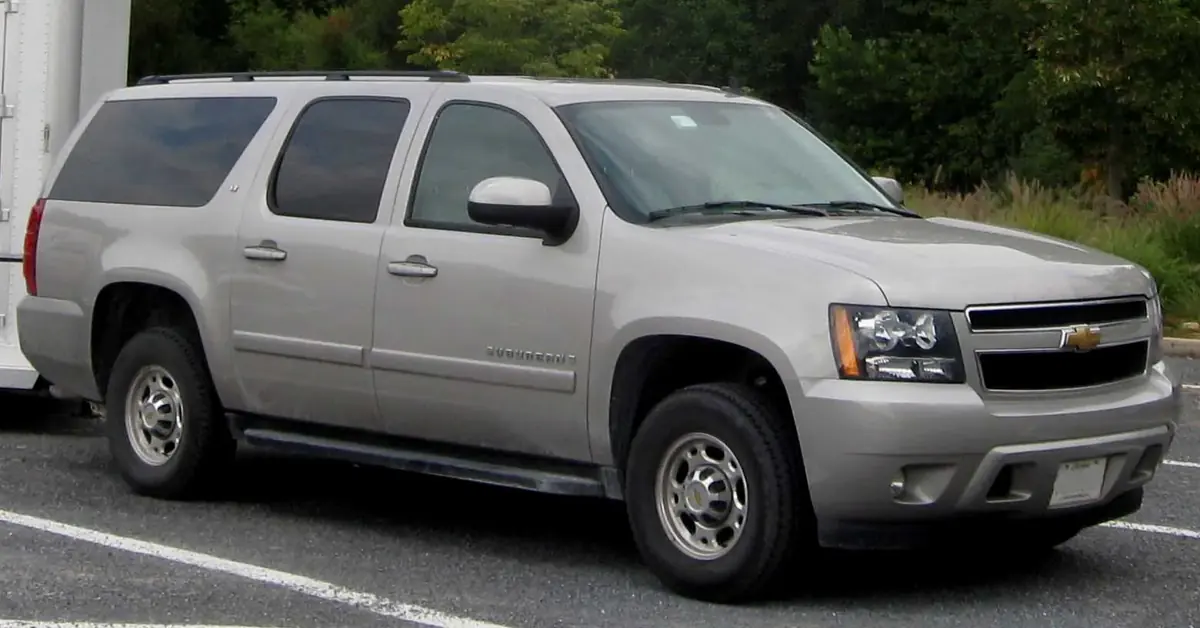
The bulletin covers a wide spread of vehicles, and our disablers are built per vehicle line. Here is how the pieces line up for the trucks and SUVs we get asked about most.
| Vehicle | Years on GM bulletin 10-06-01-008M | Our matching disabler |
|---|---|---|
| Chevrolet Silverado 1500 | 2007 to 2013 | Silverado 1500 AFM/DFM Disabler (fits 2007 to 2018 with 4.3L V6, 5.3L V8 or 6.0L V8 per product page) |
| GMC Sierra 1500 | 2007 to 2013 | Sierra 1500 AFM/DFM Disabler |
| Chevrolet Tahoe | 2007 to 2014 | Tahoe AFM/DFM Disabler (5.3L 2007 to 2018, 6.0L 2007 to 2014, 6.2L 2010 to 2017) |
| Chevrolet Suburban | 2007 to 2014 | Suburban AFM/DFM Disabler |
| GMC Yukon | 2007 to 2014 | Yukon AFM/DFM Disabler, Yukon XL 1500 |
| Chevrolet Avalanche | 2007 to 2013 | Avalanche AFM/DFM Disabler |
| Cadillac Escalade | 2007 to 2014 | Escalade AFM/DFM Disabler |
Notice that the bulletin stops at 2013 or 2014 depending on the model, while our fitment for several of these runs through 2018. That is because the 2014-and-later trucks use the next engine generation, which still has AFM but is not part of this particular oil bulletin. If you are not sure which engine your truck has, our guide to finding your GM engine from the VIN and RPO codes walks through it, and you can always send us your VIN before ordering.
Habits that keep an AFM engine healthy
None of this is exotic. It is the same boring maintenance that keeps any engine alive, with a few points that matter more on AFM engines because the deactivating lifters depend on clean oil at the right pressure.
- Check the oil at every other fill-up. Low oil hurts lifters long before it turns on a warning light.
- Use the oil grade and specification in your owner's manual. The AFM oil circuit was designed around it.
- Change oil on schedule, and sooner if you tow or idle a lot. Our article on oil change intervals and lifter failure goes into what more frequent changes can and cannot do.
- Fix PCV problems promptly. GM's bulletin starts with the PCV system for a reason.
- Read your plugs when you change them. Cylinders 1 and 7 are the early warning on these engines.
- Listen. A new tick that follows engine speed is a reason to stop and diagnose, not to add oil and carry on.
From our side, the most common pattern in customer emails is a truck with 120,000 to 180,000 miles that has never had an oil consumption problem, and an owner who wants to keep it that way. That is the healthiest reason to buy a disabler. The second most common is a truck that is already using oil, and for those we always point people to the diagnosis steps above first.
Buying a used AFM truck: questions to ask
If you are shopping for a 2007 to 2014 GM truck or SUV, oil consumption history is worth more than a fresh detail job. Ask these questions, and ask for paperwork rather than memories.
| Ask | Why it matters |
|---|---|
| Has the AFM shield been installed? | It is the bulletin fix for aluminum block engines. Dealer records will show it |
| Were pistons and rings ever replaced under warranty? | A documented ring job means the known weak point has been addressed |
| How often does the owner add oil? | Anything vague like "now and then" deserves your own consumption test |
| Any lifter or camshaft work? | Valvetrain repairs are expensive; a documented repair is good news, an undocumented tick is not |
| Can I pull a spark plug from cylinder 1 or 7? | A clean plug is reassuring; an oily one tells you what you need to know |
Then run a cold start with the hood up and listen for ticking in the first minute. If everything checks out and you buy it, run your own oil consumption log for the first 2,000 miles. You will have a baseline that is yours, not the seller's.
Frequently asked questions
How much oil consumption is normal on a GM 5.3L with AFM?
GM's bulletin treats more than 1 quart per 2,000 to 3,000 miles as excessive and the point where the repair is performed. Less than that is generally within what GM considers acceptable, though many healthy engines use far less.
Which spark plugs foul first when an AFM engine burns oil?
GM's bulletin names cylinders 1 and 7 as the ones that can show cracked or fouled plugs from the AFM oil spray condition. Compare them with plugs from the other cylinders.
Will an AFM disabler stop my engine from burning oil?
No. It keeps the engine on all cylinders from the day you plug it in, but it cannot free stuck rings, replace the AFM shield or repair worn parts. Diagnose and repair the cause first.
Does the GM oil consumption bulletin cover 2014 to 2018 trucks?
Revision 10-06-01-008M lists 2007 to 2013 Silverado and Sierra and 2007 to 2014 Tahoe, Suburban, Yukon and Escalade. Later trucks use the next engine generation and are not on that bulletin.
Was I part of the GM oil consumption class action?
The Siqueiros case covered 2011 to 2014 vehicles with the LC9 engine built on or after February 10, 2011, sold in California, North Carolina and Idaho. The case website has the official class details.
Can I do the piston soak myself?
The procedure is published in the bulletin, but it involves removing spark plugs, soaking the cylinders for 2.5 to 3 hours, and making sure every bit of cleaner is out before restart to avoid hydro-lock. Most owners are better off having a shop do it.
Is my engine burning oil or leaking it?
Burning usually shows as fouled plugs, sometimes blue smoke on startup, and no oil on the outside of the engine. Leaking shows as wet gaskets, drips on the driveway and clean plugs.
Should I put a disabler on after a ring job?
Many owners do, so the engine runs in one steady mode after an expensive repair. Wait until the new rings have seated, which GM says takes 2,000 to 3,000 miles, so your consumption check afterward is meaningful.
Sources
Every outside figure in this article links to one of these sources. Store experience is described in general terms only.
- GM Service Bulletin 10-06-01-008M, Engine Oil Consumption on Aluminum Block/Iron Block Engines with AFM (Dec 2014) · NHTSA
- GM hit with $102.6 million jury verdict in engine flaw class action · CNBC, Oct 6, 2022
- General Motors Hit With $102.6 Million Jury Verdict in Class Action Over Defective Engines · DiCello Levitt, Oct 4, 2022
- Frequently Asked Questions, Siqueiros et al. v. General Motors LLC · Official case website
- Settlement Agreement, Case 3:16-cv-07244-EMC · Official case website
- Advanced Engine Technologies: Cylinder Deactivation · U.S. DOE / EPA fueleconomy.gov
Next steps
Healthy engine, want it in V8 mode for good? Find your vehicle in the AFM/DFM Disabler line, or go straight to the Silverado 1500, Sierra 1500 or Tahoe version. Send us your VIN and we will confirm the fit before you order. Browse AFM/DFM Disablers
Related reading: